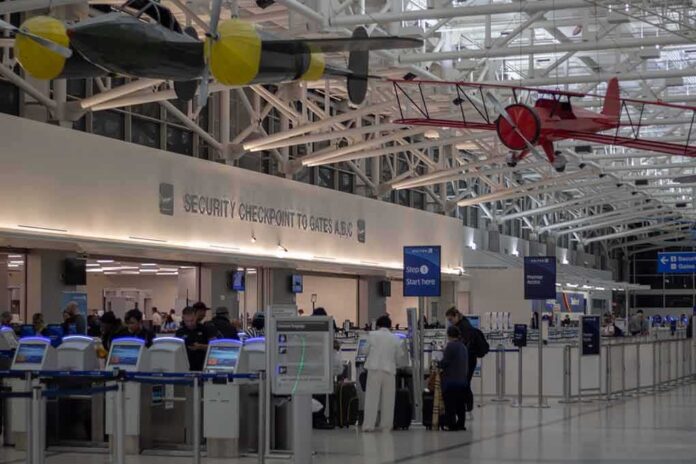
In modern airports, the first 30 minutes of communication and control determine the scale of disruption more than the final forensic answer. Miami International Airport’s recent “shots fired” response is a case study in how a rapid custody, clear public messaging, and targeted closures can halt panic and restore operations—especially when there are no injuries and no ongoing threat.
The Short Version
- Deputies responded around 4:05 p.m. to reports of shots fired at Miami International Airport and took a man into custody.
- Authorities said there was no ongoing threat; no injuries were reported.
- Airport operations were constrained briefly: the departures-level roadway and terminal doors 12–17 were closed during the response.
- Visible police sweeps and a restrained subject were documented by local outlets and eyewitness video.
What Happened: A Rapid Containment With No Injuries
Miami-Dade Sheriff’s Office deputies moved at approximately 4:05 p.m. after reports of shots fired near the departures level at Miami International Airport, swiftly taking a subject into custody and securing the immediate area. Officials emphasized that there was no ongoing threat to the public, and local outlets consistently reported that no injuries occurred. The airport temporarily closed the departures-level roadway and restricted access around doors 12 through 17 to support the law-enforcement sweep and preserve any potential evidence corridor. Witness video and on-scene reporting showed tactical deputies advancing through the affected zone and a man being subdued and handcuffed, consistent with a controlled end to the incident and the start of a standard investigative process.
Early location descriptions varied—some accounts referenced the departures level proper, others the adjacent garage or the segment near doors 12–17—but the operational picture was coherent: a localized perimeter, a subject detained, and a staged clearance that allowed airport managers to restore vehicle and passenger flows while law enforcement processed the scene.
How Airport Incidents Escalate—and De-escalate
Airports are engineered for throughput and predictability; they are also acoustically complex, crowded, and saturated with rumor paths. In this environment, reports of gunfire—even before a single shell casing is logged—can produce immediate second-order effects: self-evacuations, gridlocked curbs, and cascading gate delays. The response choreography that matters most in the first hour is simple but unforgiving: isolate the locus of concern, communicate one clear set of instructions, and name the risk level without hedging. Miami’s public signal—one person in custody, no ongoing threat—fits the playbook that practitioners have refined after hard lessons at LAX in 2013 and Fort Lauderdale in 2017, where communication gaps and social amplification magnified disruption well beyond the primary incident footprint.
When responders move quickly to custody and the airport authority brackets a small geographic slice of the terminal complex, normalcy can return without feeding panic. The brief closure of the departures roadway and the segment between doors 12 and 17 is exactly such a containment choice: protect responders’ maneuver space, reassure travelers elsewhere on the campus they are safe, and avoid a full-airport freeze that would compound knock-on delays.
The Information Problem: Why “Reports of Shots Fired” Still Drives Decisions
In public safety operations, “reports of shots fired” is not a euphemism; it is the actionable threshold for law enforcement to deploy, regardless of whether a later forensic file confirms a discharge. That distinction matters for investigators and prosecutors; it matters less for incident commanders deciding whether to hold traffic at the curb. The Miami response followed that logic: act quickly on credible reports; secure, search, and stabilize; communicate the safety posture. In parallel, a multi-agency inquiry typically reconstructs the sequence: where, how many, directionality of rounds if any, witness statements, and the physical evidence chain (casings, projectile impacts, firearm recovery, and body-worn camera timelines). That administrative arc often lags the public’s attention cycle, but it is the normal tempo for an airport district case built to stand up in court rather than on social media.
This is also where past after-action reports earn their keep. LAX’s 2013 review and Fort Lauderdale’s 2017 analysis both document how partial information, scanner chatter, and viral clips produced “echo” incidents—waves of false shooter calls that forced repeat evacuations and delayed re-opening of sterile areas. The practical lesson for communicators is counter-intuitive: speed and specificity together are safer than a vacuum. Clear statements—custody, no injuries, no ongoing threat—combined with geographically precise closures, reduce rumor velocity and give frontline staff a single script to manage crowds.
What We Know With Confidence—and What That Means for Travelers
Across multiple local outlets citing the sheriff’s office and airport officials, four points are firm. First, deputies responded around 4:05 p.m. and detained one subject. Second, authorities publicly stated there was no ongoing threat. Third, no injuries were reported. Fourth, the airport enacted short-lived closures at the departures level and near doors 12–17 consistent with a focused security sweep. For a traveler or airline operations manager, those facts describe a confined, time-bounded disruption rather than a campus-wide emergency. Flights may experience gate holds; curb traffic may be rerouted; but the risk posture—what security professionals call the protective baseline—remains stable when there’s no active shooter and the suspect is in custody.
Witness video of a person being restrained and tactical teams moving with long guns can look alarming outside context; inside the discipline of response, it is the visible sign that the search-to-clear phase is underway. It is also why airports train for these moments: so that a discrete zone can be taken offline without rippling chaos through unaffected concourses and airside operations.
🚨 BREAKING: GUNMAN OPENS FIRE AT MIAMI INTERNATIONAL AIRPORT!
SEPTEMBER 23, 2026 | MIAMI, FLORIDA
A terrifying situation unfolded at Miami International Airport (MIA) Wednesday afternoon after a man allegedly opened fire from an airport parking garage, prompting a major police… pic.twitter.com/JM8kZrjPOA
— Dreamrideguardian (@Dreamrideguard) September 24, 2026
Lessons for Airport Authorities and the Flying Public
Airports and law enforcement agencies do not get to choose the scenario, only the clarity of their choreography. Three practices distinguish disciplined responses. First, tighten the geography quickly—hard closures where deputies need space; deliberate normalcy elsewhere. Second, speak in complete, affirmative sentences: “One in custody. No ongoing threat. No injuries.” Third, pair the public message with logistics travelers can use—what doors are shut, what roadway is closed, which detours to take—so the information maps directly to behavior at the curb. These best practices trace directly to prior after-action findings that faulted vague, delayed, or fragmented communications for prolonging chaos.
For travelers, the rule is equally plain: follow on-site instructions, avoid self-evacuation that could spill into secured zones, and take official airport channels as the canonical source on closures and re-openings. Social media can surface helpful on-the-ground imagery; it can also propagate stale or incorrect location details. In Miami, official accounts carried the operational facts that matter for your next move: where to go, what is closed, and when lanes reopen.
Sources:
nbcnews.com, bnonews.com, cbs12.com, express.co.uk, hindustantimes.com, local10.com, cbsnews.com, aviationpros.com, lawa.org, files.asprtracie.hhs.gov, mashable.com, apnews.com, vpc.org, laist.com
© impactheadlines.com 2026. All rights reserved.