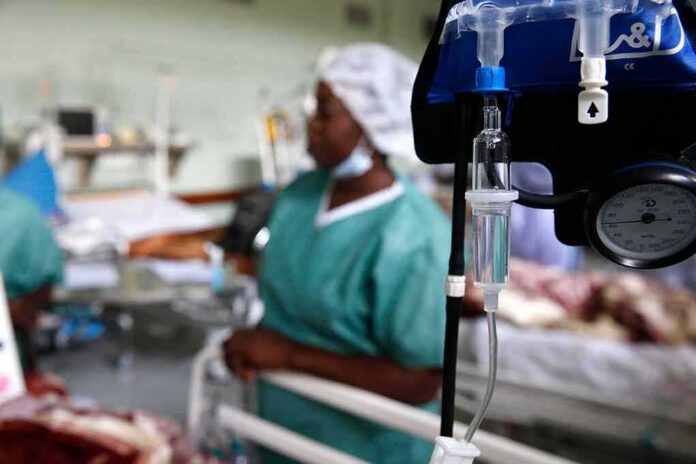
Russia’s top health watchdog says the lab worker died from pneumonia of unknown cause, not plague — and it insists the region is stable.
Story Snapshot
- Federal health agency reported no plague-linked microbes in the patient’s samples.
- Officials said the epidemiological situation in Irkutsk region remains stable.
- Nearly 200 contacts were monitored, which fueled early public fear.
- Regional voices floated plague; federal authorities rejected that claim.
What Moscow Says Happened, In Plain Terms
Russia’s consumer protection and public health agency, Rospotrebnadzor, said the researcher was diagnosed with pneumonia of unknown cause. The agency stated that expanded testing did not detect any microorganisms tied to her work at the Irkutsk Anti-Plague Research Institute. Media carried the statement because few original documents were released, but the message was clear: no plague confirmed, no lab-linked pathogen detected. The agency also said the wider health situation in the region was stable and under control.
Officials added that a special commission at the institute agreed no emergency or security breach had occurred. Outlets quoting Interfax reported no incident with pathogenic microorganisms inside the facility. The governor said no other lab workers sought medical care with similar symptoms. These points line up with a standard containment playbook: review the lab, test the obvious links, and report if anything sparks alarm. On each step, the public line said no.
Why The Public Still Smelled Smoke
Local leaders helped light the fire. The neighboring Buryatia chief, Alexei Tsydenov, said the employee died “possibly from the plague,” which jumped fast across headlines. That single line, paired with quarantine of close contacts and a hospital wing, created a strong impression of hidden danger. Large quarantines feel like proof, even when they are simple caution. That is how fear outruns fact in the first 24 hours of any bio scare.
Quarantine numbers added to the doubt. Reports cited monitoring of nearly 200 people. That is smart public health when the cause is unclear, and it does not prove an outbreak. But it clashes with calm language about stability. People hear “unknown pneumonia” and “two hundred under watch” and think cover-up. This is the cost of thin disclosures and early rumor. The response may be right and still sound wrong to the public ear.
The Evidence Standard That Actually Settles Plague
Plague is confirmed by finding the bacteria Yersinia pestis in patient samples, or by clear antibody changes over time. That means cultures, molecular tests, or specific antigen detection. Without that proof, experts write “unknown etiology” on the chart. It is not a dodge; it is the rule. The European Centre for Disease Prevention and Control lays out those confirmation steps in plain terms. Either you find the bug, or you do not call it plague.
U.S. offers Russia help after Siberia plague institute deathhttps://t.co/WKQMhhe74M
— AnewZ (@Anewz_tv) October 6, 2026
Given that standard, the federal line has weight. Rospotrebnadzor said they did not find organisms linked to the lab work. That pushes against the broken-vial tale that swirled online. Could more transparency help? Yes. Releasing post-mortem findings, test panels run, and what samples were checked would close the loop. Until then, the public has a denial without the data, and skeptics have a rumor without the culture plate. That stalemate breeds noise, not light.
What A Common-Sense Litmus Test Says
Look for spread, look for staff symptoms, look for lab breaches. Officials reported none of the three. No other workers came forward sick. The commission found no emergency at the institute. There has been no confirmed secondary case. Those facts tilt against a plague leak. Conservative common sense prizes proof you can check: chains of transmission, named failures, measurable results. The record so far points to a tragic, unclear pneumonia, not a rolling outbreak.
What To Watch Next
Three items would settle this quickly. First, an official release of lab and pathology results that lists what tests ran on blood, lung tissue, and swabs. Second, a timeline of the researcher’s exact work with Yersinia pestis, if any, in the days before illness. Third, a final report on the 197 monitored contacts, including any fevers or lung symptoms. If those remain clean, the scare should fade. If not, the story changes fast.
Sources:
insiderpaper.com, abc17news.com, themoscowtimes.com, cnbc.com, aljazeera.com, aa.com.tr, fox17.com
© impactheadlines.com 2026. All rights reserved.