The Supreme Court just told President Trump he can’t use emergency powers to levy sweeping tariffs—prompting three justices to warn the ruling could handcuff America’s ability to respond fast to foreign threats.
Quick Take
- A 6-3 Supreme Court decision struck down Trump’s “Liberation Day” emergency tariffs imposed under the International Emergency Economic Powers Act (IEEPA).
- Justice Brett Kavanaugh, joined by Justices Clarence Thomas and Samuel Alito, dissented and warned the ruling limits presidential flexibility during foreign crises.
- Chief Justice John Roberts’ majority said IEEPA authorizes “regulation,” not taxation, and invoked the major questions doctrine to demand clear congressional approval.
- The decision halts IEEPA-based tariff collections and sets up refund claims for duties already paid, with the Court of International Trade overseeing the process.
What the Court Actually Did—and Why It Matters
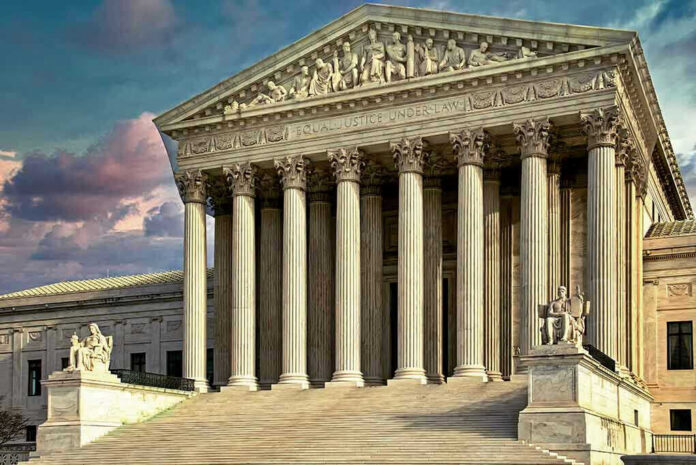
On February 20, 2026, the U.S. Supreme Court invalidated President Trump’s sweeping tariffs issued under IEEPA, a 1977 law designed for foreign-threat emergencies. The Court’s 6-3 split matters because it closes a novel pathway: no president had previously used IEEPA as a tariff statute. The ruling immediately blocks a broad tariff regime affecting most imports and resets the legal boundaries for emergency economic action.
Chief Justice John Roberts wrote that the government could not point to any statute where the power to “regulate” includes the power to “tax,” treating tariffs as duties that belong to Congress. The majority also leaned on the “major questions doctrine,” signaling that an action with massive economic and political consequences needs clear, explicit authorization from lawmakers—not a broad reading of a general emergency statute.
THANK YOU SIRS!~ Three Justices WARN Majority Is Handcuffing President Trump’s Ability to Fight Foreign Threats — Here’s What the Three Justices Said in Their Dissent https://t.co/Pd08NAMHt7 #gatewaypundit via @gatewaypundit
— Debra Dosch (@DebraDosch) February 20, 2026
Inside the Dissent: Why Kavanaugh, Thomas, and Alito Sounded the Alarm
Justice Brett Kavanaugh’s dissent framed tariffs as a long-recognized tool for regulating importation, arguing they fit naturally within a president’s emergency toolkit when foreign threats collide with commerce. Joined by Justices Clarence Thomas and Samuel Alito, Kavanaugh warned the majority’s approach risks weakening a president’s ability to respond swiftly when adversaries exploit trade, supply chains, or cross-border criminal flows that can rise to the level of national emergencies.
At the same time, the dissent tried to narrow fears of permanent paralysis. Kavanaugh suggested the practical effect could be limited because other federal statutes may still allow many of the same tariffs through different procedures. That nuance is important: the dissent is not claiming the president has unlimited power, but that the Court picked the wrong line to draw in an emergency statute—especially when time-sensitive foreign threats can demand quick economic countermeasures.
Refunds, Revenue, and Real-World Disruption
The decision stops the government from collecting “tens of billions” in tariff revenue under IEEPA and opens the door for companies to file refund claims for duties already paid. The U.S. Court of International Trade is expected to manage the refund process, which means businesses will likely navigate specialized trade litigation rather than broad constitutional battles in general federal courts. The exact timeline and mechanics for refunds remain unclear.
For consumers and import-dependent industries, the ruling could ease tariff-driven price pressures in the short run, but it also creates uncertainty for planning. Companies that structured supply chains or pricing around the emergency tariff regime now face a moving target: what was “legal enough” yesterday is invalid today. That uncertainty is a familiar theme after years of Washington’s expansive interpretations of executive authority meeting judicial pushback.
What Options Trump Still Has After the IEEPA Door Closed
Even with the IEEPA route shut, the administration still has alternative statutory tools that can support tariffs, including Section 301 of the Trade Act of 1974 and Section 232 authorities tied to national security. Those pathways tend to carry more defined procedures and tighter limits than the emergency approach at issue here, and reporting indicates some options may be constrained by caps such as tariff levels and time limits in certain scenarios.
The bigger constitutional takeaway is that the Court is reaffirming Congress’ central role over taxes and duties, even when the White House argues that foreign threats require speed. Conservatives can see two principles colliding: a strong executive able to defend the nation, and a Constitution that doesn’t let emergencies rewrite who controls the taxing power. If Congress wants a president to wield tariff power in crises, the Court is effectively demanding Congress say so plainly.
Sources:
Supreme Court strikes down tariffs
Supreme Court Tarriffs Ruling Trump
U.S. Supreme Court invalidates IEEPA as a lawful authority to impose tariffs
Supreme Court steps in; Trump’s tariffs thrown out