President Trump has ordered U.S. Central Command to blockade Iranian ports in a dramatic escalation that exposes deep confusion over whether America is imposing a targeted enforcement or risking a full-blown energy crisis in the world’s most critical oil chokepoint.
Story Snapshot
- Trump announced a blockade of ships entering or exiting Iranian ports effective 10:00 A.M. ET on April 13, 2026, following failed peace talks with Iran
- CENTCOM clarified the operation targets only Iranian vessels, not all traffic through the Strait of Hormuz, contradicting Trump’s broader public claims
- Key U.S. allies including the U.K. declined participation, with Prime Minister Starmer leading a separate 40-nation NATO coalition to ensure freedom of navigation
- Iran condemned the action as “illegal piracy” and threatened retaliation across Gulf ports, raising fears of wider conflict and oil supply disruptions
Trump’s Blockade Order Targets Iranian Shipping
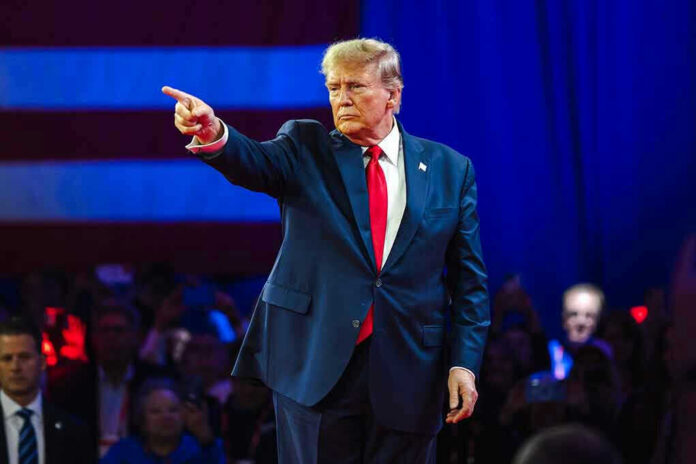
President Trump announced via Truth Social that U.S. forces would blockade ships entering or exiting Iranian ports beginning at 10:00 A.M. Eastern Time on April 13, 2026. The directive came after marathon U.S.-Iran peace negotiations over the weekend collapsed without agreement. Trump framed the move as a response to Iran’s control over the Strait of Hormuz, a narrow waterway through which roughly twenty percent of global oil supplies pass. The announcement immediately sparked alarm over potential energy price spikes and the risk of military confrontation in one of the world’s most strategically vital regions.
CENTCOM Implementation Contradicts Presidential Rhetoric
U.S. Central Command operationalized the blockade as a targeted enforcement against Iranian port traffic in the Arabian Gulf and Gulf of Oman, allowing non-Iranian vessels to pass freely through the strait. This scope directly contradicts Trump’s public messaging, which suggested a comprehensive blockade of all ships entering or exiting the Strait of Hormuz. CNN analysts highlighted the discrepancy between the president’s sweeping claims and the military’s narrower execution. The confusion raises questions about coordination between the White House and defense officials, and whether the administration deliberately overstated the operation’s reach for political or strategic effect.
Allied Nations Reject U.S. Action, Form Separate Coalition
British Prime Minister Sir Keir Starmer declined to join the U.S. blockade, instead organizing a coalition of more than forty NATO and allied nations focused on preserving freedom of navigation through the strait. This rebuff undermines Trump’s assertions of broad international support for the operation. The U.K.-led coalition emphasizes defensive maritime protection rather than offensive enforcement against Iran, reflecting European concerns about escalation and energy security. The split exposes transatlantic friction over Middle East policy and suggests America’s closest allies view the blockade as unnecessarily provocative, potentially isolating Washington at a moment when coordinated pressure on Tehran might yield better results.
Iran Threatens Retaliation as Oil Markets Brace
Iranian military officials condemned the blockade as illegal piracy and warned that Gulf ports would become unsafe for international shipping. Tehran has previously imposed tolls on vessels transiting the strait, a practice the Trump administration cited as justification for the enforcement action. The standoff threatens short-term disruptions to Iranian oil exports and fertilizer shipments critical to global food supplies, while raising long-term risks of sustained high energy prices and wider regional conflict. Shipping companies face difficult decisions about rerouting cargo, and energy markets are bracing for volatility that could ripple through economies already strained by inflation and fiscal mismanagement.
IT’S HAPPENING: Full U.S. Blockade of Ships Entering or Exiting Strait of Hormuz Will Begin Today at 10:00 A.M. ET
READ: https://t.co/Qw1LYRFnMt pic.twitter.com/Y6CODMm4q1
— The Gateway Pundit (@gatewaypundit) April 13, 2026
The blockade represents a calculated gamble by the Trump administration to counter Iranian influence without triggering full-scale war. Yet the operation’s mixed messaging, limited allied participation, and potential for miscalculation illustrate a broader pattern frustrating Americans across the political spectrum: a federal government that struggles to execute coherent strategy while ordinary citizens bear the costs of elite failures. Whether targeting Iranian ports or the entire strait, the blockade underscores how Washington’s inability to forge consensus with allies or clearly communicate objectives leaves the public guessing about the true stakes and endgame in yet another Middle East confrontation.
Sources:
CBS News Live Updates: Iran War, U.S. Iran Ports Blockade, Strait of Hormuz, Trump