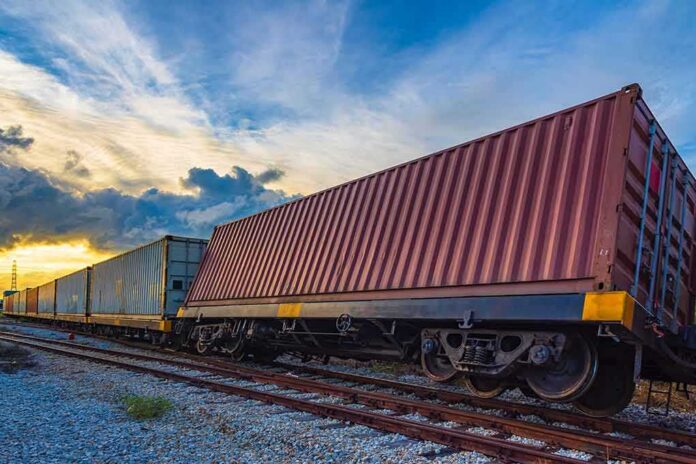
Beijing and Tehran now have a 15‑day land bridge that sidesteps U.S.-patrolled seas, exposing a sanctions gap America must close to keep pressure on Iran.
Story Snapshot
- China–Iran rail links cut transit times to about 15 days and reduce exposure to U.S. naval leverage [2][3].
- Analysts describe the corridor as a sanctions‑resistant “back door” that bypasses chokepoints like the Strait of Hormuz [1][2].
- China remains Iran’s dominant crude buyer, giving the route real economic pull even if oil-by-rail volumes are unproven [3].
- Rail capacity limits and missing shipment data mean this is a serious workaround—not a full replacement for sea trade [2][3][4].
China–Iran Rail Link Cuts Time and Dilutes Maritime Pressure
Energy trade and sanctioned goods that once took 30–40 days by sea can now move in roughly 15 days overland from China to Iran via Kazakhstan and Turkmenistan, according to reports detailing corridor upgrades through 2024–2025 [2][3]. Analysts say the faster transit chips away at the effectiveness of maritime pressure, where United States and allied navies hold the upper hand near Iran’s ports and the Strait of Hormuz [2]. The new tempo gives Tehran commercial breathing room as Washington targets revenue streams [2].
Specialized Eurasia coverage underscores the strategic logic: the rail corridor mitigates risks of interdiction and skirts chokepoints like the Strait of Hormuz, Suez Canal, and Strait of Malacca—waterways long central to Western deterrence [1]. By diversifying routes, Beijing and Tehran gain resiliency when maritime lanes face disruption or inspection risk [1]. That redundancy matters in sanctions enforcement, where time, predictability, and insurance costs can determine whether cargoes move or stall under pressure [1].
Economic Gravity: China Buys Most of Iran’s Oil
China’s role as Iran’s dominant crude customer anchors the corridor’s economic logic, with public data indicating Chinese buyers absorbed the vast majority of Iranian exports in 2024–2025 [3]. SEETAOE reporting cites about 1.38 million barrels per day imported by China, representing a large share of Iran’s export lifeline and a meaningful portion of China’s seaborne intake [3]. That demand signal encourages overland options for parts of the trade, even if bulk crude typically favors ships for cost and volume efficiency [3].
For conservatives tracking sanctions, the takeaway is clear: when a single buyer holds outsized sway, that buyer’s logistics choices can weaken U.S. leverage. Beijing’s integration of the corridor into broader Belt and Road networks expands optionality across Central Asia, giving Iran more routes to market and reducing single‑point vulnerabilities that naval patrols exploit [1]. Strategic redundancy complicates enforcement, raising the bar for effective monitoring and coordinated allied action [1].
How Much Can Rail Really Move? Capacity and Verification Gaps
Despite the corridor’s speed and resilience benefits, rail cannot match ocean‑going tankers for raw tonnage. Even supportive analyses acknowledge the lower volume capacity compared with sea routes and frame the rail option as a partial workaround, not a silver bullet [2][3]. EnergyNewsBeat flags significant logistical challenges for moving hydrocarbons by rail and refrains from quantifying oil moved via trains, underscoring the need for caution when assessing claimed volumes without manifests or customs documentation [2].
Claims that 40 percent of Iran’s trade could shift to land highlight ambition but not audited results. The strongest documented facts remain the 15‑day transit and the corridor’s role as a sanctions‑resistant alternative, not decisive proof of large‑scale crude flows by rail [2][3]. For U.S. policy and enforcement, that distinction matters: speed and redundancy degrade pressure at the margins, but capacity limits and verification gaps still leave room for targeted maritime and financial actions to bite [2][3].
Strategic Context: Long Timeline, Expanding Web
The current corridor rests on infrastructure years in the making. The Kazakhstan–Turkmenistan–Iran rail link has operated since 2014, and the first China–Iran test services predate today’s heightened tensions, showing a decade‑long buildout rather than an overnight sanctions dodge [2][4]. Recent upgrades and quasi‑normal operations from 2024 onward transformed previously intermittent routes into a more reliable land bridge, tightening China–Iran economic integration within Eurasian connectivity projects [3][4].
The U.S. is pressing hard at sea to squeeze Iran,
but an expanding China-linked rail corridor across Eurasia is offering Tehran a backdoor that naval power can’t easily close without risking a broader confrontation…https://t.co/7huUG7pbF9— Islam: a warlord deathcult of genocide & slaughter (@YitzokBenYosef) May 15, 2026
SpecialEurasia notes that the railway deepens Iran’s integration with China’s Belt and Road Initiative and offers Central Asia access to Iranian ports, expanding Beijing’s regional influence and Tehran’s options under pressure [1]. Additional concepts like the Five Nations Railway Corridor signal how new links could further reduce reliance on vulnerable seas, though many elements remain at planning or partial‑implementation stages [1][4]. The direction of travel is unmistakable: more tracks, more choices, more complexity for sanctions enforcers.
Policy Implications for the Trump Administration
The Trump team can treat this as an enforcement stress test, not a strategic defeat. Clear next steps include tighter end‑use tracking for sensitive cargoes, better rail‑node intelligence, and coordinated pressure on insurers, freight forwarders, and financiers connected to high‑risk shipments moving along the corridor. Public‑private data partnerships—covering rail car counts, terminal throughput, and customs anomalies—would sharpen visibility, while targeted sanctions on facilitators can raise costs without overextending U.S. commitments at sea [2][3][4].
Bottom Line for Readers
China and Iran just made sanctions work harder and slower, not impossible. The 15‑day rail option narrows America’s maritime advantage, helps Tehran manage around chokepoints, and strengthens Beijing’s leverage in Eurasia [1][2][3]. Capacity limits and missing oil‑by‑rail proof mean this is a workaround, not a game‑ender [2][3]. Smart enforcement—rooted in facts, manifests, and financial tracing—can adapt and hold the line without buying into hype or downplaying a real, growing challenge [2][3][4].
Sources:
[1] Web – How Will Iran-China’s Corridor Impact Eurasian Connectivity?
[2] Web – How Effective is the Iran Back Door Rail Line to China?
[3] Web – Beyond the Strait of Hormuz, the China Iran railway …
[4] Web – Five Nations Railway Corridor