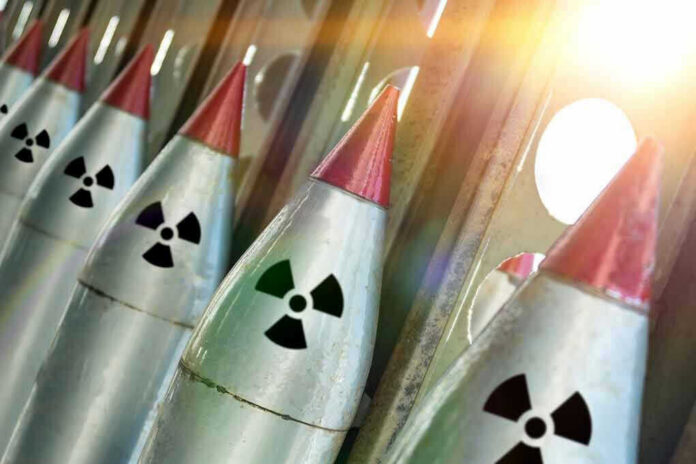
China’s secret nuclear tests and massive arsenal expansion threaten American deterrence just as President Trump seeks a stronger arms control deal, exposing Beijing’s dangerous disregard for global stability.
Story Snapshot
- US officials confirm China conducted covert nuclear tests, including one in June 2020, detected by seismic data from Kazakhstan.
- China’s warheads doubled from 260 in 2015 to 600 in 2025, with projections to 1,000 by 2030, shifting the global nuclear balance against US interests.
- New START Treaty expired February 5, 2026, unleashing unconstrained buildups while China refuses transparency.
- President Trump pushes for resumed US testing on an equal basis and a new treaty including China to restore deterrence.
US Exposes China’s Covert Nuclear Tests
On February 6, 2026, US Under Secretary of State Thomas DiNanno addressed the UN Conference on Disarmament in Geneva. He accused China of secret nuclear tests, citing a June 2020 event. Assistant Secretary Christopher Yeaw followed on February 17 with seismic evidence from a Kazakhstan station. This data shows activity incompatible with non-nuclear operations. China’s denials highlight its opacity, undermining trust in international norms. President Trump’s administration frames these actions as violations of testing moratoriums like the CTBT.
Arsenal Growth Reshapes Nuclear Balance
China expanded its nuclear warheads from 260 in 2015 to 600 by 2025. Projections indicate 1,000 by 2030. This buildup occurs without limits or transparency, contrasting with US and Russian arsenals of about 5,177 and 5,459 total warheads respectively. Operational US and Russian figures stand at roughly 3,700 and 4,300. China’s rise disrupts post-Cold War arms control focused on US-Russia parity. Facilities expanded from 2020-2024 support missile tests on DF-26 and H-6N platforms.
President Trump prioritizes US modernization to counter this threat. His approach strengthens deterrence amid Beijing’s strategic ambiguity aimed at US missile defenses. This expansion erodes the effectiveness of prior treaties that excluded China.
New START Expiration Fuels Arms Race
The New START Treaty expired on February 5, 2026, after Russia suspended participation in 2023. This ends constraints on US and Russian deployed warheads. China, never included, accelerates its program unchecked. President Trump called for a new, improved treaty on February 5. DiNanno urged trilateral talks including China. Beijing refuses dialogue under Xi Jinping, prioritizing buildup over verification.
Russia tested its Poseidon torpedo in December 2025, aligning with China against US interests while competing in expansion. Experts like Jeffrey Lewis note CTBT gray areas on subcritical tests, but US views them as violations. Brookings analysts stress China’s rapid growth demands inclusion, though US defenses complicate engagement.
Impacts Demand Strong US Response
Short-term risks include testing spirals and miscalculations, eroding CTBT and NPT norms. Indo-Pacific allies face heightened threats. Long-term, an arms race accelerates, with China nearing parity despite lagging totals. US modernization costs rise, global trade disrupts, and non-proliferation weakens. USSC and ASPI declare a new nuclear age reshaping stability.
President Trump’s push for equal testing and trilateral control aligns with conservative priorities of robust defense and limited government overreach abroad. China’s actions justify renewed American strength to protect sovereignty and families from foreign aggression.
Sources:
USSC Insights: Three Key Nuclear Developments in 2026
ASPI Strategist: Revelations of Chinese Nuclear Tests Mark Start of a New Era
Brookings: What Comes After New START
US Embassy China: The Next Era of Nuclear Arms Control
State Department: Statement to the Conference on Disarmament
AMACAD: Opportunities & Challenges in US-China Nuclear Arms Control