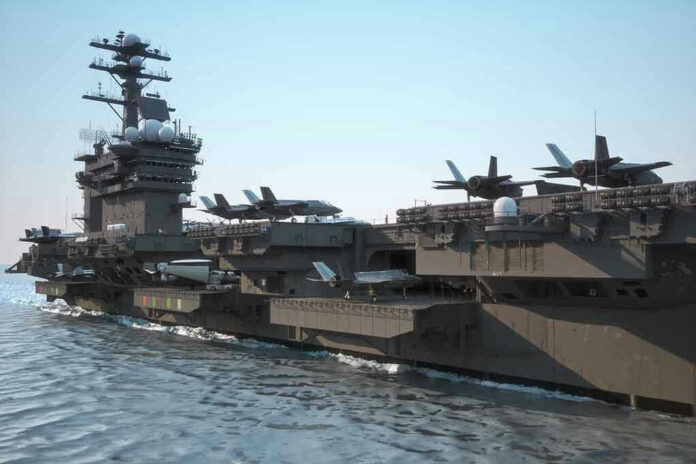
America’s most expensive warship, the $13.3 billion USS Gerald R. Ford, limped into port after a catastrophic 30-hour laundry fire left over 600 sailors sleeping on decks and floors—a humiliating breakdown that raises serious questions about Navy leadership, crew exhaustion, and whether this floating money pit was worth deploying into another Middle East conflict we were promised to avoid.
Story Highlights
- A non-combat laundry fire aboard the USS Gerald R. Ford burned for over 30 hours, destroyed berthing spaces, and forced more than 600 sailors to sleep on decks, tables, and floors during active Red Sea operations against Iran.
- The $13.3 billion flagship carrier, plagued by years of cost overruns and technical failures, returned to Crete for repairs as the Pentagon revealed insufficient test data on critical systems including weapons elevators and radar.
- Crew exhaustion from a grueling 10-month deployment, 19-hour maintenance shifts, and deferred upkeep on failing plumbing systems created conditions ripe for disaster, with NCIS now investigating potential sabotage.
- The incident exposes a broader crisis: America’s most advanced carrier knocked out of action not by enemy fire, but by neglect and overwork—undermining operations in a war many MAGA supporters never wanted in the first place.
Laundry Fire Cripples $13 Billion Warship
The USS Gerald R. Ford, the Navy’s flagship nuclear-powered aircraft carrier, suffered a devastating fire on March 12, 2026, in its main laundry facility while operating in the northern Red Sea as part of operations against Iran. The blaze burned uncontrolled for over 30 hours, spreading through the ship’s ventilation systems and destroying berthing compartments that house the crew. Two to three sailors sustained injuries requiring medical attention, while dozens—possibly over 200 according to some reports—were treated for smoke inhalation. The fire did not damage the ship’s nuclear reactors or propulsion systems, but left over 600 sailors without sleeping quarters, forcing them onto open decks, mess tables, and floors.
Exhausted Crew and Deferred Maintenance Set Stage for Disaster
The Ford had been deployed for 10 months in support of U.S.-Iran operations when the fire erupted, and crew exhaustion was already reaching critical levels. Sailors were working 19-hour shifts attempting to maintain the ship’s notoriously unreliable vacuum plumbing system, which had been sabotaged multiple times by crew members flushing foreign objects—a symptom of low morale and brutal operational tempo. Maritime expert Sal Mercogliano described shipboard laundries as a “smorgasbord of dangers,” with flammable lint accumulation, overloaded industrial dryers, and overworked personnel creating perfect conditions for catastrophe. Deferred maintenance on high-use facilities like the laundry only compounded risks that should never have been tolerated on America’s most advanced carrier.
Pentagon Reveals Deeper Systemic Failures
By March 25, when the Ford limped into Souda Bay, Crete, for repairs, the Pentagon’s Office of Operational Testing and Evaluation disclosed that the Navy lacks adequate performance data on the ship’s critical systems—including its electromagnetic aircraft launch system (EMALS), advanced radar, damage control resilience, and weapons elevators. This isn’t the first time the Ford-class has disappointed: the ship has been plagued since commissioning in 2017 by delays, cost overruns exceeding $13 billion, and chronic failures in elevators and launch systems. The fire exposed not just a maintenance failure but fundamental design flaws, including ventilation that allowed smoke and flames to spread rapidly through crew living spaces—a potentially lethal weakness in combat scenarios.
Sabotage Investigation Raises Troubling Questions
NCIS has launched an investigation into possible arson or sabotage, with speculation mounting that disgruntled sailors—pushed to the breaking point by grueling deployment schedules and a war many question—may have deliberately sparked the fire. While no official confirmation of sabotage exists, the narrative fits a troubling pattern: repeated plumbing sabotage, exhausted crews working extreme hours, and deteriorating morale on a ship that was supposed to project American strength. Instead, the Ford projects dysfunction and waste, sidelined by a laundry fire while our troops remain entangled in yet another Middle East conflict that drains resources and lives without clear justification or exit strategy.
600 Sailors Are Sleeping on Floors Aboard the USS Gerald R. Ford Due to Fire — Some Keep Suggesting the Aircraft Carrier Was Sabotagedhttps://t.co/JPBsYu0bFY
— Harry J. Kazianis (@GrecianFormula) March 23, 2026
The Ford incident is more than an embarrassing mishap—it’s a symbol of everything wrong with Washington’s priorities. We spent over $13 billion on a carrier that can’t survive its own laundry room, deployed exhausted sailors into harm’s way for a war Trump promised to avoid, and now face repair costs and operational setbacks that weaken our actual national defense. Americans were told this administration would end endless wars and rebuild strength at home, not send our sailors to sleep on floors in the Red Sea while chasing regime change fantasies. This disaster demands accountability: for the Navy brass who ignored crew welfare, for the Pentagon that certified an unproven ship, and for leaders who broke their promise to keep us out of new conflicts.
Sources:
New problems have been discovered on the US aircraft carrier that caught fire
Was Sabotage to Blame for USS Gerald R. Ford Carrier Fire?
Carrier USS Gerald R. Ford Suffers Fire
Fire aboard USS Gerald R. Ford displaces 600 sailors in Red Sea
A Fire Broke Out Aboard U.S. Navy Nuclear USS Gerald R. Ford Aircraft Carrier
US aircraft carrier fire exposes design, damage control flaws