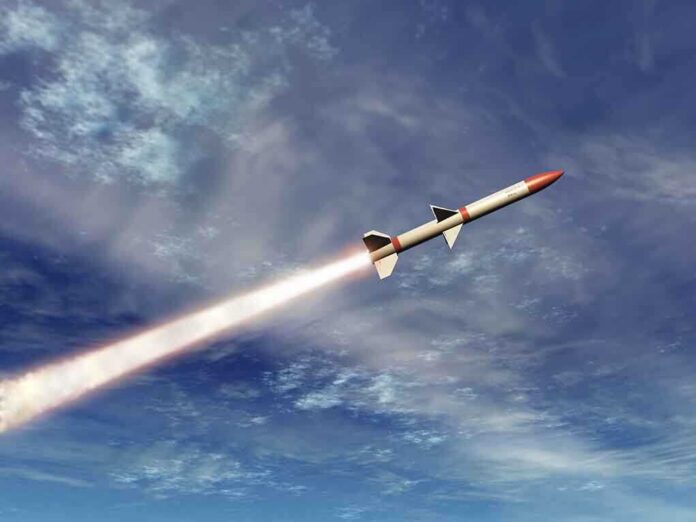
A single NATO-standard 155mm howitzer round just demonstrated missile-like range and accuracy—without forcing allies to buy brand-new launch platforms.
Story Snapshot
- Tiberius Aerospace says it successfully ignited a liquid-fueled ramjet projectile fired from a standard 155mm howitzer during tests in New Mexico.
- The company advertises Sceptre’s reach at roughly 140–160 km and speeds around Mach 3.5 within seconds, potentially reshaping what “tube artillery” can do.
- Sceptre is designed for NATO-standard 155mm guns with no platform modifications, though its length can create compatibility issues with some autoloaders.
- The concept targets a long-standing battlefield problem: missiles provide range and precision but are expensive and production-limited, while conventional shells are scalable but short-legged.
What Tiberius Aerospace Says It Proved in New Mexico
Tiberius Aerospace, a UK-based defense technology firm, announced that it achieved what it calls the first successful ignition of a liquid-fueled ramjet projectile launched from a NATO-standard 155mm howitzer. According to the company and multiple defense outlets covering the unveiling, the Sceptre round (TRBM 155HG) transitions from a gun launch to powered flight, aiming to combine conventional artillery’s logistics with long-range, high-speed performance.
Sceptre Just Outflew Every Guided Artillery System Ever Builthttps://t.co/qQYkpOdDi2
— 19FortyFive (@19_forty_five) April 29, 2026
Reported specifications emphasize why the claim is drawing attention: an advertised 140–160 km range depending on configuration, speeds around Mach 3.5 reached within about six seconds, and a flight profile above roughly 65,000 feet. The company also highlights guidance designed to function in GPS-contested conditions using a mix of GPS and inertial navigation, along with encrypted features and self-correction algorithms described in trade reporting.
Bridging a Real Capability Gap: Scalable Shells vs. Scarce Missiles
Modern militaries have lived with an uncomfortable tradeoff for years. Conventional 155mm rounds are comparatively easy to manufacture and stockpile, but typical maximum range figures are far shorter and accuracy is looser than precision weapons. Missiles, meanwhile, can reach deep targets with high precision, but they come with higher price tags and tighter industrial bottlenecks. Sceptre’s pitch is that it narrows that gap by delivering longer-range precision from guns already fielded across NATO.
That matters politically as well as tactically. In 2026, lawmakers in Washington talk constantly about rebuilding the industrial base and sustaining allied deterrence without blank-check procurement. When a system promises “missile-like” effects from existing howitzers, it naturally attracts interest from budget hawks who prefer upgrading capability without expanding federal footprints or creating yet another bespoke platform. The available reporting, however, still leaves open questions about production scale and timelines for real-world fielding.
Compatibility Claims Come With a Catch: The Autoloader Constraint
One of Sceptre’s strongest selling points is integration. Reporting indicates the round is intended to fire from existing 155mm systems without modifications, and to remain backward compatible with established fuzes and propulsion systems. That kind of compatibility is a major advantage in any NATO context, where standardization and logistics drive costs. But there is a practical limitation: Sceptre’s length is reported at about 1.55 meters, which can exceed autoloader limits built around shorter ammunition.
Accuracy, Electronic Warfare, and the New Reality of “Contested GPS”
Tiberius Aerospace and defense publications describe a guidance package built around dual navigation modes—GPS and inertial—with encryption, backup navigation, and hardened software intended to keep the round on target even when electronic warfare is present. Reported circular error probability figures sit in the single-digit-meter range, which would be a substantial improvement over unguided artillery and a meaningful factor for minimizing collateral damage when rules of engagement demand precision.
Even so, the public data is mostly performance claims and early demonstrations rather than long-term operational results. Trade reporting also flags that a terminal seeker for moving targets is discussed more as a future upgrade path than a confirmed, fielded capability today. For Americans frustrated with bureaucracy and waste, that distinction matters: the difference between a promising demo and a deployable program is where procurement often bogs down. The upside is that the system is described as modular and open-architecture, which could shorten future upgrade cycles.
Sources:
Tiberius Aerospace Sceptre Liquid-Fuelled Ramjet Ignition
Tiberius Aerospace unveils Sceptre, a 150 km 155 mm round