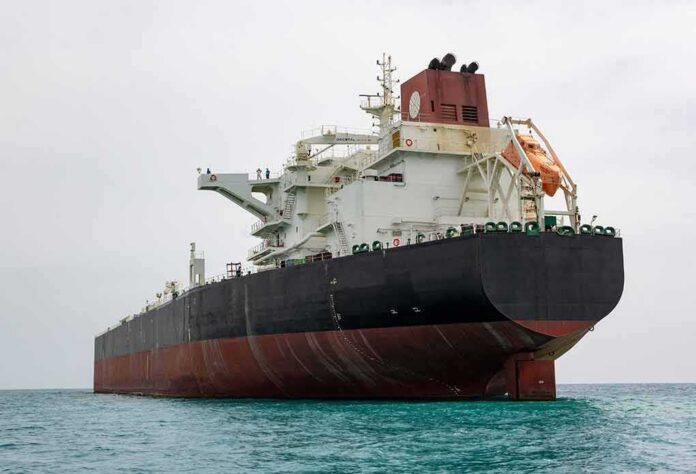
Saudi Arabia’s seaborne oil exports have two gates to the world; when one narrows, the other becomes indispensable. The Houthis’ declared ban on ships calling at Saudi ports targets that indispensable gate — the Bab el-Mandeb corridor on the Red Sea — at the precise moment the Strait of Hormuz is perilous. That is why this episode matters: it weaponizes geography, coercing global trade not by sealing a chokepoint absolutely, but by making prudent mariners decide to avoid it.
The Short Version
- The Houthis announced a ban on vessels loading or discharging at Saudi ports and warned they would target ships “within reach,” converting risk into operational disruption.
- Major outlets and maritime advisories treated the ban as a de facto blockade; several tankers turned back and Red Sea transits slowed, signaling immediate market impact.
- Claims of strikes on Saudi-linked tankers were paired with at least some physical attacks, moving the threat beyond rhetoric.
- Because Bab el-Mandeb is Saudi Arabia’s relief valve when Hormuz is constrained, even selective attacks and insurer pressure can compress global spare capacity.
What the Houthis actually did: a declared ban with teeth
The Houthis notified shipping companies that vessels were “banned from loading or discharging cargo at any Saudi ports” and warned those that did so could be targeted anywhere they were within range. That language — circulated directly and then reported across multiple outlets — is the core of the claim that a blockade exists. Press summaries described the move as a maritime blockade or embargo, effective immediately, and not merely a rhetorical flourish; this was framed as a rule the Houthis intended to enforce, not a slogan for domestic audiences.
Crucially, enforcement was not left to imagination. The group publicly claimed attacks on Saudi oil tankers in the Red Sea and Gulf of Aden. While wartime claims require scrutiny, reputable reporting aligned on at least some strikes causing fires aboard targeted vessels — the step change from threat to kinetic interdiction that turns advisory risk into ship-operator policy.
How a coercive “blockade” works without a boom gate
Blockades in the 21st century are often selective and psychological. You do not need a wall across a strait if insurers, charterers, and masters decide it is not worth the premium, the exposure, or the headline risk. The Red Sea campaign since 2023 has proven this repeatedly: threat bulletins and a handful of highly publicized strikes have diverted billions in cargo and weeks of sailing time around the Cape of Good Hope. In this episode, real-time behavior followed the script. The BBC reported tankers executing sharp U-turns near Yemen after the announcement, and subsequent data showed a measurable slowdown in Bab el-Mandeb traffic. That is the market translating words and a small number of hits into large-scale avoidance.
Maritime-security advisories amplified the signal. Joint and European naval warnings emphasized credible preparations to attack shipping with missiles and drones, and circulated guidance that vessels connected to Saudi trade were at heightened risk. Security circulars do not close lanes in a legal sense; they recalibrate acceptable risk. For shipowners facing war-risk surcharges, charter penalties, and crew safety obligations, that recalibration is often decisive.
Why Bab el-Mandeb is uniquely consequential for Saudi exports
Saudi Arabia’s export geography is bifurcated. The Persian Gulf handles the lion’s share in normal times, but its outlet — the Strait of Hormuz — is the world’s most sensitive oil chokepoint. When Hormuz tightens, the Red Sea route via Yanbu and other western ports becomes the pressure-release system for crude and products moving to Europe and, via Suez, to broader markets. That redundancy is strategic doctrine, not convenience. Disrupt the Red Sea lane at the same time Hormuz is troubled, and you have compressed Saudi flexibility to a narrow band of pipelines and expensive detours.
Reuters captured the macro risk succinctly: a determined Houthi campaign against Saudi-linked shipping could obstruct a significant share of Saudi exports, threatening to choke an additional slice of global oil supply at a time when alternatives are already strained. Even if flows continue, longer routes, smaller parcel sizes, and scheduling friction erode effective capacity — a shadow cut to supply that shows up first in freight and insurance, then in refinery runs.
Evidence of disruption: from bridge wings to dashboards
Operational signals are the most honest. On the bridge, masters turned vessels away from the southern Red Sea after the ban, according to contemporaneous ship-tracking seen by major outlets. In the market, analytics firms recorded fewer Bab el-Mandeb transits in the days after Houthi attacks on Saudi targets. Neither data point proves an airtight closure — ships continued to move — but together they establish a de facto narrowing of the corridor under fire.
Diplomatic reaction matched the maritime picture. The European Union characterized the threats as a dangerous escalation and a direct challenge to freedom of navigation, explicitly linking the need for unimpeded passage across both the Red Sea and the Strait of Hormuz. When seasoned institutions adopt that framing, underwriters notice; the next renewal cycle bakes it in.
The law and the label: blockade, embargo, or targeted interdiction?
International law draws sharp lines: a lawful naval blockade requires declaration, effectiveness, impartiality, and allowance for humanitarian passage, among other criteria. Armed groups rarely meet those tests. Human rights monitors have previously argued Houthi attacks on merchant shipping violated the laws of war, underscoring that whatever label the group uses, it does not convert selective violence into a lawful blockade. That legal reality, however, has limited practical effect on a master deciding whether to sail; risk is priced, not litigated, at sea.
This is also why headlines can compress “ban,” “embargo,” and “blockade” into a single, stronger idea. The Houthis announced a ban, threatened to attack, and claimed to strike; media and markets translated that into a blockade narrative because behavior changed accordingly. Readers should keep two truths in view: the waterway was not physically closed in the classic sense, and yet the effect on routing made it narrower in practice. Both can be, and here were, true at once.
🚨 Saudi Arabia weighs backing Yemeni ground offensive to seize Red Sea coast from Houthis after ballistic missile killed crew on Tihamah. Escalation threatens shipping lanes, oil prices could swing. Will Riyadh step in?
— Dino Vibes Daily (@DinoLeadingNews) August 13, 2026
Strategic consequences: leverage for Houthis and latent fragility for markets
For the Houthis, this is asymmetric leverage at its purest. With a finite arsenal of anti-ship missiles, drones, and coastal surveillance, they can force the world’s most heavily capitalized maritime system to self-divert. The more the group demonstrates credible reach — and the more it times its moves to coincide with Hormuz volatility — the greater the bargaining power it extracts from Riyadh and its partners. This is not a one-off stunt; it is part of a sustained Red Sea coercion campaign in which selective interdictions and credible threats have repeatedly reshaped global routing choices since 2023.
For energy markets, the implications compound. A voyage that detours around Africa adds roughly one to two weeks, more fuel, and higher day rates. Repeated at scale, those frictions function as a capacity tax: fewer delivered barrels per calendar week even at unchanged production. The risk of sporadic strikes raises premiums, and the mere possibility of escalation forces refiners and traders to hold more inventory or accept delivery uncertainty. Reuters’ assessment that sustained Saudi-targeted interdiction could encumber a nontrivial portion of world supply is not speculative; it maps to the mechanical realities of ship scheduling and port lineups under duress.
The caveats that matter — and those that don’t
Three caveats deserve emphasis. First, the evidence base here rests overwhelmingly on public threat notices, credible media reporting, and ship-tracking summaries rather than comprehensive primary records from owners, charterers, and insurers; it shows clear disruption, not a statistical audit of sustained export loss. Second, independent confirmation of each claimed strike is uneven; in conflict zones, that is the norm, not an anomaly. Third, the waterway itself was not “sealed” end to end; ships continued to move, and some Saudi cargoes likely loaded and sailed under heightened risk protocols. Those caveats refine, but do not undercut, the central point: the Houthis’ declared ban produced immediate, measurable operational effects that a prudent operator would call de facto blockade conditions.
What to watch next: signals of durability and adaptation
Two indicators will separate transient shock from durable constraint. On the supply side, watch berth nominations and liftings out of Yanbu and other Red Sea terminals: a persistent shortfall versus pre-crisis cadence indicates that rerouting and pipeline backfills are insufficient. On the demand side, monitor war-risk premia and time-charter rates for Suezmax and Aframax classes; if elevated risk pricing persists beyond the initial scare window, the market has internalized a longer horizon of disruption. Either way, the episode crystallizes a strategic truth. Saudi Arabia’s redundancy works until a capable non-state actor credibly threatens the relief valve; at that moment, geography becomes leverage, and leverage becomes price.
Sources:
theguardian.com, aljazeera.com, reuters.com, pbs.org, bbc.com, bloomberg.com, washingtonpost.com, cnbc.com, apnews.com, eeas.europa.eu, wsj.com
© impactheadlines.com 2026. All rights reserved.