President Trump has delivered a massive victory for American manufacturing and national security by securing a groundbreaking $500 billion semiconductor deal with Taiwan that slashes our dangerous dependence on foreign chip production.
Story Highlights
- Taiwan commits $250 billion in direct U.S. investments plus $250 billion in credit guarantees for semiconductor manufacturing
- U.S. tariffs on Taiwanese goods capped at 15%, down from 20%, rewarding companies that build American factories
- TSMC agrees to construct four additional plants beyond six already promised, dramatically expanding U.S. chip capacity
- Deal reverses decades of offshoring that left America producing only 10% of global semiconductors despite controlling 37% in 1990
Trump Administration Secures Historic Manufacturing Victory
The Department of Commerce announced on January 15, 2026, that Taiwanese semiconductor companies will invest at least $250 billion directly in U.S. manufacturing facilities, supplemented by another $250 billion in credit guarantees. This represents the largest foreign investment commitment in American semiconductor production history. The agreement caps U.S. tariffs on Taiwanese goods at 15%, compared to the standard 20% reciprocal tariff framework, creating powerful incentives for companies to relocate production to American soil.
Reversing Decades of Globalist Manufacturing Destruction
America’s semiconductor manufacturing capacity collapsed from 37% of global production in 1990 to under 10% by 2024, creating what the Trump administration correctly identifies as a critical national security vulnerability. This catastrophic decline occurred as globalist policies encouraged offshoring to maximize corporate profits while hollowing out American industrial capacity. The new agreement directly addresses this strategic weakness by requiring Taiwanese companies to build substantial U.S. production facilities in exchange for preferential tariff treatment.
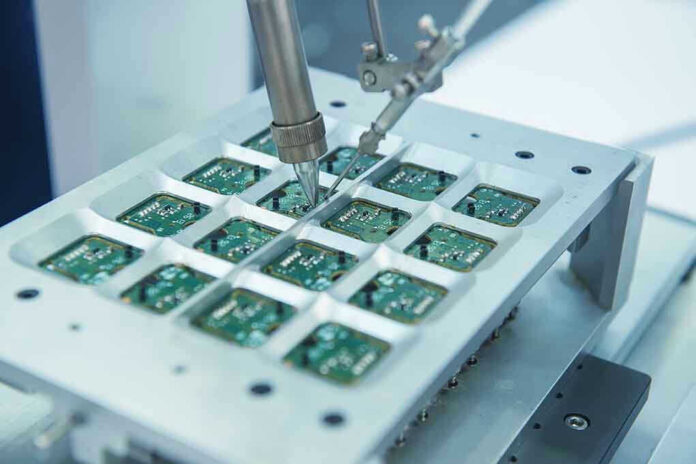
Taiwan Semiconductor Manufacturing Company, the world’s largest chip producer, will construct four additional plants beyond the six factories already promised, along with two packaging facilities. These investments will create thousands of high-paying American manufacturing jobs while reducing our dangerous reliance on foreign supply chains. The deal establishes a framework where future tariff benefits reward companies based on their actual U.S. manufacturing capacity, ensuring investments translate into real production capabilities.
Strengthening America’s Competitive Position Against China
The agreement positions semiconductors as a cornerstone of U.S. national security strategy, recognizing these advanced chips as essential for artificial intelligence development and military capabilities. By securing Taiwan’s commitment to expand U.S. production, President Trump has strengthened America’s competitive position against China while deepening economic ties with a crucial democratic ally. The deal follows similar agreements with Japan and South Korea, creating a network of trusted semiconductor suppliers committed to American manufacturing.
Zero tariffs will apply to select items including generic pharmaceuticals, aircraft components, and unavailable natural resources, while companies investing in U.S. production can access duty-free imports for manufacturing inputs. This smart tariff structure rewards job creation and domestic investment rather than simply punishing foreign competitors. The reciprocal investment framework also includes U.S. commitments to Taiwan’s semiconductor, defense, AI, telecommunications, and biotech industries, creating mutual economic benefits.
Restoring American Industrial Independence
This landmark agreement demonstrates how strategic tariff policy can reverse globalist destruction of American manufacturing. Rather than accepting permanent dependence on foreign supply chains, President Trump has leveraged America’s massive consumer market to secure unprecedented investment commitments from foreign companies. The $500 billion total commitment represents a fundamental shift toward domestic production in the most critical technology sector of the 21st century.
The deal establishes industrial parks specifically designed for semiconductor manufacturing, creating integrated supply chains within American borders. This approach reduces vulnerability to foreign disruptions while ensuring American companies maintain access to cutting-edge semiconductor technology. By requiring substantial capital commitments before granting tariff benefits, the agreement ensures foreign companies have genuine skin in the game for American manufacturing success.
Sources:
US, Taiwan Come to $250B ‘America First’ Tariff Deal Over Semiconductors
Taiwan to invest $250B in US semiconductor manufacturing
U.S. and Taiwan reach deal lowering tariffs to 15%, boosting chip financing
Taiwan-US Semiconductor Trade Agreement Details