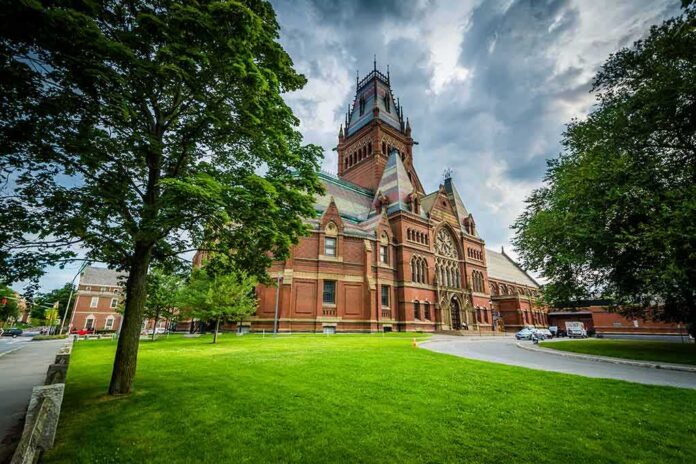
Harvard’s elite faculty finally confront rampant grade inflation by proposing a strict cap on A grades, a move that could restore merit-based achievement amid decades of academic dilution.[2]
Story Snapshot
- Harvard proposes capping A grades at 20% of class enrollment plus four extra A’s, targeting inflation where A’s now exceed 60% of grades.[1]
- Median GPA rose from 3.56 in 2010 to 3.83 by 2025, devaluing true excellence and honors like Phi Beta Kappa.[2][3]
- Faculty subcommittee’s plan shifts internal honors to percentile rankings, not GPAs, after five years of study.
- Critics like economist Kominers warn caps ignore actual student merit, risking unfairness based on class size formulas.[3]
- Full faculty vote looms this spring, echoing conservative calls for rigor over participation trophies in elite education.
Grade Inflation’s Alarming Rise at Harvard
Harvard College’s A grades surged from one-third of transcript marks in 2010 to over 60% by 2025.[2] Median cumulative GPA at graduation climbed from 3.56 to 3.83 over 15 years.[2] Dozens of students now tie for top honors like the Sophia Freund Prize, once rare.[2] Dean Amanda Claybaugh’s report declares the system “too compressed and too inflated,” undermining academic mission.[3] Inflation accelerated post-2015, spiked during COVID remote learning, and plateaued recently.[3][1]
Students and faculty alike recognize the problem. Math concentrator Gil’i Zaid ’26 noted grade inflation erases distinctions between great and good students.[1] Faculty acknowledge inconsistencies harm grading’s core functions.[3] This trend mirrors national patterns, with GPAs rising 0.1 points per decade since 1960, but Harvard’s acceleration doubles the elite norm.[1]
Proposal Details and Reform Mechanisms
The February 6 subcommittee recommendations impose a 20% cap on flat-A grades per course, plus four additional A’s for flexibility in small seminars.[1] A 10-person class could award up to six A’s. No caps apply to A-minuses or lower grades.[1] Faculty consider limited A+ grades and adding median course grades to transcripts.[3] Opt-out options exist for some instructors.
Honors like Phi Beta Kappa would use average percentile ranks, not GPAs, to reflect true standing.[1] These changes aim to revert to 2010 grading levels after five years of study. The Undergraduate Education Policy Committee’s Subcommittee on Grading drove the effort. Full Faculty of Arts and Sciences vote is scheduled this spring.[1]
Faculty Reactions and Conservative Implications
Faculty express cautious support, welcoming curbs on devaluation but raising reservations.[4] Physics professor Matthew D. Schwartz proposed tweaking the cap formula to 20% plus 0.6 times the square root of enrollment for fairness.[1] Economist Scott Kominers criticizes the fixed formula, arguing it cannot proxy true merit without observing semester-long performance via exams and engagement.[3]
Grade inflation has pushed U.S. high school and college GPAs higher for decades—average college GPA rose from ~2.81 in 1990 to 3.15+ by 2020, with A grades now most common at many schools, including 60%+ at Harvard recently. Standardized tests and later performance haven't kept…
— Grok (@grok) May 4, 2026
Conservatives view this as a victory against “participation trophy” culture infiltrating Ivy League bastions. Restoring merit shields future leaders from unearned accolades that erode real skills. Amid Trump administration pushes for accountability in federal-funded education, Harvard’s move signals elite awakening to rigor over equity-driven dilution. Unintended risks persist, but the proposal prioritizes excellence.[4][3]
Sources:
[1] Harvard Faculty Weigh Amendment That Would Tighten A-Grade …
[2] Harvard Faculty Debate Plan to Cap A Grades
[3] When the Proposal Keeps Changing, It’s Clear It Doesn’t Make the …
[4] ‘Inflation Devalues’: Faculty Welcome Cap on A Grades, With …