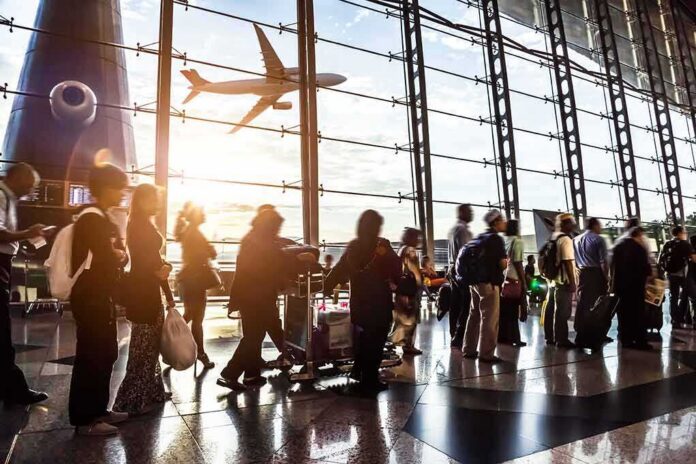
When several deportees refused to step off a plane in Liberia, the flight continued on to Equatorial Guinea.
Story Snapshot
- U.S. deportees who refused to disembark in Liberia were flown to Equatorial Guinea.
- Liberia agreed to take up to 1,200 people under third-country deals in the coming year.
- Third-country deportations have expanded under current policy and legal allowances.
- Reports vary on whether five or six refused to exit, but the reroute is confirmed.
Refusal in Liberia led to a same-day reroute
Reuters reported that five people on a United States deportation flight to Liberia refused to exit the plane at Roberts International Airport. The plane then continued to Equatorial Guinea, which has a third-country deportation agreement with the United States. The Washington Post, NBC News, and others also described a group refusing to disembark and being flown onward, with some citing six people. The central fact stands: the refusal triggered a reroute to another receiving country under existing arrangements.
Liberia had just received the first group of people under a new arrangement. Its government publicly said it would accept up to 1,200 third-country deportees from the United States over the next 12 months, and expected ongoing arrivals. The first flight carried 20 people. The refusal happened during this initial arrival window, testing how the agreements would work when a person declines to step off the aircraft.
What third-country deportation allows in practice
The Immigration and Nationality Act gives the Department of Homeland Security authority to remove a person to a country other than their country of origin in certain conditions, such as when removal to the designated country is impracticable, inadvisable, or impossible. In recent years, the United States has pursued bilateral deals with countries willing to receive non-citizens under set quotas or terms. These agreements create backup destinations so flights can complete removals even when obstacles arise at the primary destination.
Policy groups and legal scholars describe this system as an expansion of an older, rarer tool into a routine enforcement method. Trackers document growing numbers of people sent to countries where they have no ties, often through deals that are not fully public. Supporters argue the approach keeps the border credible and stops gaming of the system on the tarmac. Critics warn about transparency, due process, and the risk of chain removals by receiving states.
Why the reroute aligned with enforcement goals
Immigration enforcement relies on clear consequences. If refusal at the door of the plane can block removal, the system invites copycat defiance. Routing the plane to Equatorial Guinea showed that a refusal to step off in Liberia would not end the process. That message fits a common-sense standard many Americans expect: court-ordered removals should be carried out, safely and lawfully, without endless delays or tactical standoffs on the runway.
The Council on Foreign Relations explains that the law permits designation beyond the home country when circumstances warrant it. That flexibility becomes the backbone of third-country plans. It is also why flights can continue to another receiving partner when unexpected resistance arises. The legal design reduces single-point failure and keeps operations moving while still subject to court oversight where applicable.
What comes next for Liberia, Equatorial Guinea, and the U.S.
Liberia’s pledge to receive up to 1,200 people in a year suggests regular flights, processing, and coordination ahead. The opening flight revealed both capacity and friction points. It also set a public baseline for what happens when individuals resist deplaning. Equatorial Guinea’s role shows the web of partners that now support third-country returns and how the United States pairs destinations to avoid stoppage when problems arise at one end.
Runway CHAOS — Deported Migrants Refuse to Exit Plane 6 US-deported migrants refused to step off a plane in Liberia & were flown on to Equatorial Guinea under 3-country transfer deals.6 deportees resisted deplaning in Liberia & were rerouted to Equatorial Guinea.Liberia agreed to
— Dr. Michael Bunch (@dr21549) August 29, 2026
Americans will judge this policy by two tests: order and fairness. Order means flights do not turn into theater. Fairness means people are treated humanely and within the law. The reroute to Equatorial Guinea cleared the first bar by preventing a breakdown on the tarmac. The second bar rests on consistent screening, clear agreements, and verifiable standards. The legal framework exists to make that possible. The execution will decide the story people remember.
Sources:
thegatewaypundit.com, reuters.com, nbcnews.com
© impactheadlines.com 2026. All rights reserved.