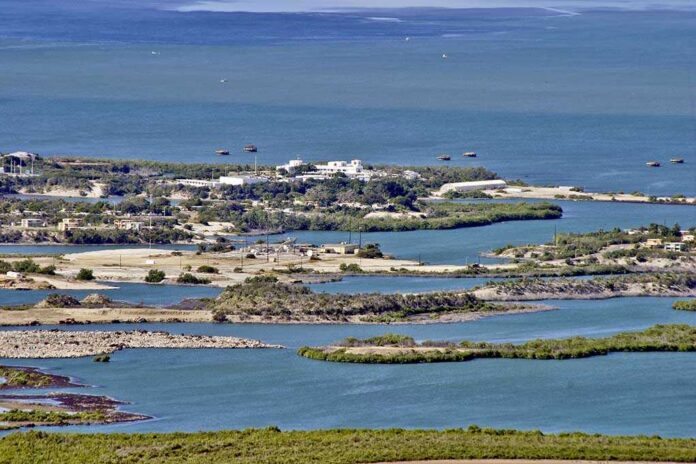
A fully armed 3.8-megaton hydrogen bomb, capable of obliterating a city, lies buried in Georgia’s coastal waters 68 years after a U.S. Air Force blunder—and the Trump administration must address whether it’s a ticking threat or government neglect.[1][2]
Story Snapshot
- On February 5, 1958, a B-47 bomber collided mid-air with an F-86 fighter and jettisoned a 7,600-pound Mark 15 nuclear bomb into Wassaw Sound near Tybee Island, Georgia.[1][2]
- The Air Force conducted a 10-week search with divers, sonar, and drag detectors but declared the bomb irretrievably lost on April 16, 1958, likely buried under 5-15 feet of silt.[6][2]
- 1966 congressional testimony confirmed the bomb as a complete weapon with a plutonium nuclear capsule, contradicting earlier claims of a dummy device.[1]
- 2001 and 2004 investigations located the site and dismissed radiation concerns as natural, but no recovery occurred, fueling ongoing public distrust.[2][5]
The 1958 Mid-Air Collision and Bomb Jettison
On February 5, 1958, during a Cold War training exercise off Georgia’s coast, a U.S. Air Force B-47 Stratojet bomber collided with an F-86 Sabre fighter jet at 32,000 feet. The B-47, piloted by Major Howard Richardson, carried a Mark 15 hydrogen bomb weighing 7,600 pounds with 400 pounds of conventional high explosives and highly enriched uranium. The collision destroyed the fighter—its pilot ejected safely—but crippled the bomber.[2][3]
Richardson attempted three landings at Hunter Army Airfield near Savannah but faced risks of a conventional explosion from the damaged aircraft. Air traffic controllers authorized jettisoning the bomb into shallow waters of Wassaw Sound, north of Tybee Island, at coordinates 32°0′N 80°51′W. The crew landed safely, but the bomb vanished into the seabed.[5][6]
Intensive Searches Yield No Recovery
The day after the incident, an Air Force-Navy-Coast Guard team launched a secretive 10-week search using the 270th Explosive Ordnance Disposal Squadron, 100 Navy personnel, hand-held sonar, galvanic drag detectors, and cable sweeps. Bad weather and poor visibility hampered efforts. On April 16, 1958, the Air Force declared the bomb irretrievably lost, hypothesizing burial under 10-15 feet of silt and mud.[6][4]
In 2001, following inquiries from locals and Congressman Jack Kingston, a hydrographic survey pinpointed the bomb under 5-15 feet of silt in Wassaw Sound. The Air Force report concluded that if intact, its explosives posed no hazard, recommending no recovery to avoid disturbance. A 2004 interagency team revisited after civilian radiation claims but found no cause for action.[2][5]
Disputes Over the Bomb’s True Nature and Risks
The Mark 15 bomb had a potential yield of 3.8 megatons—190 times the Nagasaki bomb’s power. Initial reports described it ambiguously, but 1966 testimony from Assistant Secretary of Defense W.J. Howard called it a “complete weapon” with a nuclear capsule and plutonium trigger, one of two such losses.[1][2] Howard later recanted, claiming error, while the Air Force maintains it lacked a plutonium pit, rendering it non-nuclear but still radiologically hazardous.[3]
Retired Lt. Col. Derek Duke detected radiation 7-10 times normal one mile offshore in 2004 after a five-year private search, prompting the interagency review. Officials attributed readings to natural seabed minerals without releasing raw data. No deep-sea imaging, core sampling, or independent verification has confirmed the bomb’s condition after 68 years in saltwater silt.[5][2]
This incident fits a Cold War pattern of 32 “Broken Arrow” nuclear mishaps, 11 lost at sea. Public skepticism persists amid absent 1958 search logs and unverified risk models. Under President Trump’s second term, with its focus on military accountability and transparency, patriots demand FOIA releases, ROV inspections, and spectrometry to end the mystery—protecting coastal families from potential government overreach in dismissing real dangers.[6][1]
Sources:
[1] Web – 1958 Tybee Island mid-air collision – Wikipedia
[2] Web – Fact Sheet: The Missing Tybee Bomb
[3] Web – Tybee Island Bomb – Low Country Drifters
[4] YouTube – American nuclear bomb lost off the coast of Tybee Island in Georgia …
[5] Web – Interagency Team Checking for H-Bomb Lost in 1958 – DVIDS
[6] Web – ‘Tybee Island bomb’ still rests in depths of Wassaw Sound