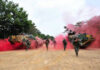
Iran’s latest drone and missile barrage on Bahrain, paired with a tanker attack in the Strait of Hormuz, shows just how quickly a “retaliation” campaign can put American forces, global energy supplies, and innocent civilians in the crosshairs.
Story Snapshot
- Iran launched drones at Bahrain and a ship was attacked in the Strait of Hormuz after U.S. airstrikes on Iranian targets.
- Tehran claims it is “defending itself” and targeting U.S. military sites, but Gulf states report hits on civilian infrastructure and energy facilities.
- Bahrain and Arab allies condemn the strikes as aggression that violates sovereignty and threatens citizens.
- The pattern of tit-for-tat attacks is eroding a fragile ceasefire and raising risks for U.S. forces, global trade, and regional stability.
Iran Hits Bahrain After U.S. Strikes, Tanker Attacked In Strait
Officials say Iran launched a drone assault against Bahrain on Saturday, only hours after overnight U.S. airstrikes on Iranian missile, drone, and radar sites along the Gulf coast. Bahrain’s foreign ministry reported that “a number of Iranian drones” targeted the kingdom and called the attack a clear threat to the safety of citizens and residents. Around the same time, a tanker traveling through the Strait of Hormuz was attacked, though its crew was reported safe and no major spill or damage was immediately reported.
U.S. Central Command said its earlier strikes were aimed at Iranian military surveillance, communications, air defense, and mine‑laying facilities, and were a direct response to attacks on commercial shipping in the strait. Iran’s Revolutionary Guard quickly cast its own actions as payback, claiming it had targeted sites tied to what it called the “U.S. terrorist army in the region.” That framing fits Tehran’s broader message in the 2026 Gulf war: Iran insists it is hitting American bases, while neighbors say their territory and civilians are bearing the brunt.
From “Retaliation” To Civilian Damage And Energy Shock
Since late February, Iran has carried out waves of missile and drone strikes on Bahrain, hitting districts in Manama and areas near the U.S. Navy Fifth Fleet headquarters, as well as other infrastructure. Reporting and rights groups say these strikes have killed and injured civilians and damaged homes, hotels, airports, and refineries across Gulf Cooperation Council countries. In one Bahraini incident, drones slammed into an oil refinery operated by Bapco Energies, damaging a storage tank, sparking a fire, and forcing the company to declare force majeure on energy commitments.
Bahrain’s partners in the Gulf Cooperation Council have condemned the attacks as systematic targeting of civilian sites and critical infrastructure, accusing Iran of trying to undermine efforts to stabilize the region. Amnesty International has warned that lethal Iranian drone strikes on Bahrain and Saudi Arabia may amount to war crimes, pointing to repeated hits on civilian infrastructure and neighborhoods. For American readers, this means Iran is not just challenging U.S. military posture; it is also striking the energy and water systems that keep ordinary families in the Gulf going.
Iran Claims Self‑Defense, But Bahrain Says Its Sovereignty Is Under Fire
Iran’s foreign ministry and Revolutionary Guard argue that their operations are “defensive” and lawful responses to what they call U.S. and Israeli aggression, including strikes on Iranian ports, cities, and even a desalination plant on Qeshm Island. Tehran says it is aiming at U.S. radar, air defense systems, missile batteries, and bases in Bahrain and Kuwait, and has publicly tied several attacks to previous American raids. This is classic Iranian messaging: present every strike as protecting “sovereignty,” even when drones are crossing borders and hitting facilities in other nations.
Bahrain, by contrast, has told the United Nations that it is “an independent sovereign nation that is not a party to any conflict” and rejects Iran’s claim that hitting its territory is legitimate retaliation. Bahraini officials say Iranian drones have struck residential buildings and damaged a water desalination plant, calling the attacks indiscriminate and a violation of international humanitarian law. For conservatives who care about national sovereignty and clear borders, this dispute highlights a hard truth: Iran is trying to rewrite the rules by calling cross‑border strikes on neighbors an extension of its own self‑defense.
Risks For U.S. Forces, Global Trade, And American Energy Bills
Iran’s strikes on Bahrain matter directly to the United States because the kingdom hosts the U.S. Navy’s Fifth Fleet, a key hub for keeping sea lanes open in the Gulf. Tehran and state media have boasted of attacks on air defense systems, radar sites, and facilities they claim support U.S. operations, including reports of damage to an Amazon Web Services data center tied to American military networks. Although some of those claims are still being verified, the message from Iran is clear: U.S. bases and linked infrastructure in the region are prime targets if Washington keeps hitting Iranian territory.
Daily intel brief — July 26, 2026
Bottom line: US forces launched strikes across Iran including near the Caspian Sea after Iran and Houthi forces extended attacks to the Red Sea, drawing Iranian missile and drone retaliation on US bases in Bahrain, Jordan, and Kuwait.
1.…
— Monitor the Situation (@MTS_alerts) July 26, 2026
The immediate effect is a spike in risk for commercial shipping through the Strait of Hormuz, one of the world’s most important energy chokepoints. Tanker traffic has already been disrupted by repeated attacks and interceptions, and financial analysts warn that the largest wave of strikes since the recent peace agreement is adding new pressure on bond markets and global energy prices. For American families already squeezed by past inflation and high energy costs, a prolonged crisis in the Gulf could mean higher gas, heating, and food prices at home, even as U.S. forces work to keep trade routes safe.
Sources:
military.com, en.wikipedia.org, apnews.com, usnews.com, aljazeera.com, youtube.com, iranintl.com, arabnews.com, cbc.ca
© impactheadlines.com 2026. All rights reserved.