A brazen arson attack forced a Texas family to flee their burning home in the dead of night while the suspect remains free, reigniting concerns about community safety and law enforcement’s ability to protect law-abiding Americans.
Story Snapshot
- A Texas family of six, including two children, survived a targeted arson attack while they slept; the arsonist remains at large.
- The mother’s public statement to the perpetrator highlights the trauma and fear that now drive the family’s decision to relocate.
- Rising arson rates, especially in poorer neighborhoods, expose longstanding failures in public safety and community protection.
- Experts link arson risk to socioeconomic decline, undermining both neighborhood stability and fundamental American values of security and homeownership.
Deliberate Arson Attack Sparks Fear and Displacement
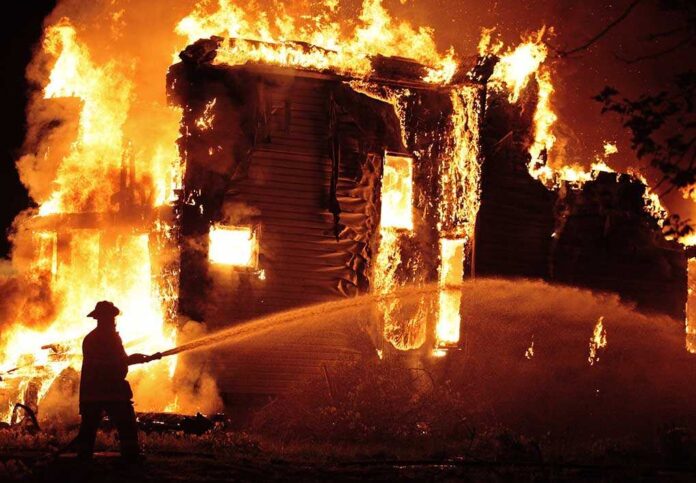
A Texas family of six, including two young children, narrowly escaped with their lives after their home was deliberately set ablaze while they slept. The crime, committed by a hooded arsonist in the middle of the night, left the family traumatized and prompted the mother to publicly confront the perpetrator. Her statement accused the arsonist of attempting to kill her family, underscoring the intent behind the crime and the overwhelming sense of vulnerability felt by those targeted. The family’s immediate response has been to announce plans to move, a direct result of the ongoing threat and unresolved fear that lingers with the arsonist still at large.
Law enforcement and emergency services responded quickly, but the suspect escaped, leaving the investigation open and the community on edge. The incident reflects a disturbing national trend: arson remains a persistent threat to residential safety, with an estimated 267,000 cases annually across the United States, causing $1.4 billion in property loss, thousands of injuries, and hundreds of deaths each year. Most concerning for many families is the fact that occupied homes—especially in lower-income neighborhoods—are increasingly targeted, exposing the limits of current public safety measures and highlighting the challenges faced by law enforcement in both prevention and prosecution.
Socioeconomic Decline and Community Vulnerability
Research consistently points to a strong correlation between high rates of arson and socioeconomic decline. Factors such as poverty, neighborhood disorganization, and urban density significantly increase the risk for residential arson. While vacant and abandoned buildings are frequent targets, families in occupied homes are not immune, particularly in communities already struggling with economic hardship. This dynamic erodes not just property values but also the very fabric of local communities, leading to higher rates of displacement, social disruption, and a breakdown of trust among neighbors. Residents are left feeling abandoned by the institutions meant to protect them, fueling frustration with government overspending, failed urban policies, and a lack of accountability for repeat offenders.
The ongoing trauma experienced by arson victims extends far beyond property loss. Survivors face immediate dangers—such as injury or even death—as well as lasting psychological scars and financial hardship from displacement and rebuilding. As families like the one in Texas are forced to move, communities lose stability and cohesion. These outcomes directly contradict the core conservative value of safeguarding family and home, further driving calls for stronger enforcement, tougher penalties, and policies that prioritize the rights and safety of law-abiding citizens over leniency for criminals.
Law Enforcement, Policy Gaps, and the Fight for Security
The persistent challenge in apprehending arsonists and preventing future attacks reveals critical gaps in law enforcement resources and policy effectiveness. Despite the implementation of various legislative and policing efforts, many communities—especially those already under strain from economic decline—remain exposed to serious crime. Data from the U.S. Fire Administration and the National Institute of Justice highlights that African American and Hispanic communities, as well as impoverished neighborhoods, are disproportionately affected. This raises urgent questions about equal protection under the law and the allocation of public safety resources.
Experts argue that effective prevention requires more than just reactive policing. A combination of targeted law enforcement, legislative reform, and robust community support is necessary to address both the causes and consequences of residential arson. Some advocate for increased social services and neighborhood revitalization, while others emphasize stricter penalties, expedited investigations, and support for property owners and victims. What remains clear is that without decisive action, the cycle of fear, displacement, and vulnerability will persist, undermining the basic rights and freedoms that define American life.
Texas family of 6, including 2 children, narrowly escape house fire set by hooded arsonist … – https://t.co/tdCDzr3YMx #GoogleAlerts
— MOIZ ESUFALLY (@moizesufally) August 18, 2025
As the Texas family’s ordeal demonstrates, the threat of arson is not abstract but personal and immediate. Their experience is a stark reminder that the ability to live securely in one’s own home is fundamental to American liberty. For many, the unresolved case is yet another example of government overreach in some areas and neglect in others—leaving law-abiding families to bear the brunt of failed policies and ineffective enforcement. Until communities see real change, concerns over safety, constitutional rights, and the protection of traditional family values will only intensify.
Sources:
Arson in Chicago: Patterns and Correlates
USFA – Arson – Volume 1, Issue 8
Arson: Measurement, Analysis, and Prevention
Arson: Measurement, Analysis, and Prevention – Executive Summary