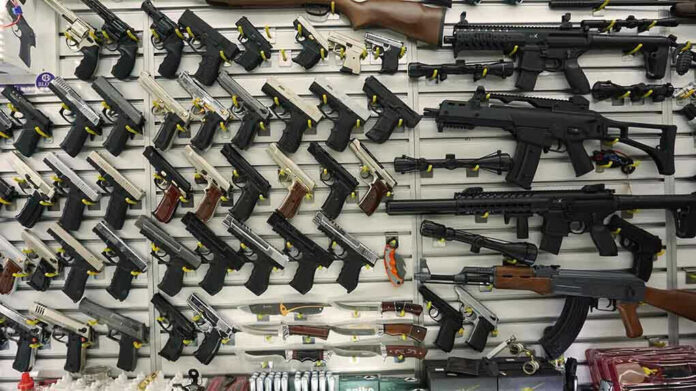
Virginia’s attempt to limit “assault firearms” ignited a buying boom that could flood the very market the law aims to drain [1][2][3].
Story Snapshot
- Background checks more than doubled in May as buyers raced the July 1 deadline [1][2][3]
- Governor Abigail Spanberger framed the ban as a public-safety shield for families and police [2][3]
- Retailers say the rule touches most of their shelves, not a niche corner of the market [2]
- At least ten prosecutors reportedly refuse to enforce the measure, signaling patchwork application [1][3]
What Virginia’s Ban Actually Does And When It Bites
Virginia’s new statute prohibits the sale, purchase, transfer, import, or manufacture of defined “assault firearms” beginning July 1, while leaving most current owners untouched for simple possession [2][3]. The measure also restricts magazines capable of holding more than 15 rounds, extending the reach beyond a single rifle platform [2][3]. Supporters cast the law as a future-focused filter, designed to choke off supply without mass confiscation. That design elevates the political optics of restraint yet concedes little change to today’s gun stock [2][3].
Governor Abigail Spanberger said firearms “designed to inflict maximum casualties do not belong on our streets,” linking the ban to family and law-enforcement protection [2][3]. That framing echoes other states; at least eleven states and Washington, D.C., already restrict sales of certain semi-automatic firearms, though details vary [2][3]. The novelty here is not the concept but the timing and scope in a gun-saturated state where year-to-date background checks already ran high. The political bet is that throttling new retail commerce reduces tomorrow’s risk [2][3].
The Pre-Ban Rush That Scrambles The Narrative
Virginia logged 72,956 firearm background checks in May, more than double the prior-year month, as buyers raced to beat the cutoff [1][2][3]. Fox News cited 75,376 for May using a similar state data window, reinforcing the same surge dynamic from a separate tally [1]. That wave looks less like contraction and more like acceleration, at least in the short term. When policy targets tomorrow’s shelf, the public often empties today’s. That pattern complicates claims of near-term harm reduction even if long-run goals hold [1][2][3].
Retail counter evidence sharpened the scope debate. One dealer estimated the law would affect about 65 percent of his inventory; another put it near 90 percent—claims that underscore how the feature list and magazine limit reach ordinary configurations, not just exotic rifles [2]. Those are shop-level estimates, not a statewide audit, so they should be treated as directional rather than definitive. Yet they illuminate who feels the immediate pinch: mainstream retailers and buyers, not fringe collectors [2].
Enforcement Realities And A Test Of Uniformity
At least ten Commonwealth’s Attorneys publicly signaled they would not enforce the new rules, setting up a county-by-county map of friction rather than consistency [1][3]. Laws that lean on retail chokepoints still hinge on prosecutors to bring charges against violators. Selective prosecution blunts deterrence and invites forum shopping. Supporters may argue courts, not press releases, will decide the law’s fate. That is correct as a legal matter, but the on-the-ground signal to consumers and dealers remains fractured [1][3].
Virginia gun sales spike ahead of July 1 assault weapons ban signed by Gov. Spanberger https://t.co/nDMRDgJNzd #FoxNews
— phx_reader (@ReaderPhx) June 6, 2026
Supporters assert that limiting future sales and high-capacity magazines reduces the potential lethality of mass shootings; critics counter that criminals mainly ignore commerce controls, while existing owners keep their stock. The provided record confirms the policy’s intent and structure but does not supply Virginia-specific outcome data tying this exact approach to reductions in homicide or mass-casualty events [1][2][3]. Common-sense conservatism asks for results: if you redesign a market to save lives, produce metrics that prove it worked, not just rhetoric that it should.
What To Watch After July 1
Three benchmarks will reveal whether the law shifts safety or just sales timing. First, background-check and sales trends: a post-deadline dip that persists beyond the initial spike would indicate real supply restriction, while stable or rising transaction proxies would suggest displacement. Second, trafficking and seizure patterns: fewer newly manufactured, feature-defined firearms in crime guns would validate the retail choke. Third, enforcement consistency: statewide charging data will show whether local resistance is symbolic noise or a structural gap [1][2][3].
Sources:
[1] Web – Virginia gun sales spike ahead of July 1 assault weapons ban signed by …
[2] Web – Virginia sees surge in gun sale background checks ahead of July 1 …
[3] Web – Virginia sees surge in gun sale background checks ahead of July 1 …
© impactheadlines.com 2026. All rights reserved.