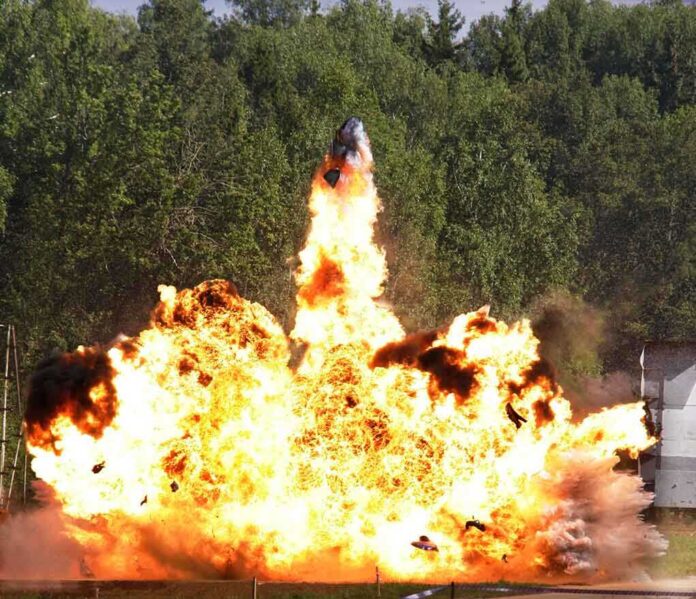
A $20 million U.S. Air Force Thunderbirds F-16C Fighting Falcon crashed in a massive fireball near Death Valley, but America’s military training and safety systems proved their worth when the pilot successfully ejected and survived with only minor injuries.
Story Highlights
- Thunderbirds F-16C fighter jet crashed on dry lake bed near Death Valley on December 3, 2025
- Pilot successfully ejected from $20 million aircraft and sustained only minor injuries
- Dramatic crash captured on video and shared across social media platforms
- Investigation ongoing by China Lake Police and Naval Air Weapons Station China Lake
Thunderbirds Pilot Survives Catastrophic Aircraft Loss
On Wednesday morning, December 3, 2025, an F-16C Fighting Falcon operated by the U.S. Air Force Thunderbirds crashed on a dry lake bed adjacent to Trona Airport in San Bernardino County, California. The San Bernardino County Sheriff’s Office received the crash report at 10:28 a.m. local time. Despite the complete loss of the $20 million aircraft in a dramatic fireball, the pilot’s successful ejection and minor injuries demonstrate the effectiveness of American military safety systems and training protocols.
The Thunderbirds, officially known as the 16th Weapons Squadron, represent America’s premier aerial demonstration team and have maintained an excellent safety record since beginning operations in 1953. These elite pilots regularly perform high-speed maneuvers and precision flying that push F-16C aircraft to their operational limits during demonstration tours across the United States and internationally.
Remote Desert Location Aids Pilot Survival
The crash occurred in a remote desert region near Death Valley, with the aircraft coming down on a dry lake bed that provided a relatively open landing surface. This terrain likely contributed to favorable conditions for the pilot’s successful ejection and survival. The remote location of Trona Airport, while extending emergency response times, meant the incident posed no threat to civilian populations or infrastructure.
Video footage of the dramatic crash was captured and shared online, showing the moment of impact and resulting fireball. The daylight timing allowed for clear documentation of the incident, which is now being analyzed as part of the ongoing investigation. The pilot was transported to a hospital in Ridgecrest for evaluation of minor injuries, demonstrating the remarkable effectiveness of modern ejection systems.
Investigation Focuses on Operational Safety
The China Lake Police Department and Naval Air Weapons Station China Lake are conducting the investigation into the crash. As of December 4, 2025, the cause remains undetermined, with investigators analyzing aircraft wreckage and video evidence. The investigation will determine whether operational changes or safety protocol updates are necessary to prevent future incidents.
US military plane goes down in massive plume of black smoke in Death Valley #news https://t.co/MuqNQyExU7
— Filtered News (@filterednews) December 3, 2025
This incident stands in stark contrast to other 2025 aviation disasters, including the January 29 midair collision between American Airlines Flight 5342 and a military helicopter over the Potomac River that resulted in 67 fatalities. The Thunderbirds crash demonstrates how proper training, equipment maintenance, and safety systems can turn potential tragedy into a survivable incident that preserves our military’s most valuable asset – its personnel.
Sources:
Video Shows US Military Plane Crash Near Death Valley
Deadly Plane Crashes 2025 Timeline
Video Shows US Military Plane Crash Near Death Valley