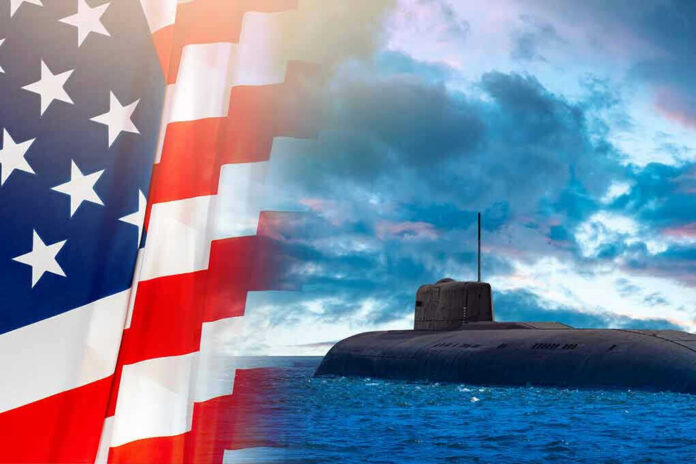
America’s next-generation attack submarine program has been pushed back a full decade to 2040, jeopardizing undersea dominance while China races ahead in submarine production at nearly double our pace.
Story Snapshot
- Navy’s SSN(X) submarine procurement delayed from mid-2030s to 2040 due to industrial base constraints and skyrocketing costs reaching $6.7-8 billion per vessel
- China produces submarines at nearly twice the U.S. rate while America’s two shipyards struggle with backlogs from Columbia and Virginia-class programs
- FY2026 requests over $600 million for research and development despite production being 14 years away, raising concerns about acquisition mismanagement
- Secretary of Defense Pete Hegseth targets the delays as emblematic of dysfunctional Pentagon acquisition processes needing immediate reform
Pentagon Acquisition Failures Strike Again
The Navy’s SSN(X) next-generation nuclear attack submarine has become the latest casualty of bureaucratic dysfunction plaguing defense procurement. Originally slated for production in 2031, the program now targets first procurement in fiscal year 2040—a stunning nine-year slip that underscores the kind of government inefficiency Americans have grown tired of watching. Despite requesting between $222.8 million and $623 million for FY2026 research and development, the Navy admits costs are rising faster than inflation while schedules slide one to three years behind projections. This pattern repeats itself across multiple programs, wasting taxpayer dollars while adversaries surge ahead.
The U.S. Navy’s $8 Billion SSN(X) Stealth Submarine Is Now a Giant Headachehttps://t.co/Jntbi6oizG
— 19FortyFive (@19_forty_five) January 25, 2026
Industrial Base Collapse Threatens Naval Superiority
America’s submarine manufacturing capacity has become a critical chokepoint threatening national security. Only two shipyards—General Dynamics Electric Boat and Huntington Ingalls Industries Newport News—can build nuclear submarines, and both operate beyond sustainable capacity. The Navy prioritized Columbia-class ballistic missile submarines in 2019, forcing Virginia-class attack submarines into backlogs exceeding one submarine per year versus required production rates. This bottleneck directly delayed SSN(X), which aimed to blend Virginia-class stealth with Seawolf-class payload capacity, electric drive systems, and advanced sensors. China exploits this weakness, building submarines at rates approaching two vessels for every 1.4 American submarines produced, steadily eroding the undersea advantage that has protected American interests for decades.
Eight Billion Dollar Question Demands Answers
Estimated unit costs of $6.7 to $8 billion per SSN(X) submarine—double the $4 billion Virginia-class price tag—raise fundamental questions about program viability and Pentagon spending priorities. Congressional committees demand clarity on capabilities, budgets, and controversial reactor fuel choices between low-enriched uranium and highly enriched uranium. LEU proponents argue nonproliferation benefits justify potential cost increases, while critics warn against compromising performance for political optics. Brett Seidle, Acting Assistant Secretary of the Navy for Research, Development and Acquisition, testified that costs outpace inflation while schedules collapse. These aren’t just numbers on spreadsheets—they represent real capability gaps against peer competitors like Russia and China operating advanced submarine fleets in contested waters.
Reform or Lose Undersea Dominance
Secretary Hegseth’s push for acquisition reform directly targets the arcane processes strangling SSN(X) and similar programs. The submarine aims for full-spectrum undersea warfare capabilities including quantum technology, directed energy weapons, additional torpedo tubes, and unmanned underwater vehicle coordination across a 10,000-ton displacement hull. However, remaining trapped in concept refinement and risk-reduction phases while production slips to 2040 guarantees capability gaps lasting through the 2040s. The Navy’s 30-year shipbuilding plan aspires to a 296 to 381 ship fleet, but achieving undersea superiority requires functioning acquisition systems, robust industrial capacity, and congressional commitment to fund programs through completion. Without immediate reforms breaking bureaucratic logjams and expanding shipyard capacity, America risks ceding undersea dominance to adversaries who won’t hesitate exploiting our self-inflicted delays.
Sources:
The U.S. Navy’s $8 Billion SSN(X) Stealth Submarine Is Now a Giant Headache – 19FortyFive
The U.S. Navy’s $132 Billion Columbia-Class Submarine Is Now a Giant Headache – 19FortyFive
The SSN(X) Stealth Nuclear Attack Submarine Is a Giant Headache for the U.S. Navy – 19FortyFive
U.S. Navy’s Next Generation SSN(X) Attack Submarine Delayed Until 2040 – Defence Industry Europe
Navy’s Next-Generation Submarine Program Faces Alarming Delay to 2040 – Fox News
Report to Congress on SSN(X) Next-Generation Submarine – USNI News
Navy SSN(X) Next-Generation Attack Submarine Program – Congressional Research Service
Navy’s Top Admiral Eyes Modular Construction to Speed New Frigate Construction – The War Zone