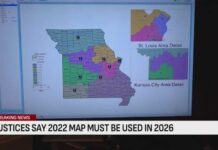
In Missouri’s redistricting fight, the decisive question was not whether the map advantaged one party, but who controls the switch that turns a map into binding law when citizens invoke the referendum power; the courts answered that question squarely, and the answer reorders the state’s playbook for power and process.
The Short Version
- Missouri’s highest court affirmed that the General Assembly may redraw congressional districts mid-decade — but that authority sits alongside the people’s right to seek a veto by referendum when the legislature does not insulate a map from that process.
- A lower court briefly allowed the Trump-backed map to proceed and rejected referendum challenges; the Missouri Supreme Court later rejected those theories and upheld use of the referendum pathway in this context, reshaping the immediate election calendar.
- The conflict exposed a tactical frontier of modern redistricting: timing, emergency clauses, and certification power can determine which map governs when litigation and petitions collide.
- For campaigns and voters, the ruling clarifies a principle with national relevance: where state constitutions preserve robust referendum rights, redistricting is not final until the people’s veto window closes or is lawfully foreclosed.
What this case was really about: authority, not line-drawing
Redistricting disputes are often framed as battles over partisan geometry — which neighborhoods get split, who gets a safer seat — but the Missouri saga hinged on institutional design. The legislature enacted a new congressional map during the decade, a practice the Missouri Supreme Court said the state constitution permits because it contains no prohibition against mid-cycle redistricting. That was only the first question. The second was whether the people’s referendum power — a constitutional mechanism that allows voters to approve or reject non-emergency statutes — reaches a congressional redistricting law that lacks an emergency clause. The lower court said no and briefly greenlit the new map for the upcoming election; the state high court later rejected that position and sustained the use of the referendum pathway here, altering which map could be used while voters decide.
That pairing of holdings matters. It leaves the legislature’s structural authority intact while reaffirming a parallel, time-limited check by the electorate when lawmakers do not insulate a measure from referendum. In practical terms: maps can be redrawn mid-decade, but they are not beyond a popular veto when enacted as ordinary legislation.
How the mechanism works: emergency clauses, certification, and the referendum clock
Missouri’s referendum framework functions as a temporary brake on non-emergency statutes. If citizens collect sufficient signatures within the statutory window, the targeted law is suspended and submitted to a statewide vote — unless an emergency clause lawfully places it beyond referendum. The friction point is administrative: secretaries of state certify petitions, and delays or denials can run out the clock and effectively decide which rules govern the oncoming election. That is why the Missouri litigation focused so sharply on whether redistricting is even a referendable “act,” whether the petition was timely and sufficient, and whether election officials could proceed as though the petition were a nullity. The lower court concluded the referendum did not apply and allowed the map; the Missouri Supreme Court later resolved the legal questions in favor of the referendum pathway and against administrative foot-dragging.
This is not a parochial quirk. Across states with direct democracy, the choice to attach an emergency clause, the timing of petition review, and the calendar realities of ballot printing dictate which legal defaults lock in. Scholars long ago noted that, in redistricting, institutional rules often shape outcomes more than cartographic details; Missouri’s case is a textbook demonstration.
The competing arguments — and why one prevailed
Supporters of the Trump-backed plan advanced two core contentions. First, they argued the map was enacted lawfully and, absent explicit constitutional language to the contrary, should remain operative through the election cycle; second, they maintained that Missouri’s referendum provisions do not reach congressional redistricting at all, rendering the petition campaign legally irrelevant. The Cole County circuit court agreed and held that the referendum process could not be used to challenge maps legislatively enacted, keeping the plan in force for the election at hand.
On review, the Missouri Supreme Court drew a different line. Earlier in the year, it had already held the mid-decade enactment itself permissible. But on the referendum question, it concluded that, when the legislature passes a map as ordinary legislation without an emergency clause, the people’s referendum power applies; that meant the referendum process could suspend the new map’s operation and send the question to voters, with the prior map governing in the interim. This resolution preserved legislative prerogative while reaffirming the constitutional check of popular review — a balance consistent with Missouri’s text and with broader state constitutional practice.
Consequences for parties, campaigns, and voters
For party strategists, the ruling underscores a blunt operational lesson: if a majority intends a map to govern immediately, it must either attach a valid emergency clause or absorb the risk of a referendum pause. For election administrators, it is a warning against relying on certification delays as a policy lever; high courts are increasingly skeptical of clock-management tactics that erode direct-democracy guarantees. And for voters, the outcome reaffirms that signature drives, when successful, do more than place a question on the ballot — they can restore the status quo ante while the electorate decides.
The national import is larger than a single state’s lines. As more states experiment with mid-decade map changes, the Missouri framework will be cited in litigation and legislative drafting: the people’s veto is not a symbolic flourish but an operative power with immediate effect on which map governs pending a vote. That message, backed by a state supreme court and grounded in constitutional text, travels.
How we got here: Missouri’s evolving redistricting law
Missouri’s redistricting regime has been in flux for a decade. Voters approved reforms in 2018 and then scaled them back via Amendment 3 in 2020, returning key powers to the political branches and reintroducing conventional partisan incentives into line-drawing. Within that architecture, the legislature used a special session to pass a favorable congressional plan. Litigation followed on two tracks: one challenging the permissibility of mid-decade mapping, the other contesting the state’s attempt to sidestep the referendum process. The first challenge failed — the state high court said the constitution allows mid-cycle redistricting — while the second succeeded, reviving the referendum as a live constraint on immediate implementation.
Seen against that backdrop, the latest decisions do not whipsaw doctrine; they delineate it. The General Assembly has latitude to act, but not carte blanche to negate the people’s constitutional prerogative when it legislates without emergency shielding.
The Missouri Supreme Court has unanimously blocked new congressional districts backed by President Donald Trump from being used in the November election and ordered a statewide vote on whether to uphold or reject the new map.
Read more: https://t.co/MBJyVfr71p pic.twitter.com/qCdX5LWJiC
— WGN TV News (@WGNNews) September 4, 2026
What to watch next
Two practical tests remain. First, how campaigns adapt when primaries and general elections straddle maps — fundraising, field operations, and legal positioning must all adjust to uncertain lines. Second, how lawmakers draft in future sessions: expect more frequent use of emergency clauses in election laws and tighter administrative timelines for petition review, each certain to draw its own round of litigation. The Missouri decisions do not end the redistricting wars; they change the terrain. By clarifying that the referendum power can suspend a mid-decade map enacted as ordinary law, the court shifted leverage back to the electorate — and forced both parties to plan around a constitutional brake that actually stops the car.
Sources:
washingtontimes.com, kcur.org, washingtonexaminer.com, democracydocket.com, thebeaconnews.org
© impactheadlines.com 2026. All rights reserved.