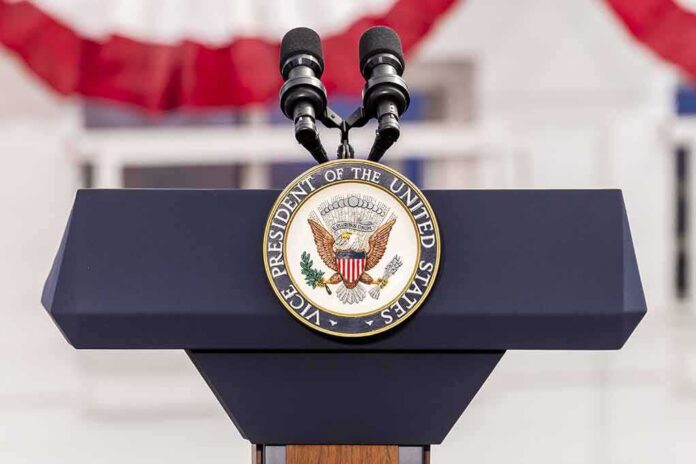
Political friendship in the age of algorithmic outrage carries a cost that ordinary friendship never did: every handshake becomes evidence, every kind word a data point in someone else’s argument about loyalty and betrayal. That is the real subject beneath the headline about Vice President JD Vance calling Tucker Carlson a friend after Carlson suggested Trump should be removed from office — not whether the two men like each other, which is well documented, but whether personal loyalty can survive in a political culture that increasingly treats it as a confession.
Key Points
- Vance told reporters at a White House briefing that Carlson remains a friend “despite the fact that we disagree on a number of things,” refusing to disavow him.
- The Vance-Carlson relationship predates the controversy by years, spanning Vance’s 2021-2022 Senate campaign, a joint 2024 campaign event, and a 2026 tribute to Charlie Kirk.
- Carlson’s actual position on removing Trump is narrower than the shorthand “impeachment call” suggests — he has said he opposed Trump’s two prior impeachment trials while arguing a president should be removed only over first-use nuclear weapons.
- Vance’s defense is relational, not evidentiary: it explains why the friendship endures but does not engage the substance of Carlson’s criticism of Trump.
- The episode fits a broader pattern in which conservative media figures and elected officials are bound together by dense, mutually reinforcing networks that turn personal association into a proxy for ideological loyalty.
What Vance Actually Said, and Why It Matters
At a September 3, 2026 White House press briefing, Vance was asked directly to address Carlson’s public argument that a president who seriously entertains first-use nuclear weapons should be removed from office. His answer was unambiguous on the point that mattered to reporters: he would not distance himself from Carlson personally. “Everybody knows that Tucker Carlson and I are friends,” Vance said. “Tucker is a friend of mine… despite the fact that we disagree on a number of things.” He went further, framing the refusal to condemn Carlson as a matter of principle rather than convenience: “I’m not gonna play the game where I throw friends under the bus because I have political disagreements with them.”
That framing is worth sitting with, because it draws a line many politicians blur under pressure. Vance did not defend Carlson’s remarks about Trump. He defended the idea that disagreement, even sharp disagreement over a sitting president’s fitness, should not automatically dissolve a personal relationship. Whether that stance survives scrutiny depends on how one interprets the difference between shielding a friend from unfair attack and tacitly normalizing a friend’s most inflammatory claims — a distinction the available record does not resolve, since Vance’s remarks address the former without directly rebutting the latter.
A Relationship Built Over Years, Not Invented for a Crisis
Skeptics might assume “friend” is a convenient label deployed only when convenient. The public record argues otherwise. Carlson interviewed Vance during his 2021-2022 Ohio Senate run, appeared alongside him at a campaign event in Hershey, Pennsylvania in 2024, and joined him in 2026 for a televised tribute to the slain activist Charlie Kirk, where the two discussed Kirk’s model of civil disagreement within conservative ranks at length. Axios separately reported in January 2026 that Trump-aligned figures have deliberately avoided publicly linking Carlson and Vance precisely because the two are known to be friends — evidence that the relationship was recognized inside Republican circles well before it became a flashpoint. Carlson himself has reciprocated the sentiment on camera, saying plainly, “I think of him as a friend. I will always think of him as a friend.”
What Carlson Actually Argued, Beneath the Headline
The phrase “called for Trump’s impeachment” compresses a more careful position into something blunter than what Carlson said. His removal argument was conditional: any president who seriously considers using nuclear weapons first should be removed immediately, a standard he applied hypothetically rather than as a live accusation. In the same breath, Carlson said he had “strongly opposed” the two actual impeachment efforts brought against Trump, including the 2019 Ukraine-call proceedings he nonetheless criticized on the merits at the time, calling the underlying conduct something for which “there’s no way to spin this.” That combination — opposing formal impeachment while criticizing specific conduct — is a familiar Carlson pattern, one that gets flattened in headline shorthand into a simple pro-impeachment stance it does not fully represent.
Why the Story Reads as a Loyalty Test
Conservative media and Republican politics have grown unusually intertwined over the past two decades, with commentators, advocacy groups, and elected officials operating inside a network of mutual reinforcement rather than at arm’s length. Pew Research has found that consistent conservatives cluster around a small number of trusted sources far more tightly than other ideological groups, with 47% naming Fox News as their primary political news source and 88% expressing trust in it. In that environment, a phrase as small as “he’s a friend” carries outsized signaling weight — it is heard simultaneously as a personal statement and as a coded assurance to an audience watching for defection. That dual audience is why commentators like Megyn Kelly and Jeremy Boreing have treated Vance’s refusal to condemn Carlson as a strategic puzzle rather than a simple character note, debating whether it reflects gratitude for Carlson’s early backing of Vance’s Senate run, genuine ideological kinship, or a calculated effort to hold together a fractious Trump coalition ahead of Vance’s own political future.
The Political Exposure Vance Accepts by Staying Close
Every joint appearance, past and future, becomes fresh material for critics who want to paint Vance as aligned with positions he has not endorsed. That risk is compounded by the fact that Carlson’s commentary regularly wanders into territory — his Iran and Israel commentary among the most cited examples — that draws its own controversy independent of the Trump-removal question, meaning Vance inherits reputational exposure on multiple fronts simply by declining to create distance. Vance has shown a consistent pattern here beyond Carlson himself: he has also publicly defended Carlson’s son, a member of his communications staff, against what he called baseless attacks, describing the criticism as dishonest rather than substantive. The through-line in all of it is the same: Vance treats personal loyalty as a value that outranks distancing himself from controversy, a bet that carries real cost if the coalition he needs eventually forces a choice he has so far avoided making.
JD Vance says Tucker Carlson is his “close friend” and dismisses the problem as a few “political disagreements.”
But this isn't about political disagreement.
Lying isn't a political position.
Gaslighting isn't a political position.
Knowingly misleading your audience isn't a…— Mikha Ralin (@MikhaRalin) September 4, 2026
What This Means Going Forward
The episode is unlikely to be the last time Vance is asked to choose between a friendship and a political headache, because the structural conditions that produced it — a networked conservative media ecosystem, an audience trained to read personal association as ideological signal, and a commentator class willing to stake out provocative positions for attention — are not going away. What the record actually supports is narrower than the loudest framing suggests: Vance defended a friendship of long standing while explicitly disagreeing with Carlson’s substance, and Carlson’s own position on removing a president was more conditional than “impeachment call” implies. The lasting story here is less about one September briefing than about how durable personal ties will keep colliding with a political culture allergic to nuance.
Sources:
youtube.com, mediaite.com, axios.com, podcasts.happyscribe.com
© impactheadlines.com 2026. All rights reserved.