Survivable outcomes in small-aircraft power loss are rarely luck alone; they are the product of energy management, terrain judgment, and just enough structure to absorb the last of the kinetic load.
The Short Version
- A Piper PA-32 carrying pilot Dustin Davis, his wife Autumn, and two dogs lost engine power en route across eastern North Carolina and ended in the trees; all survived with at most minor injuries.
- Multiple local outlets quoted Davis and cited FAA involvement; descriptions align that the airplane descended under partial control and came to rest off the ground in the treetops.
- “Engine wasn’t producing power” conveys the emergency, not the root cause; power loss spans mechanical breakage, fuel issues, icing, and more.
- The pattern fits general-aviation risk data: powerplant-related events are a leading accident category alongside loss of control and fuel-related occurrences.
What happened in the North Carolina treetops
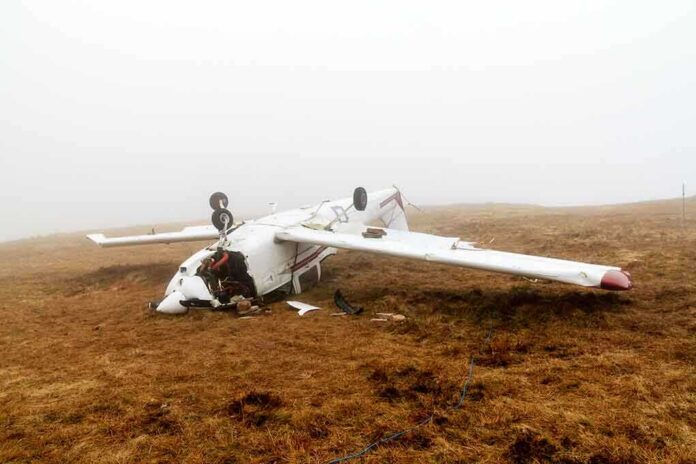
Local reporting converges on a clear sequence. On October 7, 2026, Dustin Davis departed Hickory Regional Airport with his wife, Autumn, and their dogs, Sophie and Royce, bound for Ocean Isle Beach in a single-engine Piper PA-32. Partway across eastern North Carolina, the engine stopped making usable power. Davis reported trimming and maneuvering to stretch the glide, threading among trees until the aircraft contacted a flexible smaller tree and then a larger one that arrested the descent, leaving the cabin suspended several feet above the ground. The couple escaped, the dogs were unharmed, and first responders evaluated the adults for minor injuries.
Two elements matter operationally. First, the airplane remained controllable long enough to trade altitude for distance, align with the best available “surface” — in this case, the canopies — and arrive at minimum survivable energy. Second, the trees functioned as a quasi-crush zone: branches progressively shed speed before fuselage structure met immovable trunks. That combination often makes the difference between a hard arrival and a fatal deceleration. FAA confirmation that the aircraft experienced mechanical issues is consistent with the pilot’s account; investigators opened a routine inquiry, as they do after any power-loss accident.
Why “the engine failed” is not a diagnosis
To pilots, “engine failure” is a cockpit reality — thrust is gone, the glide begins — but to investigators, it is a starting point. Power loss spans distinct mechanisms with different fingerprints: fractured engine components, carburetor icing, induction or exhaust blockage, fuel exhaustion, fuel starvation from mismanagement or system anomaly, contamination, or an installation or maintenance defect. In general-aviation safety reviews using NTSB data, powerplant system/component failure consistently ranks among the top causal categories for fatal accidents, alongside loss of control in flight and controlled flight into terrain. The taxonomy exists for a reason: prevention depends on the specific mechanism, not the phrase.
Investigators therefore work the chain methodically. Wreckage tells an energy story — propeller strike signatures indicate whether power was being produced at impact; spark-plug coloration, borescope images, and oil and fuel samples reveal combustion health; control continuity checks rule out primary flight-control failures masquerading as engine problems. Maintenance records, recent fueling logs, and airworthiness directives provide the paper trail. Only when those threads converge does an “engine failure” become an identified failure of a part, a system, or a human decision.
How pilots turn a power-off emergency into a survivable forced landing
Glider discipline is the bedrock. When thrust disappears, airspeed control and best-glide configuration preserve options; altitude is time, and time is geometry. Good airmanship prioritizes landing into the wind to cut groundspeed, aiming for terrain that trades rolling hazards for energy absorption — crops, brush, and yes, trees, can out-perform hard surfaces if the area ahead is obstructed. In wooded terrain, arriving in the upper canopy at the lowest controllable airspeed can allow branches to “saw” away velocity in increments. The goal is a controlled crash — a term of art that acknowledges impact while maximizing occupant survival space and minimizing deceleration spikes.
Survivability then hinges on restraints and structure. Shoulder harnesses and properly secured cargo, including pets in carriers, prevent secondary injuries. The PA-32’s cabin height and wing-root structure can protect the occupant volume in vertical and oblique loads, provided the arrival energy has already been spent in the trees. In the North Carolina case, Davis described just missing multiple trees before contacting a smaller one that flexed and then a larger one that stopped the aircraft; media accounts place the fuselage several feet off the ground after the sequence — an indicator that the canopy did the final work of absorbing energy.
The PA-32, mission profile, and the decision space
Piper’s PA-32 family — the Cherokee Six/Lance/Saratoga lineage — is a six-place, fixed- or retractable-gear, single-engine design chosen precisely for missions like Hickory to the coast: modest IFR capability, useful load for passengers and baggage, and benign handling. Its single point of vulnerability is the same as all singles: one engine. Because the PA-32 lacks turbine anti-ice margins and redundant power, pilots mitigate with fuel planning, weather avoidance, and currency in power-off drills. When power loss does occur, the type’s relatively docile stall behavior and stable glide lend themselves to precise energy control, buying the pilot time to pick the least-bad option.
Flight-path details in press accounts — altitudes, minutes in glide, miles to a diversion — are helpful context but not essential to the core assessment: the aircraft lost power, remained controllable, and arrived in trees under pilot command with survivable forces. FAA engagement and parallel NTSB procedures follow from that fact pattern; those agencies will address the causal mechanism.
How this fits the broader safety picture
General aviation safety improves when we separate headline drama from causal learning. National reviews show that a handful of archetypes dominate accident risk: loss of control in flight, controlled flight into terrain, powerplant system/component failure, and fuel-related events account for a large share of serious outcomes. For prevention, that means recurrent training in engine-out procedures, meticulous fuel management, and maintenance vigilance on high-risk components — magnetos, fuel pumps, induction systems, and propeller governors on constant-speed installations. For survivability, it means wearing the restraints every leg, securing the cabin, carrying a charged handheld radio and PLB, and briefing non-pilots on egress even on a blue-sky hop.
The North Carolina tree landing is the case study people remember, but its most useful lesson is methodical: aviate, navigate, communicate — in that order. Set best glide, pick the spot you can reach, and fly precisely all the way to the crash. Done well, as here, a power-loss emergency becomes a survivable forced landing rather than a loss-of-control fatality.
Pilot, wife and dogs survive dramatic tree-top crash landing after plane suffers engine failure: 'Just pray' https://t.co/hHmo9uw5f7 pic.twitter.com/fQa3RfBwBw
— New York Post (@nypost) October 23, 2026
One final caveat and a practical takeaway
Investigators, not headlines, assign causes. FAA and NTSB processes will determine whether Davis’s power loss traced to a mechanical failure, a fuel-system anomaly, or something else; until that is complete, “engine wasn’t producing power” is the accurate cockpit description of the emergency, not the root-cause label. For the rest of us, two habits pay back disproportionately: practice real engine-out approaches to a go-around at altitude with an instructor, and brief every passenger — two-legged and four — on belts, latches, and what “brace” means. When the map turns green with trees, precision and preparation make those trees an ally.
Sources:
nypost.com, article.wn.com, m.dailyadvent.com, faa.gov, faasafety.gov
© impactheadlines.com 2026. All rights reserved.