Declaring a national emergency is not the automatic hallmark of a government in control; in France, it is a last-resort legal instrument with costs that can exceed its immediate tactical value. The more durable question is not “are they nuts?” but whether the scale and character of unrest crossed the threshold where extraordinary powers outperform targeted policing, administrative restrictions, and political de-escalation.
The Short Version
- France faced one of its worst bouts of unrest in years, with mass arrests, widespread violence, and hundreds of injuries to police and public servants.
- President Emmanuel Macron withheld a nationwide state of emergency, opting instead for prefect-level protest bans, reinforced policing, and a track to address underlying grievances.
- French law already permits sharp, targeted restrictions when a gathering threatens serious public order risks, subject to necessity and proportionality.
- History shows emergency regimes expand state power quickly but resolve disorder unevenly and can linger, raising civil-liberties costs without proven public-order gains.
What “state of emergency” means in France, and what it unlocks
France’s state of emergency is a distinct legal regime, created by the 1955 Act and refined over decades, that broadens administrative authority—house arrests, warrantless searches under defined circumstances, movement restrictions, venue closures, and the ability to forbid demonstrations—subject to judicial review by administrative courts. It is designed for an imminent, nationwide threat to public order or a national calamity, not as a convenience when policing is hard. Because it centralizes exceptional powers and often endures beyond the immediate crisis, French courts and rights institutions have pressed the executive to prove both necessity and proportionality when using the tool, and to prefer ordinary law when it suffices.
The 2015–2017 terrorism period illustrated these trade-offs. Parliament extended the emergency repeatedly; measures multiplied and hardened operational posture—but retrospective assessments questioned whether those powers were effective at their stated counterterrorism goals relative to their civil-liberty costs. That history weighs on any contemporary choice to invoke the regime.
The scale and character of the 2026 unrest
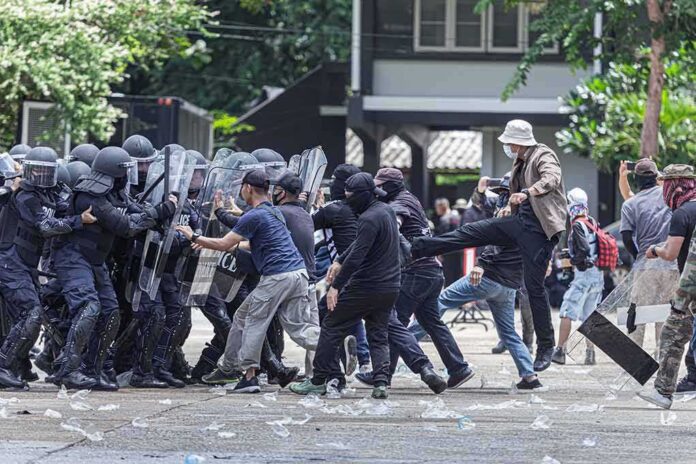
The disorder was real and severe. Reportage describes nationwide violence, looting, arson against public buildings, and significant injuries among police and civilians. Police made thousands of arrests; single-day tallies and cumulative totals varied across outlets and dates, but all pointed to an extraordinary public-order burden. One Reuters account called it among the worst days of unrest in years and cited roughly 2,400 arrests and nearly 1,000 injured officers at one point in time. Education officials reported hundreds of high school closures and widespread damage to school facilities, suggesting disruption beyond street demonstrations into essential public services.
Participation was broad. The interior minister’s estimate of roughly 550,000 participants underscored the intensity and geographic spread; rapid-response police were deployed in Paris and other cities as violence escalated at the margins of otherwise large mobilizations. These figures, while not perfectly harmonized across reports, establish a simple truth: ordinary policing faced an exceptional, multi-city challenge.
Why Macron did not pull the emergency lever
Macron’s strategy distinguished between mass protest and violent opportunism. He condemned the violence and promised accountability, while treating peaceful demonstrators’ grievances as legitimate; he directed prefects and mayors to protect vulnerable sites and, where necessary, ban specific protests to safeguard public buildings and local businesses. He also tasked the government to convene students, teachers, lawmakers, unions, and business leaders to produce concrete proposals, a bid to reduce the temperature even as prosecutions proceeded.
Legally, France already has tools—outside a formal emergency—to restrict or prohibit gatherings that pose serious public-order risks, provided measures are necessary and proportionate. That doctrinal baseline allows authorities to narrow bans to place, time, and risk profile, rather than imposing a national curfew or blanket suspension of assembly rights. A published legal analysis captured the orthodoxy: prohibition is a last resort within ordinary law, not an automatic trigger for an emergency regime. Macron’s posture aligned with that orthodoxy.
What the numbers can and cannot settle
Arrest and injury counts circulated in competing versions because they referred to different time windows and agencies; that inconsistency complicates any argument that hinges on a precise single cumulative total. But it does not obscure the essential picture: violence and damage were widespread, police and teachers were injured by the hundreds, and daily life—especially schooling—was heavily disrupted in many locales. This is enough to establish a grave public-order problem; it is not enough, on its face, to prove that ordinary powers were inadequate or that a nationwide emergency would have restored order faster or at lower cost to rights.
Equally important, the record did not establish a single command structure orchestrating the unrest. Accusations flew—far-left organization, Islamist exploitation—but public evidence tying disparate episodes to a unified conspiracy was absent in the contemporaneous reporting. That matters, because a centrally coordinated insurrectionary threat can justify broader instruments; a heterogeneous mix of grievances, spontaneous violence, and criminal opportunism often calls for tailored policing, judicial processing, and political channeling rather than maximal legal tools.
Comparative performance: targeted powers versus emergency regime
Two criteria should guide any emergency calculus. First, capability: does invoking the 1955 regime unlock distinct, indispensable powers that ordinary statutes and prefectural orders cannot supply? Second, efficacy: is there credible evidence that those powers reduce violence faster or more durably than targeted bans, arrests, and negotiations? In 2026, the government’s choice—selective protest prohibitions, reinforcement of police, and a parallel consultative track—answers the first with “not yet,” and the second with a bet that containment plus political off-ramps beats escalation. Past scholarship, especially on the post-2015 period, cautions that emergency measures can drift, extend, and deliver ambiguous security returns while exacting real civil-liberties costs.
That does not make a national emergency illegitimate in principle; it sets a burden of proof. When ordinary law, properly enforced, can manage risk with proportional restrictions, the French constitutional tradition prefers it. The fact that authorities publicly emphasized that the vast majority demonstrated peacefully reinforces the case for narrow measures calibrated to violent subsets rather than a blanket regime.
🇫🇷 FRANCE IN CHAOS: President Macron has condemned nationwide riots, looting and violent clashes, expressing “anger and shame” as nearly 2,400 people were arrested and around 1,000 officers injured in a single day.
Macron has vowed tougher security measures but stopped short of… pic.twitter.com/BDAUNSaPe6
— Mews Post (@mewspost) October 18, 2026
What to watch to judge the policy on its results
Four indicators distinguish prudence from wishful thinking. One, operational adequacy: did police and prefects, using ordinary powers, prevent repeat arsons on critical infrastructure and protect schools and hospitals? Two, judicial throughput: were arrests converted into timely, proportionate charges and sentences that deter copycat violence? Three, calibration: were protest bans targeted and time-limited, with transparent necessity justifications that withstood administrative-court scrutiny? Four, de-escalation: did the consultation track yield concrete policy changes that siphoned participants away from street confrontations while isolating violent actors? A positive answer across these dimensions vindicates the non-emergency strategy; failure across them revives the case for extraordinary measures—backed by specific capability gaps, not rhetoric.
Bottom line
France confronted a nationwide public-order crisis. The executive chose hard-edged, targeted tools under ordinary law over a sweeping national emergency. Given the legal architecture and France’s own experience with long emergency horizons after 2015, that choice is coherent: it preserves proportionality, keeps courts engaged, and aims to separate legitimate protest from violent exploitation. If evidence emerges that ordinary powers cannot protect essential services or prevent cascading violence, the emergency lever remains available. Until then, restraint is not naiveté—it is constitutional muscle memory.
Sources:
townhall.com, foxnews.com, reuters.com, cnn.com, npr.org, bbc.com, newsobserver.com, cnbc.com, diplomacyandlaw.com, econotimes.com, justsecurity.org
© impactheadlines.com 2026. All rights reserved.