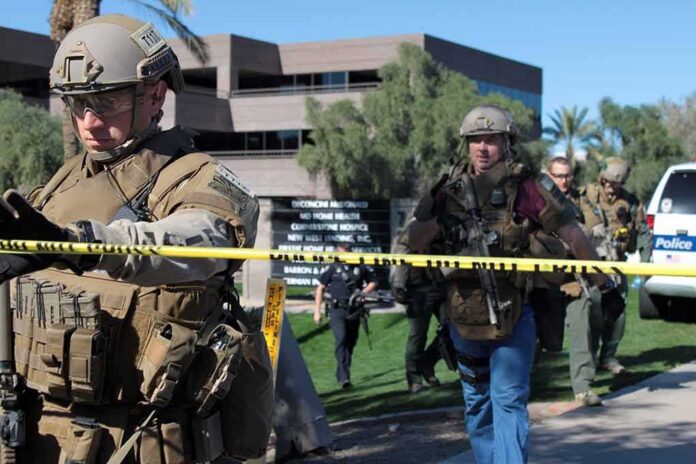
When police serve a residential search warrant, seconds of confusion can decide who lives. In Atlantic City, that moment arrived the instant a door swung open and gunfire exploded both ways—two officers hit, the occupant mortally wounded, and body-cam video later released to show how quickly a controlled operation became a close-quarters gunfight.
At a Glance
- State investigators say Donald Gardner opened fire as officers began to enter his residence during a SWAT-served search warrant.
- Two Atlantic City officers were struck—one in the leg, another in the helmet; Officer Robert Reynolds returned fire and fatally shot Gardner.
- Body-worn camera footage and radio traffic released by the New Jersey Attorney General provide contemporaneous evidence of the exchange.
- The case exemplifies how dynamic-entry warrant service can turn lethal within seconds, even when announcements are made.
What Happened Inside the Threshold
On June 2, 2026, a joint team from the Atlantic City Police Department SWAT and the Atlantic County Prosecutor’s Office SWAT arrived to execute a court-approved search warrant at a residence on the 100 block of North Florida Avenue. According to the New Jersey Attorney General’s Division of Criminal Justice, as officers opened the door, the occupant, identified as Donald Gardner, fired multiple shots at the entry team. Two officers were struck—one suffered a leg wound; another took a round to his helmet. An ACPD officer, Robert Reynolds, was positioned to respond; he fired multiple times, striking Gardner, who was later pronounced dead at the scene. The Attorney General’s office released synchronized body-worn camera clips and radio transmissions that capture the rapid sequence and confirm the state’s preliminary account of who fired and when.
The audiovisual record is notable for what it does and does not leave to inference. Television outlets that reviewed the state’s release reported officers audibly announcing “Police Department search warrant” before the breach; gunfire followed in immediate succession as the door opened. This sequencing, described by 6abc after its review of the footage, aligns with the Attorney General’s narrative about the first shots originating from inside the residence as the threshold was crossed. The released package is preliminary by the state’s own description—typical when lethal-force incidents move through formal review—but the core facts reported across outlets do not conflict with the official timeline.
The Mechanics of a Rapidly Evolving Entry
Dynamic-entry warrant service compresses time, space, and decision-making. SWAT teams are trained to announce, breach, and clear rooms quickly to reduce the window in which a suspect can arm, destroy evidence, or flee. That speed, however, moves the risk curve steeply: once the door opens, the team is committed, with members stacked in a narrow cone, visibility evolving frame by frame, and muzzle discipline intersecting with split-second threat identification. When an occupant fires from inside—as investigators say Gardner did—the geometry of the stack means the lead officers absorb the first shots. The body-cam and radio audio underscore this reality: commands, a hard knock and announcement, the breach, an eruption of gunfire, and immediate casualty calls. Reynolds’s counter-fire, per the state’s account, exemplifies the assigned role of cover officer in the stack—engage the source of lethal threat to stop the attack and create space to extract the wounded.
The detail about an officer’s helmet receiving a round matters beyond drama. Helmets and ballistic vests are not talismans; they are probability shifters, designed to defeat certain calibers at certain angles. A struck helmet implies a near headshot at close range—precisely the risk envelope of doorway engagements. The leg wound to another officer matches what tactical medicine routinely sees in threshold fights: extremity hits from rounds traveling on shallow or deflected paths in confined hallways.
What the Body-Cam Adds—and What It Doesn’t
Body-worn cameras offer contemporaneous, sensory-limited vantage points: a torso-high, cone-of-vision record with compressed audio that can saturate during gunfire. Their value lies in corroborating sequencing—announce, breach, first shot, counter-fire—and in capturing commands and immediate reactions. In this case, the cameras and radio traffic were released by the state within the investigative process, rather than only after a final report. That gives the public a look at the operative facts early: entry conditions, the first auditory cues of gunfire, and the officers’ medical urgency once two teammates were hit.
What body-cam cannot resolve alone are the forensic specifics—caliber-to-weapon matches, the exact muzzle distance of the shooter, bullet trajectories, and round counts across all weapons. Those answers come from ballistic comparison, scene diagrams, projectile recovery, autopsy findings, and the search-warrant return inventory. The absence of those documents from public release at this stage is normal for an open state review; it does not alter the core event sequence the video and on-scene audio already ground.
The Setting: Warrant Service as a High-Risk, Low-Frequency Shooting
Although SWAT deployments are common for search warrants, shootings during those operations remain relatively rare compared with the overall volume of raids. Research summarized by the Council on Criminal Justice indicates that a large majority of SWAT uses are for executing search warrants, with a significant share involving forcible entry, yet the percentage that culminate in gunfire is small relative to total deployments. That statistical context explains why departments invest so heavily in entry planning, equipment, and medical readiness: the baseline probability of a gunfight is low, but the consequence when it occurs is acute and unforgiving.
Against that backdrop, the Atlantic City incident reflects the canonical hazards of threshold engagements: the inelastic timing between announcement and breach, the tight geometry that concentrates both officers and rounds, and the asymmetric visibility between someone inside a room and officers moving through a doorway. When a defender decides to shoot as the door opens, the team’s survivability depends on milliseconds of reaction, available cover, and whether a designated cover officer can identify and suppress the source of fire without inducing crossfire—a role the Attorney General’s account attributes to Reynolds in this case.
Competing Tactics, Constant Tradeoffs
Agencies continue to debate the merits of dynamic breach versus surround-and-call-out tactics, particularly at residences with indicators of elevated risk or occupants with limited mobility. Dynamic entry can reduce the chance of an armed suspect preparing an ambush or destroying time-sensitive evidence; call-outs can lower the risk of close-quarters crossfire but can extend standoffs and create perimeter hazards. There is no tactic that deletes risk; commanders select a method based on the warrant’s purpose, the structure’s layout, intelligence on occupants and firearms, and the legal and policy framework governing the operation. Nationally, expert reviews and policy bodies document that most SWAT activations center on warrant service, which makes the rigor of pre-raid risk assessment and post-incident review—not just the moments at the threshold—central to public safety outcomes.
In Atlantic City, the operational snapshot we have—a clear announcement, immediate shots from inside, two officers down, rapid counter-fire—tracks to an engagement that turned lethal at the fastest possible tempo. The Attorney General’s office has custody of the broader record and has stated the investigation remains active; as with other officer-involved shootings in New Jersey, the state’s process is designed to consolidate criminal and use-of-force review in a single venue rather than disperse it across multiple local agencies.
Atlantic City Officer Fatally Shoots Armed Felon After Two Officers Are Shot
Atlantic City, New Jersey — June 2, 2026, at approximately 2:55 p.m., 52-year-old Donald Gardner, also known as Donald Capriotti, was fatally shot by an Atlantic City police officer after gunfire… pic.twitter.com/6UejATBU9O
— Police Incidents (@PoliceIncident) October 15, 2026
Why This Case Resonates Beyond One Doorway
Three threads make this shooting instructive beyond Atlantic City. First, it illustrates how body-worn cameras have matured from disputed novelty to central evidentiary tool; here, they anchor the timeline and corroborate the state’s preliminary account. Second, it shows the irreducible danger at the threshold—where policy, planning, and training meet the occupant’s free will. Even a clear announcement does not guarantee de-escalation if a resident chooses to fire. Third, it demonstrates that outcomes hinge on the basics under stress: protective equipment, stack discipline, immediate threat suppression, and fast casualty care.
Sources:
nbcphiladelphia.com, newjersey.news12.com, fox29.com
© impactheadlines.com 2026. All rights reserved.