When a vessel goes down far offshore, minutes matter and borders blur; the Baja capsizing underscored that reality, as a cross-border rescue lifted 16 people from the Pacific and launched a sustained, multi-agency search over open ocean for others believed missing.
The Short Version
- Coast Guard aircrews rescued 16 people after a predawn Mayday from a sinking boat roughly 140 miles west of Ensenada.
- Survivors were flown to San Diego hospitals; injuries included hypothermia, trauma, and at least one suspected shark bite.
- A large search continued with U.S. aircraft and ships and Mexican naval forces for additional people reported in the water.
- The offshore corridor is notoriously dangerous and increasingly trafficked, but the boat’s identity and cause of sinking remained unresolved.
What Happened: The Rescue Triggered by a Mayday
Shortly after 1:00 a.m., U.S. Coast Guard watchstanders received a distress transmission—described as a Mayday—reporting a vessel taking on water well offshore of northern Baja California. Air and surface assets were launched quickly. When responders reached the last-known position, they found people in the water and debris but no intact hull. Sixteen individuals were hoisted or recovered and transported to San Diego for medical care. The Coast Guard continued searching based on survivor accounts that more people had been aboard, prompting an expansive operation beyond the initial rescue window.
The incident location—about 140 miles west of Ensenada—matters operationally. At that range, helicopter endurance, refuel planning, and hoist cycles become decisive, as does fixed-wing surveillance to vector rescue swimmers onto survivors. Coast Guard Petty Officer Chris Sappey and multiple outlets placed the search and recovery in that same offshore box, corroborating the position and the response geometry.
The Search: Assets, Coordination, and Why Coverage Must Be Broad
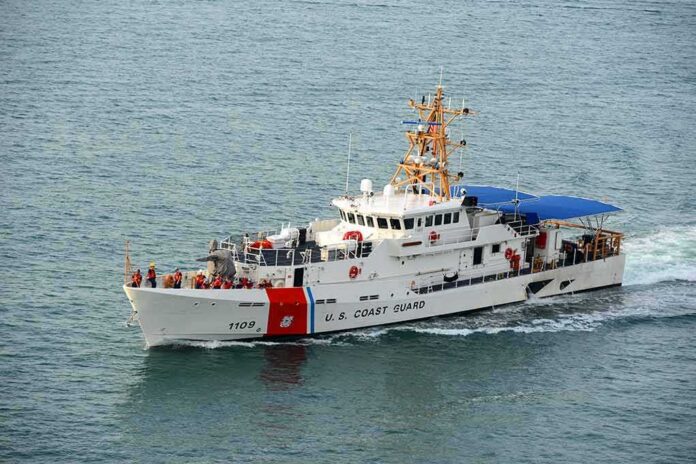
Coast Guard command layered rotary and fixed-wing aircraft to detect, mark, and recover survivors while extending the search for those still unaccounted for. A cutter and a U.S. Navy surface combatant widened the surface net, while the Mexican Navy out of Ensenada mounted parallel search-and-rescue (SAR) efforts in Mexican waters. That combined posture—airborne lookouts to spot heads and lifejackets in swells, surface ships to recover and reconstitute search lines—reflects the playbook for long-range SAR when a vessel is gone and people are adrift without a reliable datum for last-known position drift.
The search persisted because authorities assessed that more people were likely in the water. Initial reporting cited 27 aboard, derived from survivor statements; agencies emphasized that while the figure informed search planning, the total count was not yet confirmed—a common operational tension when the vessel has sunk and no manifest exists. Even with robust air coverage, wide-area ocean searches are probabilistic: search patterns are driven by wind, current, and “leeway” (how different bodies drift). Good teams adapt plans as new debris or survivor sightings refine the drift model.
Medical Realities in Open-Ocean Rescues
Sixteen rescued individuals arrived in San Diego with a spectrum of conditions common to prolonged immersion: cold stress despite temperate water, dehydration, soft-tissue injuries from debris, and in at least one case, wounds consistent with a shark bite as assessed by treating clinicians. Two people were reported in critical condition during the early hospital phase. Offshore survival is a race against exposure; even in warmer seasons, evaporative cooling and fatigue degrade functional capacity quickly, and night operations compound the risks for both victims and crews.
Shark encounters, while statistically rare, do occur in drift scenarios where people remain in the water for extended periods. The clinical task is to distinguish bite-pattern morphology from propeller or debris trauma—something emergency and trauma teams are trained to do. That triage unfolded in parallel with consular support, as officials confirmed the rescued were Mexican nationals and coordinated next-of-kin and services typical after cross-border rescues.
What We Don’t Yet Know—and Why That’s Typical in a Sinking
Key facts remained unresolved in early reporting: the boat’s identity and type, a definitive passenger count, the precise failure chain that led to the sinking. None is surprising when a vessel founders offshore, goes down before responders arrive, and leaves only floating seats and scattered debris. Without a hull or engines to examine, investigators must backfill with survivor interviews, debris forensics, and any electronic breadcrumbs, from AIS gaps on nearby traffic to radio logs and radar returns. Those processes take time; meanwhile, SAR doctrine instructs responders to act on the best available estimate of persons in the water rather than await perfect certainty.
As for cause, possibilities range from mechanical failure to overloading to a collision or weather interaction—each with different signature evidence. Here, the decisive priority remained life-saving; incident reconstruction follows, and sometimes it never fully resolves if the wreck lies deep or dispersed.
The Corridor: A Dangerous, Busier Sea Lane for Irregular Crossings
The corridor between northern Baja and Southern California has seen a marked rise in maritime smuggling attempts, with law enforcement describing steep growth over the past several years and dozens of known fatalities—numbers that, by their nature, likely undercount the real toll. The common features are consistent: small craft not designed for offshore transits, night movements, poor maintenance, and too many people on board. In 2021, a panga associated with a smuggling case broke apart near Point Loma, killing three; the captain later received an 18-year sentence after a multiagency investigation.
Context, however, does not substitute for proof. Officials routinely note that this offshore box is used by smugglers, but that general pattern does not, by itself, establish the status of a specific vessel. In the Baja capsizing, agencies focused on rescue and medical care while acknowledging the location’s risk profile. That is the correct ordering of priorities; classification questions, if any, are addressed by investigative units after survivors are stabilized and search operations conclude.
Baja California Boat Capsizing Leaves 11 Missing After 16 Rescued https://t.co/6KguDQjEYE
— DarrenH (@darrenHEYCEL) October 18, 2026
Why This Matters for Preparedness and Policy
Two truths coexist offshore: prevention reduces tragedies, and when prevention fails, only disciplined, well-practiced rescue saves lives. The Baja case illustrated both sides. The Coast Guard’s ability to put helicopters, fixed-wing aircraft, and cutters on scene, coordinate with a Navy ship and Mexico’s Navy, and deliver survivors to definitive care is a system working as intended. At the same time, the very need for such a far-offshore rescue highlights the human and operational costs of fragile vessels attempting long transits across busy, unforgiving waters.
Bottom Line
A predawn Mayday led to the rescue of 16 people and a days-long, multinational search in one of the Pacific’s most dangerous migration corridors. The identities of the boat and the precise cause of its loss may take time to resolve—if they ever do—but the life-saving phase is clear: rapid detection, layered assets, cross-border coordination, and hard flying kept a bad night from becoming worse. Offshore, that is success measured in survivors.
Sources:
military.com, nbcsandiego.com, sandiegouniontribune.com, ice.gov
© impactheadlines.com 2026. All rights reserved.