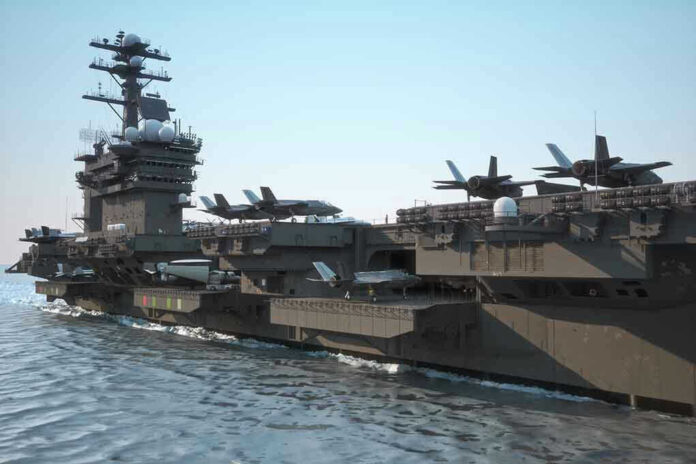
China’s newest supercarrier signals an aggressive push to challenge U.S. naval dominance—raising urgent alarms for American security and constitutional values.
Story Snapshot
- China commissions its third and most advanced aircraft carrier, the Fujian, featuring cutting-edge launch technology.
- The carrier’s capabilities enable Beijing to project military power further into contested Indo-Pacific waters.
- China’s growing naval force threatens to destabilize regional balance and embolden aggressive moves against U.S. allies.
- American defense experts warn that China’s advances may erode U.S. strategic superiority and test constitutional priorities.
China’s Fujian Carrier: A Technological Leap and Strategic Threat
In November 2025, China officially commissioned the Fujian, its third aircraft carrier and the most advanced to date. Unlike its predecessors, which were based on Soviet-era designs, the Fujian is a fully indigenous project, boasting the world’s second-largest carrier fleet after the United States. Its electromagnetic catapult launch system allows for heavier, more versatile aircraft, including stealth fighters and advanced early-warning planes. This breakthrough positions China to maintain a continuous carrier presence, a capability previously reserved for the U.S. Navy. For patriotic Americans, China’s rapid naval modernization is a direct challenge to the strategic balance that has long protected liberty, free trade, and constitutional order in the Pacific.
China’s carrier program began with the refitting of Soviet-built Liaoning in 2012, followed by the Shandong in 2019. The Fujian’s launch marks a decisive break from these earlier models, reflecting Beijing’s ambition for blue-water naval power. The carrier’s deployment comes at a time of heightened tensions in the South China Sea and Taiwan Strait, where China aggressively asserts its maritime claims. Regional powers like Japan, Australia, and India are responding with naval build-ups, but few can match the scale or speed of China’s advances. The Communist Party, under Xi Jinping’s direction, tightly controls military decision-making, using technological progress and national pride as tools to cement its authority and reshape global norms.
Implications for U.S. Security and Conservative Values
The Fujian’s commissioning triggers immediate concerns for American national security and the constitutional principle of peace through strength. With three operational carriers, Beijing is now capable of projecting power far beyond its shores. Experts warn that China’s “three carrier era” increases the risk of maritime incidents and escalations in contested waters, threatening not just U.S. allies but also commercial shipping and fishing communities. This development could spur an arms race in the Indo-Pacific, compelling the United States to accelerate its own naval modernization and defense spending. For constitutional conservatives, maintaining a robust military is essential to safeguard America’s sovereignty, defend freedom of navigation, and deter authoritarian regimes from undermining international law.
Industry analysts note that the Fujian narrows the technological gap with U.S. carriers, though limitations remain—most notably, the absence of nuclear propulsion, which restricts operational range. While China celebrates this milestone as a symbol of national achievement, Western experts caution that true carrier battle group proficiency takes years to develop. Nonetheless, the carrier’s arrival is a wake-up call for American strategists and policymakers. It highlights the need for vigilance against foreign powers seeking to erode U.S. influence and constitutional principles abroad. A strong, well-equipped Navy—free from wasteful spending and woke distractions—is vital to preserve American values and security in the face of China’s growing threat.
Expert Perspectives: Strategic Analysis and Limitations
Defense experts agree that the Fujian’s electromagnetic launch system represents a “leapfrog” advancement, bringing China closer to parity with U.S. naval technology. However, the carrier’s lack of nuclear power means its endurance and operational flexibility lag behind American supercarriers. Some analysts estimate the Fujian can carry between forty to sixty aircraft, a significant force but still outmatched by U.S. carrier groups. Chinese sources frame the development as a historic victory, necessary for national security and prestige. Western voices, meanwhile, emphasize the persistent gaps and caution that China’s operational proficiency will take years to mature. As China continues to invest in shipbuilding and military innovation, the U.S. must respond decisively to protect its interests and uphold constitutional priorities.
New Aircraft Carrier Advances China’s Naval Power—Leader Xi Jinping marks step in his mission to modernize nation’s military@ByChunHan https://t.co/zWZnaVi9u9https://t.co/zWZnaVi9u9
— Jonathan Cheng (@JChengWSJ) November 7, 2025
In summary, China’s commissioning of the Fujian marks a pivotal moment in naval and global power dynamics. For conservative Americans, the carrier’s debut underscores the urgency of strong defense, strategic vigilance, and unwavering support for constitutional values. The Trump administration’s success in revitalizing U.S. military capabilities and restoring American leadership is more critical than ever in an era of rising authoritarian threats.
Sources:
China’s Type 003 Fujian Aircraft Carrier
China Unveils Its Most Advanced Aircraft Carrier
What to Know About China’s Newest Aircraft Carrier, the Fujian
The Chinese Navy Has Commissioned the Aircraft Carrier Fujian, the Most Advanced in Its Fleet