When a United Airlines crew squawked code 7500 over Louisiana airspace on November 10, 2026, they activated a protocol built for exactly one purpose: telling air traffic control, without saying a word over the radio, that someone aboard the aircraft might be a danger to everyone on it. That single transponder code, more than any headline, explains why an unconfirmed claim from one agitated passenger can ground a jet, summon a tactical response, and dominate news cycles for days — even before investigators know whether a bomb ever existed.
Key Points
- A 34-year-old man aboard United Flight 2174, Newark to New Orleans, allegedly told crew he had a bomb; the aircraft squawked code 7500 before landing and he was arrested on arrival.
- Deputies with the Jefferson Parish Sheriff’s Office booked him for communicating false information of planned arson and terrorizing, both state charges.
- The arrest is confirmed and on the record; whether an actual explosive device existed has not been established in available reporting.
- A separate United incident weeks earlier — Flight 1681, Las Vegas to Newark — involved a passenger’s text message about hijacking the plane, a distinct case with its own suspect, charges, and defense.
- Both episodes illustrate a standing aviation-security principle: crews and controllers treat threats as real until proven otherwise, because the cost of underreacting dwarfs the cost of a false alarm.
What Happened Aboard Flight 2174
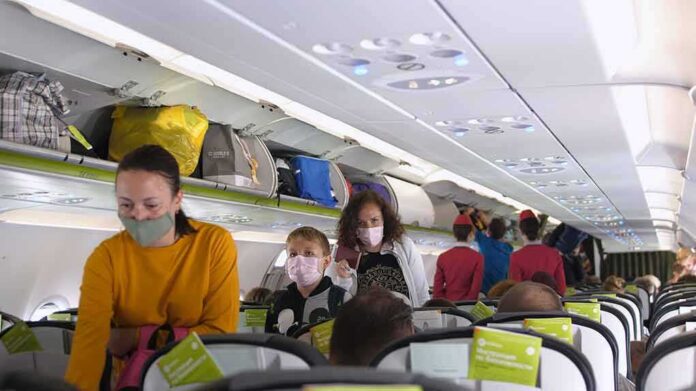
United Flight 2174 departed Newark Liberty International Airport bound for Louis Armstrong New Orleans International Airport carrying 46 passengers and six crew members. Somewhere over the flight, a passenger began acting erratically and, according to the Jefferson Parish Sheriff’s Office, told crew members he had a bomb. The crew’s response followed the only playbook aviation security allows for such a claim: they alerted the cockpit, and the aircraft proceeded toward New Orleans transmitting transponder code 7500, the internationally recognized signal for unlawful interference. Deputies met the plane on arrival and took the man into custody without incident. He was booked at the Jefferson Parish Correctional Center on charges of communicating false information of planned arson and terrorizing — both state offenses. Reporting at the time of booking had not yet named the suspect or detailed whether he attempted to approach the cockpit.
Why a Transponder Code Carries So Much Weight
Squawking 7500 is not a judgment about guilt. It is a procedural trigger, built into air traffic control systems worldwide, that reclassifies a flight from routine to high-priority the instant a controller sees it. Everything downstream — expedited handling, ground coordination, law enforcement staging at the arrival gate — flows from that four-digit code, regardless of whether the underlying claim later proves true. That is by design. Aviation authorities operate on what amounts to a precautionary model: a threat is treated as potentially real until investigation says otherwise, because the overwhelming majority of bomb and hijack threats turn out to be false, but the rare genuine one is catastrophic. The asymmetry between a costly false alarm and an unthinkable missed warning is why crews are trained to escalate immediately rather than wait for certainty.
A Second, Separate United Incident — Not the Same Case
Within weeks of the New Orleans arrest, a different United aircraft generated similar headlines for a different reason. Flight 1681, flying from Las Vegas to Newark, turned back to Harry Reid International Airport after a flight attendant saw a passenger typing a message that read, according to the criminal complaint, “I’m gonna hijack this bitch and crash ur row only”. The pilot later told air traffic control, “The flight attendant saw him texting that he was going to hijack the aircraft. They called me. We went into lockdown and we returned to Vegas”. That passenger, 25-year-old Dante Milne, was arrested, posted bond, and has since told investigators he had been drinking, calling the message “banter between coworkers” and denying any intent to take over the aircraft. He has indicated he will plead not guilty. These are two distinct flights, two distinct passengers, and two distinct sets of facts; conflating them — a risk inherent in how search results and social feeds surface overlapping United headlines together — would mean treating evidence from one case as if it corroborated the other.
How the Legal System Treats These Claims
Federal courts have spent decades drawing a consistent line in cases like these: the law criminalizes the communication of a false bomb threat regardless of whether a device exists. A passenger does not need to be carrying an explosive to be convicted — he need only have conveyed a threat that put others in reasonable fear, a standard upheld in federal appellate rulings going back to the 1970s. That legal architecture explains why the New Orleans suspect faces state charges of communicating false information and terrorizing rather than, say, a weapons count: the crime is the threat itself, not an object recovered afterward. It also explains why prosecutors can move forward confidently even when no bomb-squad finding or forensic report has been publicly disclosed — the statute was written for precisely this scenario, where the alarm and the arrest both precede any proof of an actual device.
Part of a Larger, Recurring Pattern
Neither incident is aviation’s first brush with this dilemma, and neither will be its last. Unruly-passenger and in-flight-threat reports have run well above pre-pandemic levels for several years, and federal agencies log well over a hundred aviation-related threat reports a month as a baseline. Most evaporate under investigation. A handful do not, and crews have no reliable way to distinguish one from the other in real time — which is precisely why procedure, not judgment calls, governs the response. That same logic applied decades earlier and an ocean away, when a bomb threat phoned into a different airport triggered a diversion cascade that investigators would later cite as a contributing factor in history’s deadliest runway disaster — a reminder that the chain of consequences from a single threat call can extend far beyond the flight it targets.
What It Means Going Forward
For travelers, the operational lesson is unglamorous but durable: an offhand remark about a bomb, made in anger, confusion, or mental distress, will be treated with the same procedural weight as a credible threat, because crews have no mechanism to triage intent mid-flight. For airlines and regulators, each incident reinforces why cockpit lockdown procedures, transponder protocols, and ground-law-enforcement coordination remain non-negotiable, even as they generate disruption, delay, and cost for passengers who did nothing wrong. The New Orleans case now moves through the Louisiana state court system, where prosecutors must prove the communication occurred and caused the fear the statute addresses — a different and lower bar than proving a bomb was ever aboard. That distinction, more than any single flight’s drama, is the one worth remembering the next time a transponder code makes the news.
Sources:
facebook.com, apnews.com, 8newsnow.com, tmz.com, nj.com, people.com, thedailybeast.com
✈️ United flight triggers hijack alert after passenger claims bomb threat.
A suspect attempted to storm the cockpit on a flight bound for New Orleans.
Authorities arrested the individual following the mid-air security incident.#AviationSafety #UnitedAirlines pic.twitter.com/D8K8y4RPaD— WorldScopeX (@WorldScopeX2) November 11, 2026
© impactheadlines.com 2026. All rights reserved.