When a passenger leaves a moving vehicle on a high-speed urban expressway, the margin for survival is essentially gone; what follows is not a traffic anomaly but the predictable consequence of exposure to multi-ton vehicles traveling at highway speeds.
At a Glance
- Police say a woman exited a moving rideshare on the Brooklyn-Queens Expressway and was fatally struck by another driver, who was later arrested on suspicion of intoxication.
- This fact pattern is unusual, but the underlying dynamics are not: pedestrian fatalities concentrate on high-speed, multi-lane roads away from intersections.
- Cases like this trigger complex questions about causation, criminal liability for impaired motorists, and civil allocation of fault among passengers, drivers, and platforms.
- National data distinguish pedestrians exiting parked or stopped vehicles; stepping into live traffic from a moving vehicle is far rarer and far deadlier.
What Police Say Happened on the BQE
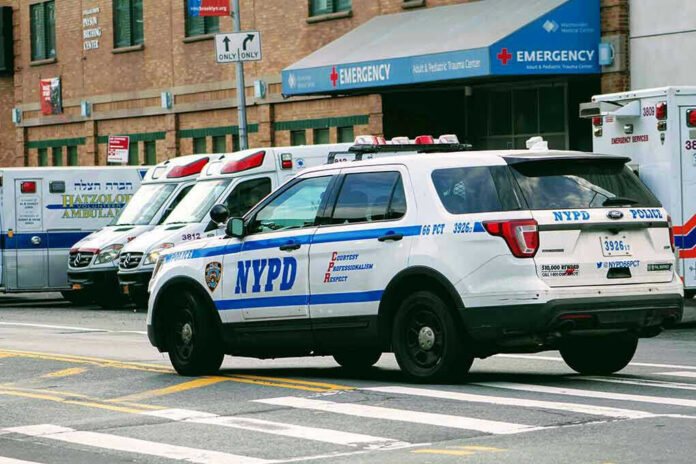
According to police and law-enforcement sources, Chasna Thelemaque was riding in a Toyota RAV4 identified as an Uber on the Brooklyn-Queens Expressway when she exited through a rear door while the vehicle was still moving in the early hours of the morning. She landed in the right lane of the westbound roadway near Exit 28 and was struck by a Hyundai Elantra; the Elantra’s driver was taken into custody on suspicion of driving while intoxicated. Thelemaque died from her injuries at the scene.
Three elements shape the legal and safety analysis from this starting point. First, the passenger’s exposure occurred directly in a live traffic lane at highway speeds, where survivability is minimal. Second, the involvement of an allegedly intoxicated driver adds a criminal layer—distinct from, but intertwined with, civil fault allocation. Third, the rideshare setting raises familiar questions about duties owed by the for-hire driver and the platform when passenger behavior creates acute roadway risk.
Why High-Speed Roadway Exposure Is So Often Fatal
Pedestrian deaths disproportionately occur away from intersections on roads posted at higher speeds—environments with limited reaction time, poor refuge options, and kinetic energy levels that overwhelm human tolerance for impact. Federal data show that roughly three-quarters of pedestrian fatalities occur at non-intersection locations and on roads with speed limits at or above 30 mph; on limited-access facilities, the risk is starker still because drivers do not anticipate pedestrians in the travel lanes.
National crash compendia do track pedestrians struck while entering or exiting parked or stopped vehicles, but those categories do not capture an individual stepping—or falling—into an active lane from a still-moving car, a scenario that collapses the available buffer to near zero. In practice, that means tiny behavioral triggers—startle, confusion, a door inadvertently opened—can convert a survivable close call at curbside into a lethal exposure measured in seconds on a freeway.
Untangling Criminal and Civil Responsibility
In roadway deaths involving intoxication, prosecutors often pursue charges ranging from vehicular manslaughter to aggravated vehicular homicide when impairment and reckless operation are supported by evidence such as blood alcohol tests, crash reconstruction, and witness statements. New York caselaw reflects the range of charging theories and evidentiary burdens in fatal and serious-injury crashes tied to intoxicated or reckless driving. While each case turns on its record, the legal through-line is straightforward: intoxication plus causation supports criminal liability; intoxication plus attenuation does not.
Parallel civil claims ask a different question: how to apportion fault when multiple acts combine to create the lethal risk. New York’s comparative negligence regime permits juries or judges to allocate percentages of responsibility to each actor whose conduct was a substantial factor—passenger, for-hire driver, and striking motorist among them. Rideshare cases layer on platform issues: plaintiffs frequently argue vicarious liability or negligent policies, while platforms rebut with independent-contractor defenses and disclaimers embedded in their terms. Courts in New York have repeatedly scrutinized, and in many instances narrowed, vicarious claims against platforms absent a demonstrable right of control amounting to employment or evidence of independent negligence by the company.
Rideshare Duty of Care: The Narrow Lane Between Passenger Autonomy and Driver Control
For-hire drivers owe passengers a duty of reasonable care in operation and in decisions about where and how to stop. On high-speed facilities, that duty pulls in opposite directions: stopping on a gore point or shoulder can itself create a hazard; continuing to a safe exit may feel untenable if a passenger insists on immediate egress. Most platforms instruct drivers to avoid unsafe drop-offs, use designated exits, and, if necessary, contact emergency services rather than facilitate a dangerous stop. When a passenger attempts to leave a moving vehicle, the driver’s options are constrained by physics; the best practice is preventative—clear communication, locked rear doors while moving where lawful and configured, and selection of safe pull-off locations.
Arbitration and court decisions outside New York have scrutinized whether platform policies, complaint handling, or driver guidance contributed to foreseeable harm. In a widely publicized California arbitration award, Uber was held jointly responsible after a driver ejected passengers at an illegal freeway location and a young woman was struck and killed; the arbitrator rejected an independent-contractor defense and faulted platform-level safety practices, resulting in a substantial monetary award. While that decision turned on California law and a specific evidentiary record, it underscores the policy stakes: when a for-hire trip goes wrong on a limited-access road, granular choices about where to stop and how to handle passenger distress can be outcome-determinative.
Mechanics of Catastrophe on Limited-Access Roads
The physics are unforgiving. At 50 mph, a vehicle covers roughly 73 feet per second; even an attentive, unimpaired driver needs perception-reaction time—commonly estimated at about 1.5 seconds—before braking begins. In that window alone, a pedestrian newly emerged in-lane has already been overtaken by more than 100 feet of roadway. Headlights, sightlines, lane curvature, and ambient lighting further compress the usable envelope. It is no surprise that in single-vehicle pedestrian fatalities, the initial impact is most often with the vehicle’s front, reflecting limited opportunity for evasive maneuvers once a pedestrian materializes in the traffic stream.
Layer intoxication onto that geometry and the risk multiplies. Impairment lengthens reaction time, narrows visual scanning, and degrades speed management; the very faculties needed to avoid an unexpected pedestrian on a freeway are the ones alcohol undermines. That is why prosecutors and legislatures treat freeway strikes by impaired drivers with exceptional gravity—and why defense counsel fight so hard over toxicity thresholds, chain of custody, and alternative causation theories.
Practical Implications for Platforms, Drivers, and Policy
For platforms, two imperatives stand out. First, driver guidance must be explicit about freeway scenarios: do not facilitate egress in live lanes or at non-refuge areas; proceed to the next safe exit; call for assistance if a passenger insists on an unsafe stop. Second, complaint systems should elevate patterns of hazardous driving or passenger-handling behavior for real review, not just refunds; repeated warnings about risky stops or erratic conduct are a leading indicator of catastrophe if left unaddressed.
For regulators and city DOTs, the design problem is tangible: where dense nightlife and for-hire demand overlap with limited-access roadways, adding safe pull-off refuges near exits, improving lighting, and tightening signage around gore points can reduce the incentive—and the perceived necessity—for dangerous stops. For drivers and riders, the rule is simple but lifesaving: no one exits into live traffic. If a medical or safety emergency arises, decelerate to a safe shoulder or exit, or summon help. On a freeway, even a few seconds of exposure is more than enough to make the worst outcome inevitable.
Sources:
nypost.com, crashstats.nhtsa.dot.gov, nhtsa.gov, nycourts.gov
© impactheadlines.com 2026. All rights reserved.