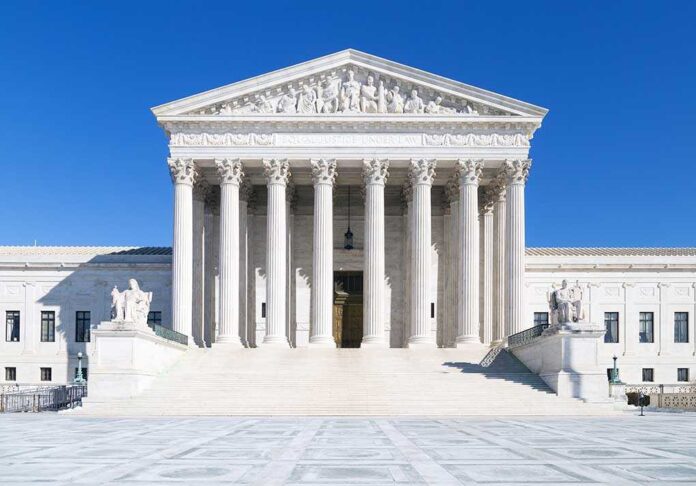
As the Supreme Court prepares to decide whether President Trump’s sweeping tariffs violate the Constitution, Americans face a pivotal moment that could redefine the balance of power in Washington.
Story Snapshot
- The Supreme Court will soon rule on Trump’s use of emergency powers to impose global tariffs without specific congressional approval.
- Lower courts have found Trump’s actions exceeded presidential authority, but tariffs remain in place pending Supreme Court review.
- This case could reshape the separation of powers, curb executive overreach, and set a precedent for future administrations.
- Over $210 billion in tariff revenue and the principle of congressional control over trade policy are at stake.
Supreme Court to Decide Limits of Presidential Emergency Powers
This fall, the U.S. Supreme Court is set to hear a landmark case that will determine whether President Trump’s 2025 tariffs, imposed under the International Emergency Economic Powers Act (IEEPA), are constitutional. The administration argues these tariffs are vital for national security, but critics say the move bypasses Congress and undermines the Constitution’s clear assignment of tariff authority to the legislative branch. Lower courts have already ruled that Trump’s use of emergency powers for tariffs was illegal, yet the tariffs continue as the nation waits for the Supreme Court’s decision.
The outcome of this case is about more than just trade policy. At its core, it’s a test of whether any president—now or in the future—can use emergency declarations as a loophole to push through sweeping economic measures without congressional approval. The “major questions doctrine,” recently invoked by the Court to check executive overreach, will be central to arguments. Many conservatives see this as an overdue check on decades of creeping executive power that has allowed unelected bureaucrats and presidents to make laws outside of Congress, threatening the very structure of American self-government.
Congressional Authority and the Constitution Under Threat
For generations, the Constitution has given Congress—not the president—the clear authority to set tariffs and regulate international commerce. The IEEPA was intended for sanctions and asset freezes in true emergencies, not as a backdoor for trade wars by executive fiat. Past abuses, such as Nixon’s emergency tariffs, led Congress to restrict such powers. Legal scholars and three federal courts have now concluded that Trump’s move goes far beyond what the law intended. If unchecked, this precedent would let future presidents—regardless of party—sidestep Congress and act unilaterally on a host of issues, eroding the checks and balances at the heart of our system.
President Trump’s supporters argue forceful executive action is essential for protecting American jobs and negotiating tough trade deals, especially after years of globalist policies and weak enforcement. Yet, the risk is that in the wrong hands, such unchecked power could be weaponized against conservative values or used to target other constitutional rights, from the Second Amendment to religious liberty. This is why many constitutionalists, including those who back Trump’s trade agenda, want the Court to set firm limits now before the damage to our system is irreversible.
Economic and Political Stakes for American Families
With over $210 billion in tariff revenue collected in 2025 alone, the stakes are enormous for American businesses, farmers, and families. If the Supreme Court strikes down the tariffs, importers may receive substantial refunds, but the disruption could cascade through supply chains and trade negotiations. The uncertainty is causing headaches for manufacturers, small businesses, and consumers already battered by years of inflation and government overreach. For the U.S. Treasury, losing this revenue could pressure lawmakers to either raise taxes or slash spending, igniting fresh debates in Congress.
Politically, the case arrives at a time of fierce division, with the 2026 midterm elections looming and both sides framing the issue as a battle for the soul of the Republic. Trump has warned of economic “devastation” if the tariffs are overturned, while critics argue that Congress must reclaim its rightful role to prevent future abuses. Legal experts agree the Supreme Court’s decision will have far-reaching consequences not just for trade, but for the entire balance of power in America. Limited data is available on how the justices will rule, but the decision will almost certainly echo for generations.
Expert Perspectives and the Road Ahead
Most legal experts believe the IEEPA does not authorize tariffs, and three lower court rulings have affirmed this view. However, some observers note the Supreme Court, with several Trump-appointed justices, has recently shown deference to executive power in select contexts. The major questions doctrine may tip the scales, requiring clear congressional authorization for significant executive actions. As the case moves forward, Americans watch closely—knowing that how the Court rules will define the limits of presidential power, the future of economic policy, and the health of our constitutional system.
Sources:
Court finds Trump’s tariffs an illegal use of emergency power but leaves them in place for now
Trump asks Supreme Court to save his emergency tariffs
Trump asks Supreme Court to save his emergency tariffs
Trump asks Supreme Court to save his emergency tariffs
A Supreme Court showdown looms for Trump’s tariffs: Will it limit presidential power?
Presidential emergencies, tariffs, and the Supreme Court’s next move
Trump tariffs, IEEPA, Supreme Court arguments, emergency powers