Sudan’s paramilitary forces have established a rival government while systematically targeting civilian populations in Darfur, creating a humanitarian catastrophe that threatens to permanently fracture the African nation.
Story Highlights
- Rapid Support Forces (RSF) paramilitaries have overrun key Darfur cities while declaring a parallel government
- Over 10 million civilians displaced with famine spreading across five areas of North Darfur
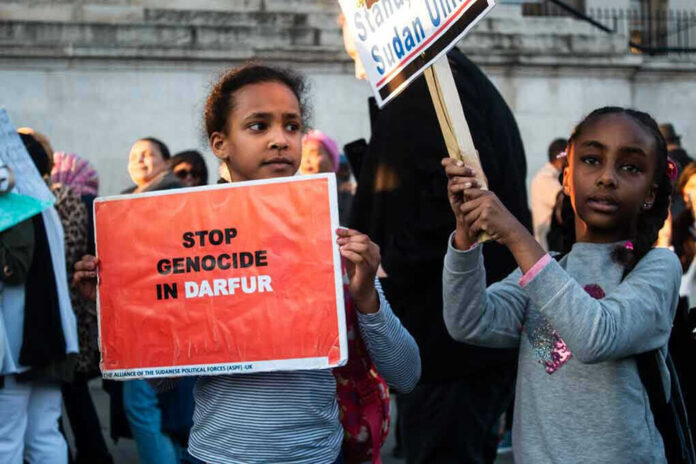
- RSF attacks on non-Arab communities raise serious allegations of ethnic cleansing and genocide
- Sudan government files International Court of Justice case against UAE for allegedly arming RSF
RSF Establishes Parallel State Structure
The Rapid Support Forces, led by General Mohamed “Hemedti” Dagalo, proclaimed a “Government of Peace and Unity” in April 2025, directly challenging the legitimacy of Sudan’s official government. This paramilitary group has adopted its own constitutional framework and announced plans to issue identification documents and currency, signaling intentions for long-term territorial control. The RSF’s declaration represents a dangerous escalation from military rebellion to attempted state-building, threatening Sudan’s territorial integrity and constitutional order.
Originally formed from Janjaweed militias accused of genocide in the 2000s, the RSF has renewed its campaign against non-Arab populations in Darfur with devastating effectiveness. The group now controls most of the western region while the Sudanese Armed Forces maintain authority over central Sudan, creating a de facto partition that could become permanent without decisive international intervention.
Humanitarian Crisis Reaches Catastrophic Levels
Famine conditions now exist in five areas of North Darfur, with five additional regions at risk by mid-2025, according to UN assessments. The scale of human suffering has reached unprecedented levels, with basic services collapsed and aid organizations struggling against access restrictions and funding shortfalls. The situation worsened when the United States paused international aid, leaving vulnerable populations without critical support during their greatest hour of need.
Civilian populations bear the heaviest burden of this conflict, facing systematic displacement, ethnic targeting, and deliberate starvation tactics. Women and children suffer disproportionately from gender-based violence and loss of education and healthcare services. The breakdown of community structures has left families scattered across refugee camps in neighboring Chad, South Sudan, and Ethiopia, creating regional instability.
International Community Fails to Stop Atrocities
Despite clear evidence of systematic violence against civilian populations, international mediators including the United States, Saudi Arabia, African Union, and United Nations have achieved limited success in their diplomatic efforts. Multiple ceasefire agreements have collapsed, highlighting the inadequacy of current intervention strategies. The paralysis of international institutions in the face of obvious humanitarian crimes demonstrates the weakness of global governance structures when confronting determined military actors.
Sudan’s government has taken the extraordinary step of filing charges at the International Court of Justice against the United Arab Emirates, alleging that UAE arms supplies to the RSF constitute complicity in genocide. This legal action could establish important precedent for holding foreign nations accountable for fueling civil conflicts, but immediate relief for suffering populations remains elusive while diplomatic processes unfold.
Sources:
Sudan Conflict Timeline – Fanack
Power Struggle in Sudan – Council on Foreign Relations
Sudan Timeline January-March 2025 – Dabanga Sudan
Timeline of the Sudanese Civil War 2025 – Wikipedia