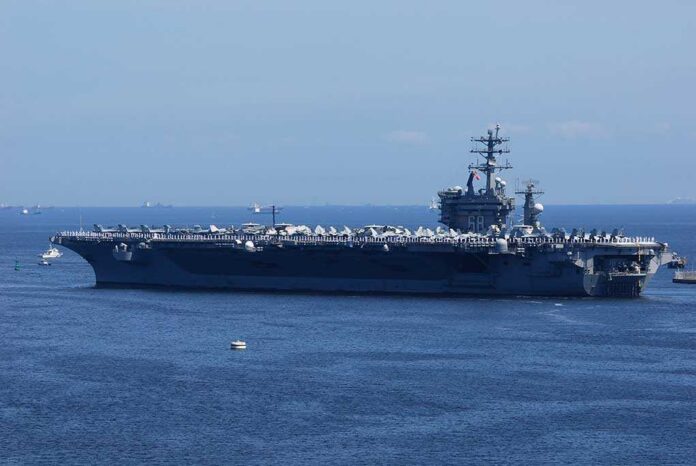
Iran claims its cruise missiles struck America’s USS Abraham Lincoln aircraft carrier, but the United States military flatly denies it happened—leaving the world with two contradictory narratives and zero independent proof.
Story Snapshot
- Iran’s Revolutionary Guard claims cruise missiles hit USS Abraham Lincoln near the Strait of Hormuz in late March 2026
- US Central Command released photos showing the carrier operational at sea, directly contradicting Iranian assertions
- The disputed strike claim emerged during Operation True Promise IV, Iran’s massive retaliatory campaign following US-Israeli attacks
- Iran fired over 500 ballistic missiles and 2,000 drones at US bases across the Middle East and targets in Israel
- Independent verification of the carrier strike remains absent, forcing reliance on competing military propaganda
When Nobody’s Story Adds Up
The Islamic Revolutionary Guard Corps released footage showing missiles launching from Iran’s coastline toward the Persian Gulf, claiming they struck the 100,000-ton nuclear-powered carrier operating 250-300 kilometers off Iran’s coast near Chabahar. Guards spokesperson Ali Mohammad Naini stated the carrier subsequently retreated toward the southeastern Indian Ocean. Iranian Army Public Relations echoed the success claim through state media channels. Yet United States Central Command countered with operational images of Abraham Lincoln at sea, showing no visible damage or operational disruption.
This represents more than a simple he-said-she-said dispute. The absence of neutral observers, satellite imagery from commercial providers, or statements from allied naval forces operating in the region creates an information vacuum filled only by partisan claims. Iran’s motivation to project strength remains obvious—demonstrate capability to American audiences and shore up domestic support following devastating US-Israeli strikes that killed Supreme Leader Khamenei. America’s motivation to deny damage seems equally transparent—maintain deterrence credibility and avoid projecting vulnerability. The truth likely resides somewhere neither party wants to acknowledge publicly.
The Broader War Nobody Saw Coming
The carrier controversy represents one thread in a tapestry of escalation that transformed the Middle East into an active combat zone within weeks. In late February 2026, President Trump authorized what he termed “major combat operations” against Iran—a coordinated US-Israeli preemptive strike targeting nuclear facilities, military bases, and command infrastructure. The operation killed Iran’s Supreme Leader, senior officials, and civilians during active nuclear negotiations, shattering any remaining diplomatic framework between Washington and Tehran.
Iran’s response came within hours. Operation True Promise IV unleashed an unprecedented barrage across the region—missiles struck Al Udeid Air Base in Qatar, Ali Al Salem Air Base in Kuwait, Al Dhafra Air Base in the United Arab Emirates, and the US Navy Fifth Fleet headquarters in Bahrain. Iran demonstrated range previously questioned by Western analysts, firing a 4,000-kilometer ballistic missile at Diego Garcia in the Indian Ocean. One missile fragmented mid-flight while another met an SM-3 interceptor launched from a US warship, according to CNN and The Wall Street Journal reporting.
The naval dimension expanded beyond the Abraham Lincoln controversy. A US submarine sank the Iranian vessel USS Dena—marking the first submarine combat sinking since the Falklands War and the first by an American submarine since World War II. Separately, the USS Gerald R. Ford, America’s most advanced carrier, docked in Crete after experiencing a fire. Reports diverge on whether Iranian action caused the damage or if mechanical issues were responsible, but the incident forced the Navy’s flagship from the battlefield regardless of cause.
Iran’s missile inventory tells its own story about the campaign’s intensity. Intelligence estimates suggest Iran possessed approximately 1,500 ballistic missiles before the conflict began. By early March, after firing over 500 ballistic and naval missiles plus nearly 2,000 drones, roughly 1,000 missiles remained. This depletion rate—one-third of strategic inventory expended in days—indicates either desperation, confidence in production capacity, or acceptance that this conflict represents an existential moment requiring maximum effort regardless of future stockpile concerns.
Strategic Implications Beyond the Headlines
The Strait of Hormuz, where Iran claims it struck Abraham Lincoln, channels one-third of global maritime oil trade through a chokepoint barely 21 miles wide at its narrowest point. Iranian anti-ship missiles positioned along this corridor represent more than military hardware—they function as economic leverage over energy-dependent nations worldwide. Whether Iran actually struck the carrier matters less strategically than the demonstrated willingness to target it. That willingness fundamentally alters risk calculations for every maritime insurance underwriter, shipping company, and energy importer dependent on Persian Gulf petroleum.
The conflict tests alliance structures built over decades. Turkey invoked self-defense rights after Iranian missiles struck its territory, prompting NATO Secretary General Mark Rutte to commit alliance support. Yet NATO’s Article 5 mutual defense provision was designed for European territorial defense, not Middle Eastern entanglements triggered by American preemptive strikes. The gap between treaty language and operational reality creates friction no diplomatic communique can smooth over. Regional US allies hosting targeted bases—Qatar, Bahrain, Kuwait, the UAE—issued evacuation orders and shelter-in-place warnings, disrupting normal operations and raising questions about sustainable force posture in an environment where host nations become targets.
Iran’s demonstrated capability to launch Operation True Promise IV within hours of suffering catastrophic leadership decapitation reveals command structures more resilient than Western planners assumed. The traditional model presumed removing top leadership would paralyze decision-making and create operational confusion. Instead, Iran executed a coordinated multi-domain campaign spanning thousands of kilometers while simultaneously managing domestic succession issues. This resilience suggests either pre-delegated authorities, redundant command channels, or operational planning sophisticated enough to survive leadership disruption. None of these possibilities comfort American strategists accustomed to assuming technological and organizational superiority.
What the Propaganda War Reveals
The credibility contest over Abraham Lincoln’s status exposes broader challenges in modern conflict verification. Iran released video footage of coastal missile launches—easily authenticated as showing missiles leaving launchers, but proving nothing about what those missiles subsequently hit. The United States released images of Abraham Lincoln at sea—easily authenticated as showing an operational carrier, but revealing nothing about potential damage below deck, temporary repairs, or reduced capability. Both sides provide evidence supporting their narrative while withholding information that might contradict it.
This information environment rewards bold claims and punishes admissions of vulnerability. Iran faces domestic pressure to demonstrate strength following devastating strikes that eliminated its supreme leader. Admitting missile failure undermines the regime’s core promise—protecting Iranian sovereignty through deterrence. America faces international pressure to maintain credible power projection. Admitting damage to a carrier strike group undermines decades of investment in naval supremacy and emboldens adversaries globally. The result creates competing realities sustained by partial evidence and motivated reasoning on both sides. Independent verification would require access neither party will grant and overhead imagery neither has released.
The pattern repeats throughout the conflict. Iranian claims regarding the USS Gerald R. Ford remain similarly disputed—some reports suggest Iranian attack damage forced the carrier to Crete, while others cite mechanical fire unrelated to combat. Casualty figures remain fragmentary, with only 104 Iranian military deaths and 32 injuries confirmed from the submarine engagement. Broader human costs—civilian deaths from the initial US-Israeli strikes, casualties from regional missile impacts, humanitarian displacement—receive minimal coverage in available reporting. This opacity serves all parties by preventing accountability while enabling continued escalation without political consequences from casualty-averse populations.
The Unanswered Questions That Matter Most
Beyond the tactical dispute over one carrier’s status lies a strategic question with global implications: what rules, if any, govern preemptive military action between nations not formally at war? The Trump administration justified the February strikes as necessary to prevent Iranian nuclear weapons development and protect American interests. Iran characterized its response as legitimate self-defense following unprovoked aggression. International law offers no clear framework for adjudicating these competing claims when both sides cite security imperatives while ignoring diplomatic alternatives.
The economic consequences extend beyond immediate oil price volatility. Reconstruction costs for damaged Iranian infrastructure, military expenditure surges across the region, insurance premium increases for Gulf shipping, and displacement of civilian populations create long-term drains on regional economies already stressed by energy transition pressures. The conflict accelerates trends—diversification away from fossil fuels, development of alternative shipping routes, investment in domestic energy production—that undermine the strategic importance of the very territory over which the fighting occurs. Iran and America wage war over a region whose global centrality may not survive the decade, making the conflict’s human and economic costs even more tragic in retrospect.
President Pezeskhian’s March 7th announcement that Iran would cease striking neighboring countries unless attacked from their territory suggests recognition that the campaign’s costs may exceed its benefits. Yet this conditional ceasefire depends on American restraint and regional neutrality—neither guaranteed given the conflict’s momentum. The depleted missile inventory constrains Iran’s options going forward, but also creates pressure to maximize impact from remaining weapons before stockpiles are exhausted. The United States maintains overwhelming conventional superiority but faces challenges sustaining operations across multiple theaters with finite resources and war-weary populations. Neither side has achieved decisive advantage, yet neither can afford to appear weak by seeking de-escalation.
Sources:
Iran International – IRGC Claims Missile Strike on USS Abraham Lincoln
Business Insider – US Forces in Air Defense Battles with Iran
Naval Today – US Denies Missile Hit on USS Abraham Lincoln