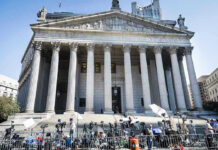
German prosecutors just stormed Deutsche Bank offices over suspected money laundering tied to a sanctioned Russian oligarch—another reminder that “too big to fail” institutions still can’t be trusted to police themselves.
Quick Take
- German federal police and Frankfurt prosecutors searched Deutsche Bank’s Frankfurt headquarters and a Berlin office on January 28, 2026.
- Investigators are probing suspected money laundering and alleged failures to promptly flag suspicious transactions under Germany’s anti-money-laundering rules.
- The case centers on Deutsche Bank’s past dealings with foreign firms reportedly linked to Roman Abramovich, covering transactions from 2013 to 2018.
- Deutsche Bank confirmed the searches and said it is cooperating, while prosecutors have not disclosed transaction details and reported no arrests.
Raids Hit Frankfurt and Berlin as Prosecutors Target AML Failures
German investigators searched Deutsche Bank locations in Frankfurt and Berlin early Wednesday, January 28, 2026, under orders from Frankfurt prosecutors’ economic crime unit working with federal police. Reporting indicated roughly 30 plainclothes investigators took part in Frankfurt. Authorities said they are investigating “unknown” responsible employees and managers for suspected anti-money-laundering violations. Deutsche Bank confirmed the searches and said it is cooperating, offering no further comment as the probe unfolds.
Prosecutors have not publicly identified specific transactions or amounts, which limits outside assessment of the scope. What is clear is the allegation that suspicious activity was not reported quickly enough—an issue that goes to the heart of banking compliance. Under Germany’s anti-money-laundering framework, delays can become the alleged offense, especially when funds involve higher-risk clients, foreign intermediaries, or politically exposed persons. For ordinary citizens, the frustration is straightforward: the rules feel strict for everyone except elite institutions.
Abramovich Link Puts Sanctions Enforcement Back in the Spotlight
German media reporting described the investigation as tied to Deutsche Bank’s past business with foreign companies linked to Roman Abramovich, a Russian billionaire sanctioned by the European Union in 2022 amid the fallout from Russia’s invasion of Ukraine. Investigators are reportedly examining transactions from 2013 through 2018 and whether those flows were used to launder money through banking channels. Authorities have not accused Abramovich in the raid announcements, but the connection underscores why sanctions-era compliance is now treated as national-level security policy.
The timing matters. Deutsche Bank had an earnings release scheduled immediately after the raid, a reminder that enforcement actions can quickly collide with markets and retirement accounts. A major bank can stay profitable while still facing questions about internal controls, correspondent banking relationships, and how aggressively compliance staff escalated red flags. The public does not yet have prosecutors’ detailed evidence, but the repeated pattern—raids, investigations, fines—shows why regulators keep returning to the same institution and the same vulnerability: weak gatekeeping.
Deutsche Bank’s History of Scrutiny Raises Hard Questions About Reform
Deutsche Bank has faced years of anti-money-laundering scrutiny, including cases tied to high-risk correspondent banking. Prior reporting connected the bank to transactions involving Danske Bank’s Estonian branch during a massive money-laundering scandal, and regulators have penalized Deutsche Bank for delayed reporting. The bank has also faced significant penalties from U.S. and U.K. authorities in past years over Russian “mirror trades” and other control failures. Those precedents frame today’s raid as more than a one-off compliance slip.
Authorities also searched Deutsche Bank offices in Frankfurt in 2022 in separate investigations, including allegations involving late suspicious activity reports and other misconduct inquiries touching its asset-management arm. Those earlier cases did not end the story; they set a baseline expectation that controls should have improved. That is the key credibility test now: if a global bank absorbed fines, promised reforms, and still gets raided again, voters and investors reasonably wonder whether compliance has become a box-checking exercise rather than a serious line of defense.
What the Case Means for Accountability and Limited-Government Voters
Conservatives generally want limited government, but limited government does not mean lawless finance. A free-market system depends on clear rules applied evenly, not a two-tier regime where insiders get endless second chances. If prosecutors can prove that suspicious transactions were mishandled or reported late, the likely next steps could include penalties, tighter oversight, and internal consequences at the bank. If prosecutors cannot prove it, the public still deserves transparency about why major institutions repeatedly reach this point.
Deutsche Bank is currently the target of investigations by the Federal Criminal Police Office. Authorities are searching premises in Frankfurt and Berlin on suspicion of money laundering.
➡️ https://t.co/y1sP2pEtpf pic.twitter.com/S1gVP7Traa— euronews (@euronews) January 28, 2026
For now, the investigation remains active, with no arrests reported and limited public detail about the transactions under review. Deutsche Bank’s cooperation statement may help operationally, but it does not answer the core question: how did a bank with years of enforcement history still end up under search warrants tied to oligarch-linked business? As Western governments tighten sanctions and financial surveillance, the constitutional concern is consistency—punish proven wrongdoing, protect due process, and stop letting politically connected money test the system’s guardrails.
Sources:
Authorities raid Deutsche Bank offices in money laundering probe
BREAKING: German police conduct raids at Deutsche Bank sites; internal ML suspects targeted
German investigators search Deutsche Bank offices in money laundering probe
Deutsche Bank offices searched in money laundering probe