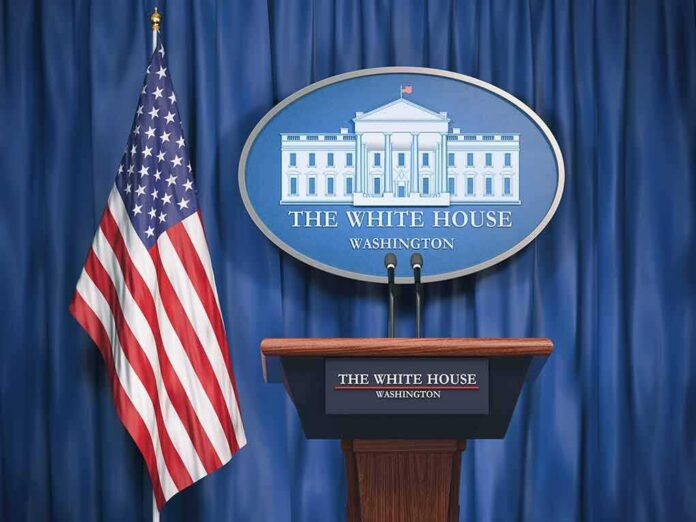
President Trump has drawn a clear red line with Europe: tax American tech, and you pay a 100% price tag at the U.S. border.
Story Snapshot
- Trump warns European countries that any “digital services tax” on U.S. tech will trigger a 100% tariff on their exports to America.
- The administration has reopened trade investigations and is building legal tools to punish foreign governments that target U.S. digital companies.
- European leaders claim a “sovereign right” to tax, even as their rules fall hardest on American firms while giving rivals like China more room.
- A bigger fight is emerging over who controls the digital economy and whether America will let foreign bureaucrats drain U.S. jobs and innovation.
Trump’s 100% Tariff Threat: Drawing a Line for American Tech
President Donald Trump has issued one of his strongest trade warnings yet, aimed straight at European governments pushing new “digital services taxes” that mainly hit U.S. technology companies like Google, Amazon, and Meta.[5] In a social media post, Trump said these digital taxes are “designed to harm, or discriminate against, American Technology” and warned that any country that imposes them “will immediately be met with a 100% TARIFF on any and all Goods” shipped into the United States.[5] That is not a small threat. A 100% tariff means European goods could instantly double in price for American buyers. This would hit European wine, luxury goods, autos, and more, while signaling to voters at home that the White House is done letting foreign governments milk U.S. companies to plug their own budget holes.
This latest warning did not come out of nowhere. As early as 2019 and 2020, the U.S. Trade Representative launched investigations into France’s digital tax, after Paris moved ahead with a special levy on large online platforms that mostly affected American firms.[16] At that time, Washington threatened tariffs on French products and only paused once France delayed full enforcement of its tax.[16] In February 2025, Trump went further, signing a presidential memorandum that labeled these kinds of foreign measures “overseas extortion and unfair fines and penalties” on American technology companies.[13] The memo ordered agencies to study digital taxes, foreign tech rules, and speech controls, and to recommend retaliatory steps, including tariffs and even higher U.S. tax rates on companies from countries that target American businesses.[13] In other words, Trump has been building toward this moment for years.
Europe’s Digital Taxes: Neutral Law or Targeted Hit on America?
European officials insist they are doing nothing wrong. The European Commission has argued it is the “sovereign right” of European Union states to regulate and tax economic activity on their territory “consistent with our democratic values.”[11] France, which has one of the most aggressive digital taxes, says its 3% levy applies to any large digital company earning more than set revenue thresholds in France and worldwide, no matter what flag they fly.[10] That claim allows European leaders to say the tax is neutral on paper. But in practice, those thresholds mostly capture a handful of very large online platforms, and the biggest of those are American. Trump and his team argue that is the whole point: write rules that appear neutral, but in reality bite the U.S. far harder than local or Chinese competitors.[4] The administration has even warned that some European proposals give “a complete pass to China’s largest tech companies,” though open legal proof of that gap is still thin.[4] For many American conservatives, the pattern looks familiar: globalist bureaucrats talking about “fairness” while writing rules that drain U.S. jobs, innovation, and tax revenue to prop up their own failing welfare states.
Behind the tax fight sits a larger clash over who sets the rules for the internet and the digital economy. Trump’s 2025 memorandum made clear that the White House is not only worried about money, but also about free speech.[15] It directed U.S. agencies to examine whether European laws, including the Digital Markets Act and Digital Services Act, effectively push or pressure U.S. platforms to censor political speech or shape online debate.[15] If foreign governments can use taxes and regulations to strong-arm American companies into enforcing their speech codes, that is not just a trade issue — it becomes a direct threat to core American values like the First Amendment and open debate. For readers who have watched “woke” censorship spread through Silicon Valley and legacy media, the idea of Brussels bureaucrats adding another layer of pressure should raise real concern. Trump’s team is signaling that it sees this as part of a single fight: protect American workers, American innovators, and American speech from foreign and globalist interference.
Tariffs, Courts, and the Coming Digital Trade War
There is still a major question: can the administration actually enforce a blanket 100% tariff that claims to override existing trade deals? Some earlier Trump-era tariffs ran into legal trouble, and courts pushed back on the broad use of emergency trade powers, which critics now point to as a sign that a new 100% move could face lawsuits.[5] At the same time, Trump’s 2025 directive laid out several legal tools Washington may use, including Section 301 of the Trade Act and Section 891 of the Internal Revenue Code, which allows the U.S. to double tax rates on companies and individuals from countries with discriminatory taxes.[13] The memo also floated using emergency economic powers to apply quick restrictions or tariffs when foreign governments cross the line.[13] These are not empty threats. The administration has already revived trade investigations focused on digital taxes and has a record of using tariffs to force talks or bring partners back to the table.[3] Still, there is risk. Studies of past tariffs show that when other countries hit back, some gains for American consumers can vanish under retaliation.[20] That is one reason big multinational businesses and some members of Congress grumble whenever the White House reaches for strong tariffs.
BREAKING: Trump hits back at countries taxing US tech firms — slaps 100% tariffs on nations with Digital Services Tax 💰🇺🇸
— BALBOA_MOSHA (@MoshaBalboa) June 26, 2026
Europe is not just sitting quietly, either. During earlier rounds of this dispute, the European Union prepared its own retaliatory tariffs of about 25% on tens of billions of dollars in U.S. exports but held back to “observe how negotiations would unfold.”[6] European leaders now talk tough on sovereignty and reject the idea that Washington can veto their tax laws, yet their reluctance to pull the trigger on full retaliation suggests they know how much they rely on the American market.[6] For U.S. conservatives, the core question is simple: should foreign governments be allowed to quietly siphon money and control from American companies through clever tax schemes and speech codes, or should the United States finally use its economic weight to defend its workers, its innovators, and its constitutional values? Trump has chosen the second path and backed it with a 100% warning. The coming months will show whether Europe backs down, doubles down, or pushes the world closer to a full-blown digital trade war.
Sources:
[3] Web – Trump Threatens 100% Tariff On European Countries Over Digital …
[4] Web – Trump Threatens More Tariffs for Countries With Digital Taxes
[5] Web – Trump threatens tariffs on nations imposing digital taxes on US tech
[6] Web – Trump vows immediate 100% tariff if countries levy digital services …
[10] Web – EU Defends Digital Taxes Following Trump’s Tariff Threat – Law360
[11] Web – Trump Threatens Tariffs Over EU And UK Digital Taxes
[13] Web – Tech and taxes risk derailing Trump’s EU trade deal
[15] YouTube – Trump Threatens Tariffs, Export Curbs to Combat Digital Tax
[16] Web – Trump Revives and Expands the Battle Over Digital Services Taxes
[20] Web – US president warns of trade retaliation over UK’s 2% digital services …
© impactheadlines.com 2026. All rights reserved.