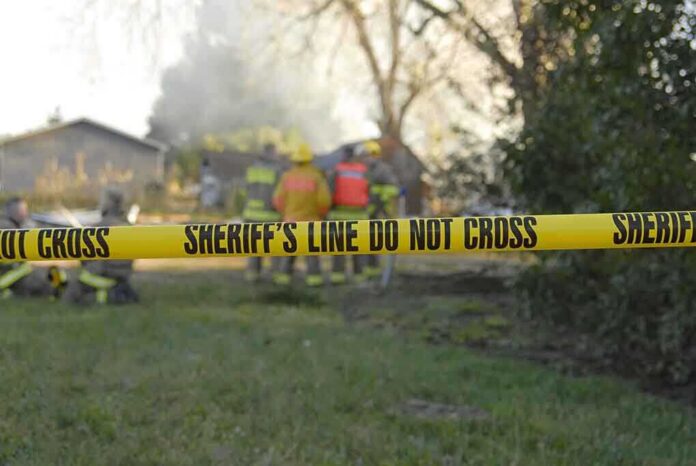
When domestic violence intersects with firearm access, escalation to irreversible tragedy can unfold in minutes; the Strawberry, Marin County double murder-suicide that claimed three members of the Mannix family is a stark, documented case of that lethal dynamic.
At a Glance
- Marin County authorities report a suspected double murder-suicide inside a Strawberry Circle residence; three adults were found dead.
- The deceased were identified as retired SFPD sergeant Kevin Mannix, his wife, retired SFPD Deputy Chief Ann Mannix, and their daughter, Katherine.
- The Sheriff’s Office describes the incident as a suspected double murder-suicide initiated by a male shooter; there was no ongoing threat to the public.
- The episode aligns with research showing firearm access dramatically increases lethality in intimate-partner violence.
A confirmed domestic shooting with three fatalities
On a Sunday just after 5 p.m., Marin County dispatchers received a 911 call reporting shots fired inside a home on Strawberry Circle in the unincorporated community of Strawberry near Mill Valley. Deputies entered the residence and found three deceased adults. In its contemporaneous account, the Marin County Sheriff’s Office deemed the case a suspected double murder-suicide with a male shooter and emphasized that there was no continuing threat to the neighborhood. The coroner later identified the deceased as Kevin Mannix, 68, a retired San Francisco Police Department sergeant; his wife, Ann Elizabeth Corriea Mannix, 65, a retired SFPD deputy chief; and their 24-year-old daughter, Katherine Elizabeth Mannix.
Local reporting, corroborating the Sheriff’s preliminary findings, described the sequence as Kevin Mannix fatally shooting his estranged wife and their daughter before killing himself. Multiple outlets, citing the sheriff’s statements and property records, placed the event inside the family’s home, with at least one person inside able to call 911 and escape. The Sheriff’s Office outlined standard investigative steps—securing the scene, awaiting search warrants for detailed processing, and scheduling autopsies—while withholding granular evidence to preserve the integrity of the case.
Who they were—and why this hit the law enforcement community hard
Both adults killed had long careers in the San Francisco Police Department. Ann Mannix retired as a deputy chief and was a visible figure in specialized assignments and leadership roles; colleagues publicly mourned her and her daughter in the days after the shooting. Kevin Mannix served about 27 years as an SFPD sergeant before retiring; in Marin County’s preliminary assessment, he is the suspected shooter who died at the scene. Coverage in the Bay Area underscored the dissonance between their professional identities—particularly Ann’s—forged in a culture that trains to intervene in violence, and the private catastrophe that unfolded in their own home.
Friends and neighbors, as frequently happens after intimate-partner homicides, tried to reconcile years of outward normalcy with sudden fatal violence. Some reports surfaced of marital strain and an impending divorce, but authorities have not publicly tied those details to a determinative motive in the case, which remains a matter of record for investigators and the coroner’s findings. One brief caveat is appropriate: while the Sheriff’s Office has framed the event as a suspected double murder-suicide, formal forensic work and final reports typically follow on a slower timetable than initial scene assessments.
How the mechanics of domestic homicide-suicide typically unfold
Murder-suicide is a descriptive category: a perpetrator commits one or more homicides and dies by suicide immediately or shortly thereafter. It is not a diagnosis; it is an event sequence that guides investigative procedure and public communication, including the assurance, when warranted, that no perpetrator remains at large. In domestic contexts, the proximate trigger can be acute conflict or perceived loss of control—separation, financial stress, legal jeopardy—but the enabling factor that transforms a violent episode into a cluster of fatalities is frequently access to a firearm.
The mechanism is not abstract. Firearms compress time and distance, multiplying the lethality of impulse and intent. Research consistently documents that more than half of intimate-partner homicides in the United States involve a gun, and the presence of a firearm in domestic violence increases the risk of a woman being killed several-fold compared with incidents without a gun. Federal and state justice agencies summarize the evidence in plain terms: firearm access in abusive settings is a critical predictor of fatal outcome, and the danger extends to anyone within range—children, relatives, even intervening neighbors.
Where this case fits in a larger, measurable pattern
Even in affluent, low-crime areas—and Strawberry qualifies on both counts—the household is the relevant environment for risk. Intimate-partner violence cuts across income brackets and neighborhoods; it is relational, not locational. The literature repeatedly shows that when a gun is present, the probability curve shifts toward death rather than injury or escape. Syntheses cited by the Department of Justice, professional associations, and peer-reviewed analyses converge on two anchors: firearms are implicated in a majority share of intimate-partner homicides, and their presence multiplies homicide risk compared with otherwise similar assaults.
This does not mean every domestic dispute involving a gun ends in death, nor that policy prescriptions are simple. Evidence on the effectiveness of specific prohibitions and enforcement regimes remains mixed or context-dependent, with ongoing debate about what combination of restraining-order enforcement, risk-warrant mechanisms, and safe storage requirements best reduce harm without overreach. What the Strawberry case does show—unambiguously, in the Sheriff’s assessment and the coroner’s identifications—is how quickly a domestic flashpoint, when armed, can eliminate options for de-escalation, intervention, or survival.
A trailblazing former San Francisco deputy police chief and her 24-year-old daughter were found dead inside their Mill Valley home Sunday evening in what authorities say was a double-murder suicide carried out by her husband, a retired SFPD sergeant.
Ann Mannix, 65, was the… pic.twitter.com/qnFA1ywazE
— Fox True Crime (@FoxTrueCrime) October 12, 2026
What responsible coverage emphasizes after a murder-suicide
When journalists cover murder-suicide, the goal is to center the verified facts and the victims, avoid speculative motive narratives that elevate the perpetrator’s grievance, and provide context that helps readers understand risk and resources without inadvertently glamorizing the act. The basic definition of murder-suicide is neutral, but editorial choices matter; specificity about official findings, restraint about uncorroborated detail, and links to crisis resources are the professional norm. Law enforcement agencies likewise balance transparency with investigative integrity: they confirm fatalities, identify the deceased once next of kin are notified, and clarify public safety status; they hold back scene details and forensic specifics until they can report them authoritatively.
Practical implications for families and communities
Domestic violence is most dangerous during periods of separation or perceived loss of control by the abuser; the Strawberry reporting referenced estrangement and an anticipated divorce, a pattern consistent with higher-risk intervals documented in the research literature, though causation in any one case must be reserved for investigators. For families, the implications are concrete. Safety planning that treats firearm access as a central variable—temporary transfer, safe storage outside the home, or court-ordered removal where statutes allow—can reduce risk. For communities, knowing the warning signs and responding swiftly to escalating threats, particularly when firearms are present, is not ancillary; it is life-preserving.
Sources:
nypost.com, people.com, marinij.com, marinsheriff.gov, cbsnews.com, sfchronicle.com, doj.state.or.us, supremecourt.gov, justice.gov
© impactheadlines.com 2026. All rights reserved.