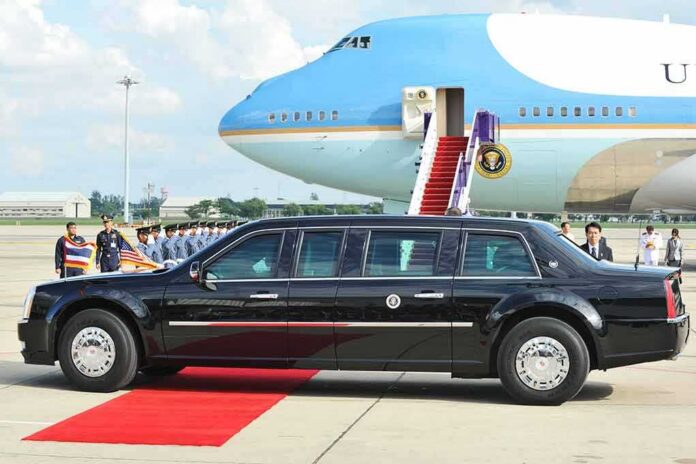
When a sitting president brings a globally recognizable artist onto Air Force One and then the rally stage, it collapses the border between governance, campaign craft, and entertainment into a single piece of political theater—one designed to travel as far online as the aircraft itself flies.
At a Glance
- Nicki Minaj flew aboard Air Force One with President Trump to Michigan, then appeared with him at a Port Huron rally.
- Onstage, Minaj offered explicit, personal support for Trump and urged backing for Republican candidates on the Michigan ballot.
- The trip and joint appearance were documented by major outlets and visuals showing Minaj disembarking and seated near the stage.
- This moment fits a long lineage of celebrity-politics crossovers whose electoral effects vary but whose media impact is immediate.
What Happened: Air Force One, a Michigan rally, and an onstage endorsement
Published reporting places Nicki Minaj aboard Air Force One with President Trump en route to Michigan, with visuals showing her stepping off the aircraft at Selfridge Air National Guard Base before the Port Huron event. Coverage from multiple outlets then documents her presence at the rally—arriving with Trump, seated near the stage, and joining him during the program. Her remarks were unambiguous in tone: an expression of ongoing support for Trump personally, including language affirming she would back him again in a future run. The onstage sequence also included her urging voters to support Republican candidates on the ticket.
The travel detail is corroborated by images and a video shared by the White House communications operation; press accounts attribute an onboard interview to Communications Director Steven Cheung, which further anchors the timeline and the setting on the aircraft. These are not stray social posts stitched into a narrative; they are consistent across mainstream coverage and stage-side observation, mapping the same Michigan-bound trip and the rally appearance.
How the staging works: access, optics, and message discipline
Presidential travel is governed by a tangle of operational security, protocol, and reimbursement rules, but the politics of the plane are simpler: who boards is a signal. Air Force One is more than transport; it is an icon. By inviting a celebrity aboard—and then threading the same figure through arrival visuals, camera-facing placement at the venue, and an onstage moment—the White House and campaign fuse logistics with message. The choice ensures that even viewers who will never watch a policy speech see and share something: a famous face in the presidential frame. The rally choreography completed the loop: Trump introduced Minaj, Minaj reciprocated with praise and electoral asks, and the cameras captured the exchange from multiple angles.
This is deliberate sequencing. Arrival visuals confer status; proximity to the stage guarantees screen time; the microphone cements the relationship in the public record. The content itself—Minaj’s lines about Trump “changing the energy” of the country and offering “a future to look forward to,” and her prompts to support Michigan Republicans—delivers both a national and down-ballot message in the idiom of pop culture. It reads as endorsement even if it is not framed as a formal campaign role or contract.
What Minaj actually said—and why words matter more than labels
Campaigns and the press often compress celebrity appearances into the term “endorsement,” but the value lies in the specific language used. Here, Minaj’s statements were plainly pro-Trump and future-oriented: a pledge of ongoing support and willingness to back another run. That phrasing telegraphs loyalty and continuity, the two currencies modern campaigns prize when translating a viral moment into volunteer energy or small-dollar giving. Down the ballot, her exhortations to support named Republican candidates localized the moment to Michigan’s races—a crucial bridge from spectacle to turnout work. The precision of those lines matters; parsing a formal endorsement agreement is less important than what voters heard and repeated.
The coverage also recorded a second, parallel narrative: Trump’s sexualized compliments about Minaj’s body. That strand dominated much of the next-day storytelling because it is easy to clip, provocative by design, and frictionless to share. As a piece of political communication, it pulls attention; as a measure of the event’s substance, it risks obscuring the straightforward facts of travel, proximity, and pledge. Both were part of the same rally; only one advances the electoral project.
Where this fits in the long history of celebrity politics
American campaigns have recruited entertainers for decades—from Frank Sinatra’s Kennedy-era glamor to Oprah Winfrey’s consequential embrace of Barack Obama. The academic literature is clear on one point and divided on another. It is clear that some endorsements can move measurable outcomes under the right conditions; scholars have estimated Oprah’s 2008 backing increased Obama’s primary vote totals by on the order of a million votes and boosted fundraising. It is divided on whether typical endorsements change candidate evaluations or vote choice at scale; experimental studies often find modest or null direct effects, with potential backlash in some audiences. Translation: the baseline effect is not guaranteed, but unusually credible or culturally central figures can punch above the norm.
So what does that mean here? Minaj commands a vast, intensely engaged fanbase and a formidable digital reach. For campaigns, that is less about persuading hardened partisans than about distribution—getting footage and frames into feeds that political media cannot natively reach. Even if the average voter’s ballot choice does not hinge on a celebrity, the amplification can still alter what people see and talk about in the days that follow, which stories lead broadcasts, and which candidates inherit momentum in earned media. That is leverage in an attention economy even before a single mind is changed.
Nicki Minaj urged Michigan voters to “vote red” at a Trump rally, while a viral post claims she can’t vote. She said in 2024 she isn’t a US citizen, and later said she was finalising citizenship paperwork, but her current status isn’t confirmed.https://t.co/iPzvdnlAYD
— Bernadette B. Tixon (@tixie_avis) October 27, 2026
Mechanics and guardrails: political travel by a president
When presidents mix official duties with political events, there are cost-allocation rules that require reimbursement by the appropriate political organization for campaign-related travel. The optics of Air Force One can blur perceptions, but the underlying framework is established: government handles security and baseline operations; campaign beneficiaries are expected to shoulder their share of expenses associated with political activity. White Houses, across administrations, assert compliance with these rules as a matter of routine. Understanding this helps separate the image—the celebrity on the presidential plane—from the governance of who pays what.
The practical takeaway: attention is the asset, and this event maximized it
Set aside the spectacle and the discourse about tone. The durable facts are that Minaj traveled with the president aboard Air Force One to Michigan, appeared at his rally, voiced personal and ongoing support for him, and urged votes for Republican candidates—facts anchored by corroborated visuals and mainstream reporting. In modern campaigning, those facts are the point: they generated national coverage, fused political messaging with pop-cultural reach, and ensured that at least for a news cycle, the Republican ticket in Michigan and Trump’s coalition-building sat at the center of the conversation. That is what the plane, the stagecraft, and the microphone were designed to deliver.
Sources:
facebook.com, bbc.com, usatoday.com, people.com, cnn.com, newsweek.com, globalnews.ca, fox10tv.com, academic.oup.com, ideas.repec.org
© impactheadlines.com 2026. All rights reserved.