Venezuela’s twin earthquakes have exposed how a broken socialist state turns a natural disaster into a man‑made catastrophe, leaving nearly 1,500 dead and millions in need.
Story Snapshot
- Nearly 1,500 killed and tens of thousands missing after Venezuela’s twin quakes, with damage running into the billions.
- Official death tolls rose slowly over days, raising hard questions about state capacity and basic transparency.
- Up to 6.76 million people may be affected as food, shelter, and medical needs overwhelm a cash‑strapped government.
- The tragedy is a warning for Americans about what happens when corruption, bad governance, and crumbling infrastructure go unchecked.
Quakes Strike a Fragile Nation
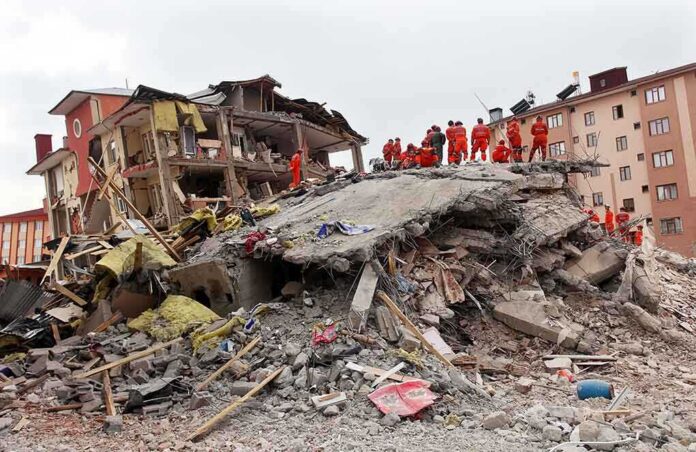
On June 24, 2026, two massive earthquakes, measuring 7.2 and 7.5, slammed Venezuela’s northern coast near La Guaira and Caracas. Buildings crumbled, roads split, and entire neighborhoods were buried under concrete and dust. Early reports confirmed at least 164 dead and nearly 1,000 injured, but rescue workers warned those numbers were only the start. Within days, the official toll passed 1,400 dead and more than 3,200 injured, as stunned families searched rubble for loved ones.
International agencies quickly realized the scale went far beyond those first numbers. United Nations officials said more than 50,000 people were missing after the twin quakes. Crowdsourcing sites and local records showed tens of thousands unaccounted for, as communication lines failed and entire blocks went dark. The International Organization for Migration warned that as many as 6.76 million people could feel the impact, including two million in Caracas. This was not a local event; it was a national trauma.
Rising Death Toll and Vanishing Citizens
Official casualty figures climbed slowly, day by day, even as morgues overflowed. Authorities reported 1,719 dead, 5,034 injured, and around 12,000 displaced only several days after the quakes, underscoring how long it took to grasp the true human cost. Later counts pushed the death toll past 3,300 and then beyond 4,500, with nearly 17,000 injured and tens of thousands still homeless. That gradual rise hinted at weak reporting systems, poor coordination, and a state struggling just to count its dead.
Behind those numbers lies a deeper concern: no clear, trusted figure for the missing. United Nations officials and aid chiefs spoke of more than 50,000 people unaccounted for. Some assessments referenced nearly 68,900 missing, especially in hard‑hit La Guaira, where families lined makeshift notice boards with photos and names. When a government cannot even say how many of its people are missing, citizens and outside observers both begin to question what else is being hidden or overlooked.
Homes Lost, Infrastructure Shattered
The earthquakes did not just take lives; they crushed Venezuela’s already fragile infrastructure. Authorities said nearly 800 buildings collapsed, including 189 completely destroyed, with more than 2,500 damaged overall. Satellite radar analysis by scientists projected about 58,870 structures likely damaged or destroyed, showing a far wider impact than early ground reports suggested. In La Guaira alone, more than 1,400 buildings were destroyed, turning dense urban blocks into fields of twisted rebar and shattered concrete.
For survivors, the hardest blow is losing their homes. Government and United Nations figures show around 17,000 to more than 16,300 people left homeless or living in unsafe, uninhabitable buildings. Many sleep under tarps, in cars, or in crowded school gyms, with limited water and power. The United Nations Office for Disaster Risk Reduction estimates direct physical damage at $37 billion, including $24 billion to buildings and $13 billion to infrastructure. That is about six percent of Venezuela’s entire economy, before counting long‑term job and business losses.
A Struggling State Meets a Massive Human Need
As the dust settled, aid groups warned that Venezuela’s crisis was not only about collapsed buildings, but about a weakened state failing under pressure. United Nations agencies said nearly 7 million Venezuelans could be affected by the quakes, stressing that 80 percent of the population already struggled to get enough food even before the disaster. With inflation, corruption, and years of mismanagement, the government entered this emergency “cash‑strapped” and short of basic supplies.
The death toll from Venezuela’s twin earthquakes has risen to 4,561, with more than 16,000 injured and thousands still in temporary shelters. Hundreds of buildings were damaged or destroyed as authorities seek international reconstruction funds. #Venezuela #Earthquake pic.twitter.com/ccS3RPXTu8
— The International Front Page (@thetifp) July 14, 2026
Officials pointed to steps they have taken: declaring a state of emergency within roughly 24 hours and mobilizing search and rescue teams, medical services, and security forces. They reported opening more than 80 shelters and delivering tens of thousands of food packages and hundreds of thousands of liters of water to affected families. Those moves matter, but they sit against a backdrop of slow casualty updates, missing‑person gaps, and a death toll that experts say reflects years of weak building standards and decayed infrastructure. The earthquakes struck hard—but it was bad government that made them far deadlier.
Why This Disaster Should Matter to Americans
For American readers, especially conservatives, Venezuela’s tragedy is a warning about what happens when government grows bigger but less accountable. Experts describe the quakes as exposing “institutional fragility,” where corruption and state erosion turn a natural event into a political disaster. When leaders control the media, hide true numbers, and let building codes slide, ordinary families pay the price when the ground finally shakes.
This matters for the United States because our own disaster response, infrastructure, and energy grids depend on honest data, strong local control, and respect for the rule of law. Venezuela shows what can happen when those pillars collapse under years of ideology, crony deals, and economic chaos. For conservatives who value limited but competent government, secure borders, and real transparency, the lesson is clear: protect our institutions now, or risk watching a similar human cost unfold someday at home.
Sources:
insiderpaper.com, en.wikipedia.org, news.un.org, reuters.com, usnews.com, cnbc.com, cnn.com, france24.com, aljazeera.com, npr.org, worldvision.org, cfr.org, bostonglobe.com, usatoday.com
© impactheadlines.com 2026. All rights reserved.