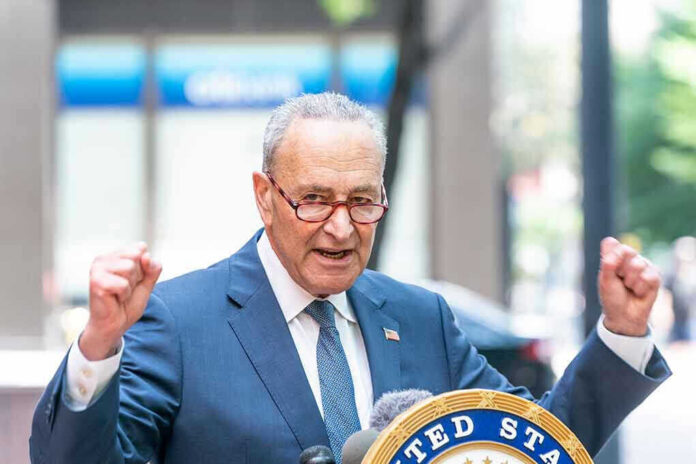
Speaker Johnson’s move to sidestep Senator Schumer and end the record-breaking government shutdown exposes a dramatic constitutional showdown and intensifies conservative frustrations with entrenched Senate obstruction.
Story Snapshot
- The ongoing government shutdown has set a new record for length, with federal services stalled and public frustration mounting.
- House Speaker Mike Johnson aims to bypass Senate Majority Leader Chuck Schumer, challenging longstanding legislative norms.
- Partisan infighting has deepened, with both sides blaming each other for the continued crisis and lack of progress.
- Millions of Americans—including federal workers, military families, and small businesses—face growing uncertainty and hardship.
Speaker Johnson’s Unprecedented Tactic to End Shutdown
On November 4, 2025, Speaker Mike Johnson escalated his campaign to resolve the government shutdown by openly planning to bypass Senate Majority Leader Chuck Schumer. Johnson and House Republicans, frustrated by what they see as Senate inaction, have explored alternative legislative strategies to reopen the government without relying on Schumer’s cooperation. This bold approach marks a significant departure from traditional House-Senate negotiation, intensifying the standoff and highlighting the breakdown of regular budget processes.
The shutdown, which has now surpassed previous records for its duration, is impacting millions across the nation. Federal employees, military families, and small businesses are feeling the brunt of missed paychecks and service disruptions. The Republican-controlled House blames Senate Democrats for prolonging the crisis, while Schumer and his caucus argue that Republican demands are unreasonable. Both parties are positioning for public blame or credit, but the American public is left grappling with the real-world consequences of the impasse.
Deepening Institutional Divides and Constitutional Concerns
Johnson’s effort to bypass Schumer signals a critical moment in American legislative history. By challenging Senate norms, the Speaker is exposing the limitations of traditional inter-chamber negotiation and the risks of unchecked partisan rivalry. The power struggle between the House and Senate is exacerbated by entrenched party control, with Johnson seeking to deliver results on conservative terms and Schumer defending Democratic priorities. Advocacy groups and public opinion are now key influencers, as the shutdown’s effects ripple through communities nationwide.
Short-term disruptions include halted federal services, economic uncertainty, and growing social strain. In the long term, experts warn that repeated shutdowns erode public trust and set dangerous precedents for future governance. The breakdown in cooperation not only undermines operational stability but also threatens constitutional principles of limited government and legislative accountability, core tenets valued by conservatives.
Rhetoric, Blame, and Expert Analysis
Recent press briefings have featured heated rhetoric from both sides. Johnson and Republican leaders have publicly criticized Schumer’s approach, while Democrats warn of the shutdown’s ongoing harm. Industry experts, including Brent Gardner from Americans for Prosperity, argue that Senate Democrats are engaging in political theater and call for an immediate reopening of the government. Policy analysts caution that the use of shutdowns as a partisan weapon reflects deeper dysfunction and risks destabilizing the U.S. economy and global reputation. Political scientists further note that the present impasse demonstrates a troubling trend toward institutional breakdown, leaving voters questioning the efficacy of their representatives and the resilience of constitutional norms.
Speaker Johnson Plans to Go Around Schumer to End Shutdown Fight https://t.co/4CDeVqggsh
— Highlands County GOP (@HighlandsGOP) November 5, 2025
As public pressure builds and no legislative breakthrough appears imminent, the country faces a pivotal moment. The shutdown’s effects—missed paychecks, delayed grants, and disrupted essential services—are felt acutely by families and businesses. The political fallout may reshape future elections and the broader balance of power in Washington. Conservatives, in particular, remain vigilant against government overreach and the erosion of constitutional values, demanding transparency, accountability, and immediate action from their leaders.
Sources:
White House Government Shutdown Clock
Shutdown Set to Break Record as Senate Democrats Agonize Over Endgame