A mysterious new structure at a disputed reef is raising fresh alarms that China is again testing American resolve in the South China Sea.
Story Snapshot
- Satellite images showed a suspected Chinese platform or barrier at the entrance to Scarborough Shoal in late May, then it vanished days later.[1][5]
- U.S. and allied analysts say the object looked like a persistent floating feature, not a camera glitch, and may fit Beijing’s pattern of blocking access to the shoal.[1][5]
- Philippine officials opened an investigation, warning any unauthorized structure inside their exclusive economic zone would violate their rights and raise tensions.[4]
- China already keeps near‑constant coast guard and militia presence at Scarborough, tightening control just 120 nautical miles from the main Philippine island of Luzon.
New images hint at fresh Chinese move at Scarborough Shoal
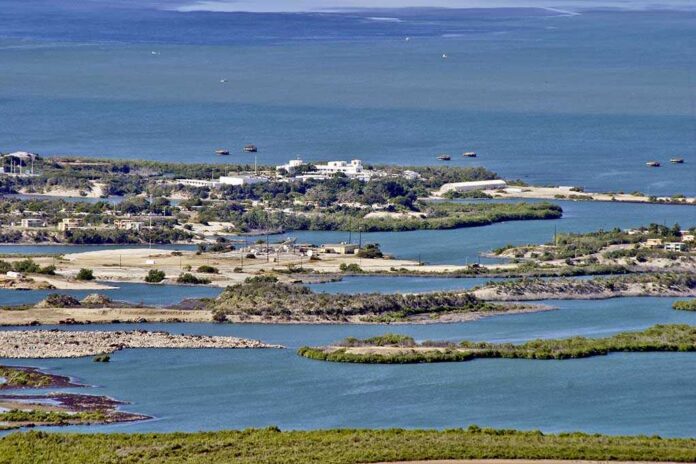
Satellite photos taken May 27–30 showed a new object positioned right at the mouth of Scarborough Shoal’s lagoon, a disputed reef that sits inside the Philippines’ exclusive economic zone.[1][5] Analysts from U.S.-based SeaLight said the feature appeared on several days of imagery in the same location, which indicates it was a real, physical object rather than a glitch or brief reflection on the water.[1][5] By June 1, however, a later satellite pass showed the object was gone.[1]
Reuters and other outlets, citing commercial imagery firm Vantor, described the object as a possible “floating platform,” “raft,” “buoy,” or barrier aligned across the entrance channel that ships and fishing boats use to enter the lagoon.[1][4][5] Philippine media stressed that whatever the exact type, any structure at that spot would sit in waters Manila claims under the 200‑nautical‑mile exclusive economic zone granted by international sea law.[4] That is the same area where Chinese ships have blocked Filipinos from fishing for more than a decade.
Philippines investigates as U.S. monitors a dangerous pattern
Philippine defense secretary Gilberto Teodoro Jr. confirmed he received raw reports about the object and ordered agencies, including the National Security Council, to investigate what was placed there and by whom.[4] He openly admitted they did not yet know if it was a barrier, platform, or something else, underscoring that the evidence is still preliminary and must be checked carefully.[4][5] Even so, Manila’s decision to treat the sighting as a serious case shows how sensitive any new fixed feature at Scarborough has become.
Scarborough Shoal has been under de facto Chinese control since a 2012 standoff, with a near‑constant China Coast Guard ship parked at the lagoon entrance deciding which vessels may pass. Research by the Center for Strategic and International Studies’ Asia Maritime Transparency Initiative found Chinese and Philippine law‑enforcement ships interacted at Scarborough on 121 days between August 2024 and May 2025, an average of more than twelve days a month. Analysts warn that this kind of routine contact raises the risk of accidents that could drag in allies under defense treaties.
Floating barriers and “gray‑zone” pressure fit Beijing’s playbook
The newly reported object comes on top of a long record of Chinese forces using rope‑and‑buoy barriers to fence off Scarborough’s lagoon from Philippine fishermen.[1] In one earlier incident, Philippine coast guard crews documented a roughly 300‑meter floating barrier being towed across the entrance by China Coast Guard boats and a militia vessel; Filipino personnel later removed that barrier to restore access. Satellite imagery from April 10–11 also showed a similar temporary barrier with Chinese vessels clustered inside and outside the shoal.
Reports by the Council on Foreign Relations and other researchers describe a larger “gray‑zone” strategy in which China builds up control using coast guard cutters, maritime militia, and legal moves rather than open warfare. China declared territorial sea baselines around Scarborough in 2024 and has steadily increased patrols closer to the Philippine island of Luzon. A Guardian investigation detailed how “fishing boats” linked to a Chinese maritime militia have been used to block Philippine humanitarian and fishing missions at the reef. All of this makes any new structure at the shoal far more worrying than a random piece of debris.
Legal fog and vanished evidence keep Beijing room to deny
Even with the new imagery, key facts remain unclear. The satellite photos do not prove beyond doubt that Chinese forces placed the object, what specific unit controlled it, or what mission it served.[1][5] It might have been a temporary barrier to keep out boats or a platform for sensors, but no public report shows concrete proof of a military function such as radar, weapons, or permanent foundations.[1][5][6] Because the object disappeared from June 1 imagery, critics can argue it was minor or accidental rather than a lasting new outpost.[1][3][5]
Legal complexity also clouds how the world reads these moves. An international arbitration panel in 2016 ruled that China’s “historic rights” claims inside its nine‑dash‑line map have no lawful effect and that Scarborough is only a rock, not an island, which means it does not generate its own exclusive economic zone. But the tribunal did not decide who owns the shoal itself, and Beijing simply rejected the ruling. This allows Chinese officials to keep calling their actions “law enforcement” in “Chinese waters,” while the Philippines insists they are illegal intrusions.
Why this matters for U.S. security and American conservatives
For Americans watching from home, this may feel far away, but the stakes are real. The Philippines is a treaty ally of the United States, and growing clashes around Scarborough raise the chance that a “small” incident could trigger big obligations under the Mutual Defense Treaty. China’s pressure campaign also targets core principles conservatives care about: national borders, rule of law at sea, and the right of a smaller nation to control its own resources without bullying from a one‑party regime.
U.S. monitoring of Scarborough Shoal, using satellites and joint drills with the Philippines, is part of a broader effort to deter that bullying without sliding into war.[2] At the same time, the uncertain nature of the new structure is a reminder to stay clear‑eyed: ambiguous pictures can be hyped into crisis, but they can also be early warning of real creeping expansion.[1][5] Getting the facts right, backing allies, and resisting authoritarian “gray‑zone” tactics are all essential if America wants to protect freedom of navigation and keep our own sons and daughters out of a conflict that Beijing chooses on its terms.
Sources:
[1] Web – U.S. monitoring Chinese activity in South China Sea around disputed …
[2] Web – Satellite images show suspected structure at disputed South China Sea …
[3] Web – Exclusive-Satellite images show suspected structure at disputed South …
[4] Web – Satellite images show suspected structure at disputed atoll
[5] Web – Philippines Probes May 28 Scarborough Shoal Satellite Imagery
[6] Web – Exclusive-Satellite Images Show Suspected Structure at Disputed South …
© impactheadlines.com 2026. All rights reserved.