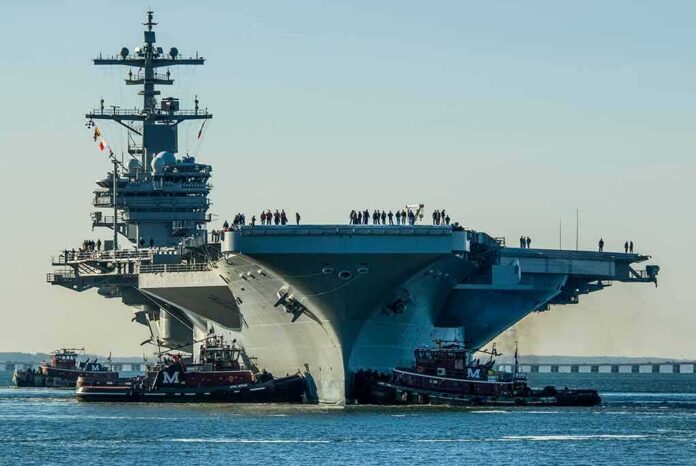
Eight non-fatal suicide attempts among roughly 7,500 sailors is, statistically, not an outlier — it is the specific, sourced count that matters, because it puts a hard number on what had been dismissed for months as unsubstantiated complaint, and because the number came not from a leak or a whistleblower but from the Navy’s own acting secretary, in writing, to a sitting United States senator.
Key Points
- Acting Navy Secretary Hung Cao told Sen. Kirsten Gillibrand in a letter that eight suicide attempts occurred across the USS Abraham Lincoln strike group during its deployment, with no fatalities.
- The count spans the carrier, its air wing, destroyer squadron staff, escorting destroyers and embarked aviation squadrons — not the Lincoln’s crew alone.
- The disclosure follows months of Navy and CENTCOM statements denying any increase in suicidal ideation or attempts aboard the ship.
- The deployment, extended to support operations tied to the Iran conflict, set a modern record for continuous time at sea and included documented shortages of food, hygiene supplies and mail.
- At least two individual incidents — a sailor recovered after falling overboard in August and another stopped by shipmates in March — sit inside the broader eight-attempt total.
What the Navy Disclosed, and to Whom
The figure originates in a letter dated Tuesday from Acting Navy Secretary Hung Cao to Sen. Kirsten Gillibrand, a New York Democrat and member of the Senate Armed Services Committee. “Since the beginning of Lincoln’s deployment, there have been a total of eight suicide attempts across the strike group,” Cao wrote, language reported consistently across CNN, The Hill, USA Today, the BBC, NBC News and other outlets. The letter also stated plainly that no service members died by suicide during the deployment — a detail that matters as much as the count itself, since it distinguishes a crisis of attempted self-harm from one of confirmed loss of life.
Cao’s letter was explicit about scope: the eight attempts are drawn from “the Lincoln crew and sailors from the carrier airwing, strike group and destroyer squadron staff, escorting destroyers and all embarked aviation squadrons”. That is a meaningful distinction. A carrier strike group is not one ship; it is a task-organized formation of several thousand personnel across multiple hulls, and treating the number as a Lincoln-only statistic — as compressed headlines sometimes invite readers to do — overstates the concentration of the problem on any single crew while understating the reach of the deployment’s strain across the whole formation.
The Deployment Behind the Numbers
Context explains why this particular strike group became the subject of congressional inquiry in the first place. The Lincoln left San Diego on a planned deployment that stretched toward roughly 300 days at sea, extended well beyond its original schedule to support combat operations connected to the war with Iran, and in doing so set what multiple outlets described as a modern record for continuous time underway for a U.S. carrier. Sailors and families interviewed during the deployment’s rare port calls, including a stop in Thailand, described reduced meal options, scarcity of fresh fruit and vegetables, and long stretches without mail or resupply of hygiene and repair items — conditions the Navy itself later acknowledged and, in part, corrected mid-deployment. None of this proves causation between logistics and any individual attempt, but it establishes the operational environment in which the letter’s figures sit.
Individual incidents give the aggregate number texture. One air wing sailor fell overboard in August and was recovered by helicopter; another sailor attempted to go overboard in March and was stopped by shipmates before reaching the water. A 19-year-old sailor involved in a separate August incident was subsequently referred for non-judicial punishment under the Uniform Code of Military Justice on a malingering charge — accused of feigning illness to avoid duty — a disciplinary path his family has characterized as a mishandling of what began as a mental health crisis. These specifics do not appear as line items in Cao’s letter, but they are documented in independent reporting and crew accounts from the same deployment window, and they illustrate the gap between a statistical disclosure and the lived experience it summarizes.
From Denial to Disclosure: A Familiar Institutional Arc
Before Cao’s letter, the Navy’s public posture was one of reassurance. ABC News and Task & Purpose both reported Navy statements asserting the service had “not identified an increase in reported suicidal ideation or suicide attempts aboard the ship”. That denial was not fabricated controversy; it was the Navy’s own on-record position for months, even as families and former crew members were describing a different reality to reporters. The later letter to Gillibrand does not necessarily contradict the earlier statements on technical grounds — an aggregate count across a full deployment can be consistent with “no identified increase” relative to a prior baseline the Navy never made public — but the sequence matters. When an institution moves from broad reassurance to a specific, congressionally requested number, the shift itself becomes part of the story, inviting scrutiny of how the earlier assessment was made and on what data.
This is not a novel pattern. Military mental-health disclosures have historically followed this same arc: informal reports and family accounts surface first, official channels initially minimize or deny an uptick, and a more precise figure eventually emerges once congressional oversight or media pressure forces a documented response. The pattern says less about whether any single number is accurate than about how armed services classify, aggregate and release self-harm data under the competing pressures of operational security, medical privacy and public accountability.
Eight Navy members aboard the USS Abraham Lincoln have attempted suicide since the beginning of their extended deployment, a top Navy official says in a letter obtained by NBC News. https://t.co/6hxODFQpIs
— NBC News (@NBCNews) September 24, 2026
What Deployment Research Already Tells Us
None of this occurs in a vacuum. Peer-reviewed military medicine research has for two decades documented elevated stressors among Navy personnel on extended carrier deployments — anxiety, coping strain, and health care access friction that intensify with time underway and diminish with port calls and family contact. Studies of self-directed violence aboard carriers have similarly found that incident rates vary with deployment length, rank, and access to behavioral health staff, all of which have been embedded aboard carriers as permanent ship’s company since the mid-1990s. A deployment stretched toward the 300-day mark, with resupply constrained by wartime tempo, sits well outside the conditions those studies treat as baseline — which is precisely why psychiatrists and retired flag officers interviewed during the Lincoln’s deployment described the strain as “unprecedented” rather than routine, and called for shorter rotations and expanded fleet capacity going forward.
Why This Matters Beyond One Ship
The Lincoln case will likely become a reference point the next time a carrier strike group is extended past its planned rotation, because it demonstrates two things at once: that a modern carrier can be pushed to record endurance to meet an operational demand, and that doing so carries a measurable human cost the service is now on record acknowledging to Congress. Sen. Gillibrand’s request, and the letter it produced, sets a template — congressional oversight compelling a specific, attributable disclosure where informal denial had previously sufficed. Whether the Navy shortens future deployment cycles, expands behavioral health staffing at sea, or simply improves how it counts and reports these incidents, the eight-attempt figure has already done its most important work: it replaced a debate about whether a problem existed with a debate about how large it is and what the institution owes the families living through it.
Sources:
mediaite.com, cnn.com, thehill.com, newsweek.com, x.com
© impactheadlines.com 2026. All rights reserved.