The numbers tell the story before the politics ever get a chance to: 22 people crammed onto a 27-foot pleasure boat, spotted from the air, run down near Key Largo, and delivered into federal custody within hours — a routine-sounding sequence that happens to sit atop one of the most heavily trafficked and least forgiving smuggling corridors in the country.
Key Points
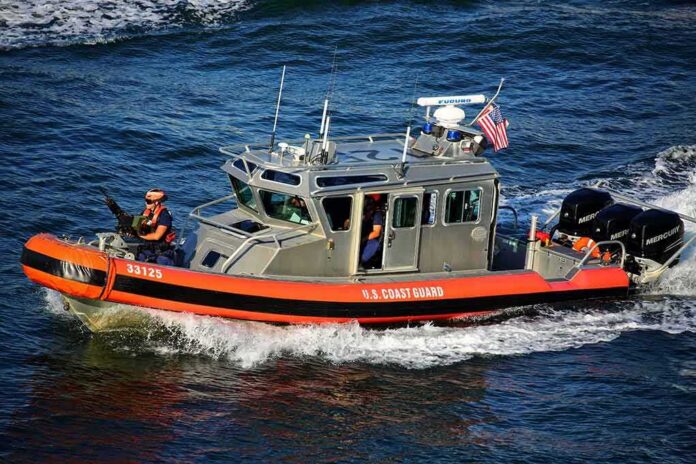
- CBP Air and Marine Operations aircraft spotted the vessel and directed Coast Guard assets to intercept it near Angelfish Creek off Key Largo, Florida.
- Twenty-two people were aboard, including 13 Chinese nationals, eight Ecuadorians, and one Dominican national.
- A Cuban national suspected of piloting the smuggling operation was arrested; the vessel was seized as evidence.
- Migrants were transferred to the Coast Guard cutter Pablo Valent for processing, a standard step in Florida Keys maritime interdictions.
- The interception fits a decades-old, statistically dominant pattern: nearly all U.S. maritime migrant smuggling activity funnels through the Florida Straits and the waters around the Keys[13 in lens].
What Happened Off Key Largo
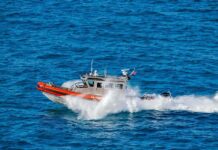
Federal aircraft assigned to CBP’s Air and Marine Operations unit picked up the vessel on radar or visually as it moved through the waters near Angelfish Creek, a narrow passage between Key Largo and the open Atlantic long favored by smugglers because it offers quick access to open water and a maze of mangrove shoreline for evasion. Once flagged, the aircraft directed surface assets — a coordinated CBP and U.S. Coast Guard response — to close in and board. The craft itself, a 27-foot cuddy cabin boat, is a common recreational hull repurposed for exactly this kind of run: enclosed forward cabin, modest draft, deceptively ordinary silhouette on the water.
Twenty-two people were aboard when it was stopped — 13 Chinese nationals, eight Ecuadorians, and one Dominican national, according to matching accounts from Fox News and the Dominican outlet Diario Libre. A Cuban national traveling with the group was identified as the suspected smuggler and taken into custody separately from the migrants. All 22 were transferred to the Coast Guard cutter Pablo Valent for processing, the vessel itself seized as evidence under federal alien-smuggling statutes. That transfer-and-seizure sequence is not improvised; it is the standard operating rhythm CBP and the Coast Guard have run in the Keys for years.
Why the Florida Keys Absorb Almost All of This Traffic
This incident did not happen in a vacuum, and it did not happen by geographic accident. CBP has told Congress that in a recent fiscal year its Air and Marine Operations unit logged roughly 6,130 maritime migrant interdictions, with 94 percent of them occurring in the Florida Straits and the Caribbean. The Government Accountability Office found something even more concentrated in earlier years: nearly 92 percent of migrants smuggled by boat along the entire U.S. mainland coastline between 2011 and 2016 were intercepted off Florida, overwhelmingly in the Straits north and south of the peninsula. Ninety miles of open water between Cuba and Key West, combined with the tight, reef-lined channels of the Keys, makes this stretch of coastline both a magnet for smuggling networks and the most surveilled maritime border segment in the country.
The playbook here — aerial detection, rapid interdiction, custody transfer to a Coast Guard cutter, vessel seizure as evidence — is not unique to this case. CBP’s own local media releases describe near-identical sequences in prior Florida Keys interdictions, including cases where seized vessels were run to Coast Guard Station Islamorada for evidence processing. Smuggling organizations operating out of South Florida and the Bahamas have for decades relied on stolen or personally owned recreational boats rather than purpose-built smuggling craft, a choice that keeps costs low and blends the vessel into ordinary boating traffic until the moment it is stopped.
The Chinese-National Dimension Is Part of a Broader Shift, Not an Anomaly
Thirteen Chinese nationals aboard a single interdicted vessel is a striking figure, but it is consistent with a documented rise in Chinese migration through maritime and land routes over recent years, a trend federal officials and outside researchers have tracked as smuggling networks diversify their client base beyond the traditional Cuban and Haitian corridors. Florida Highway Patrol and CBP records referenced in this same period document parallel apprehensions of Chinese nationals in unrelated incidents elsewhere in the state, underscoring that this is a pattern smugglers are actively serving rather than a one-off. The economics are straightforward: transnational smuggling organizations charge premium fees for longer, higher-risk routes, and demand from Chinese migrants seeking entry through maritime chokepoints has been enough to sustain dedicated pipelines feeding into South Florida.
What the Danger Label Actually Reflects
Officials and reporting characterized this as an “extremely dangerous” infiltration attempt, language that reflects the basic arithmetic of the crossing rather than rhetorical flourish: a 27-foot recreational hull is not engineered to safely carry 22 adults plus fuel, water, and whatever the smuggler charges for the passage. Overloaded small vessels running without adequate freeboard are a recurring cause of fatal capsizings in the Straits, and Coast Guard and CBP officials have repeatedly pointed to exactly this kind of mismatch — hull size against passenger count — when describing why they treat these interdictions as life-safety operations first and law-enforcement actions second. That the vessel reached Key Largo intact does not diminish the risk profile; it reflects, if anything, that the interdiction came in time.
Sources:
nypost.com, foxnews.com, hotsheet.com, seapowermagazine.org
© impactheadlines.com 2026. All rights reserved.