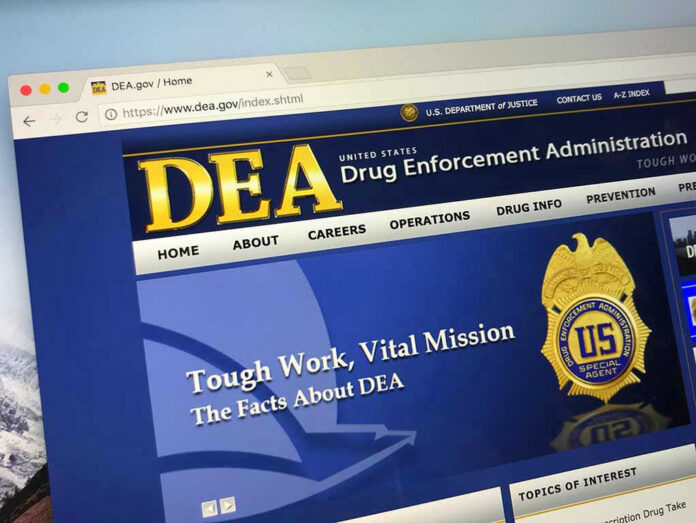
As America buries loved ones from a fentanyl flood, a federal whistleblower now says the very agency tasked with stopping it let deadly pills roll into New Mexico neighborhoods in the name of “building cases.”
Story Snapshot
- A Drug Enforcement Administration (DEA) whistleblower says agents let fentanyl shipments “walk” into New Mexico communities to chase bigger prosecutions.
- Reporters say internal records show agents tracked, but did not seize, a load of about 74,000 fentanyl pills at an Albuquerque mobile home park in 2023.[8]
- The Justice Department cleared the operation, calling the decisions “reasonable” and not a “specific danger to public health,” despite fentanyl’s known lethality.[5][8]
- DEA leaders insist they followed Department of Justice (DOJ) guidelines, while critics see echoes of the “Fast and Furious” gun-walking scandal.[7][8]
Fentanyl Crisis Meets a Stunning DEA Allegation
Across the country, families are already on edge as fentanyl overdoses rip through towns, with the Drug Enforcement Administration warning that six out of ten fake prescription pills it tests now carry a potentially lethal dose.[5] Against that backdrop, an Associated Press investigation reports that from 2023 to 2025, the Drug Enforcement Administration allowed hundreds of thousands of fentanyl pills to move through New Mexico as part of larger investigations aimed at Mexican drug cartels.[8] For many Americans, that sounds less like protection and more like a dangerous gamble with their lives.
Reporter Jim Mustian says he and colleague Joshua Goodman reviewed hundreds of internal Drug Enforcement Administration records and interviewed current and former agents, including whistleblower Special Agent David Howell.[7][8] Their reporting describes operations where agents watched large fentanyl loads move, collected intelligence, but did not immediately seize the drugs.[8] The aim, according to federal officials, was to map trafficking networks and reach high-level cartel targets. To families on the ground, it looks like the government knowingly let poison hit their streets.
Inside the New Mexico Operation: 74,000 Pills that Were Not Seized
The investigation highlights one 2023 case at an Albuquerque mobile home park, where agents monitored a shipment and logged that about 74,000 fentanyl pills were delivered.[4][8] Instead of grabbing the load on the spot, they let it continue under surveillance as they tried to follow the supply chain. Federal officials say this type of “controlled delivery” is a recognized tool that lets law enforcement track illegal goods and identify bigger players further up the ladder.[6][14][16] The question is whether this tactic makes sense when each pill can kill.
The Drug Enforcement Administration’s own threat reports describe fentanyl as a major danger driven heavily by Mexican cartels like Sinaloa and Jalisco New Generation, which have taken over production and smuggling routes into the United States.[1][6] Those same cartels churn out the counterfeit pills that the Drug Enforcement Administration lab says now often contain lethal doses.[1][5][6] Allowing tens of thousands of such pills to circulate, even temporarily, runs straight into that reality. For border communities already overwhelmed by cartel-driven smuggling, it feels like Washington is playing with matches in a dry forest.
Whistleblower vs. DOJ: Did the DEA “Poison” Its Own Communities?
Special Agent David Howell, who filed the whistleblower complaint, accuses his own agency of “gambling with public safety” and breaking internal rules meant to keep deadly drugs off the street.[7][8] In one quoted remark, he says the Drug Enforcement Administration “poisoned our community to make cases,” capturing the moral outrage many Americans feel when government power seems to override basic common sense. Howell argues that the volume of fentanyl left in circulation went far beyond any reasonable investigative risk.[8]
Federal leaders push back hard. The Drug Enforcement Administration says public descriptions claiming it knowingly allowed fentanyl to reach communities are “false” and “fundamentally mischaracterize the facts.”[7][8] A spokesperson states that the investigative decisions were lawful, reasonable, and in line with Department of Justice guidance.[7][8] The Justice Department’s Office of Professional Responsibility, essentially an internal affairs unit, later reviewed the New Mexico operations and concluded in 2024 that officials made reasonable choices and that not seizing certain loads did not pose a “specific danger to public health.”[7][8] That conclusion clashes sharply with what everyday citizens know about fentanyl’s lethality.
Controlled Deliveries or Fast and Furious 2.0?
Supporters of the Drug Enforcement Administration’s approach argue that “controlled deliveries” are a standard investigative tool worldwide, used to let illegal shipments move under tight watch so agents can expose full networks instead of just arresting low-level couriers.[6][14][16] They say limited resources force tough choices: take down a small load today, or follow it to dismantle a larger cartel pipeline tomorrow. Former U.S. Attorney Alex Uballez, who oversaw the New Mexico office during this period, openly defended sometimes letting drugs “walk” to catch a “bigger fish.”[4][7]
The DEA allowed hundreds of thousands of fentanyl pills into New Mexico communities from 2023-2025.
New Mexico overdose deaths rose 21% while the national rate fell 14%.
DOJ concluded this posed no “specific danger to public health.”
That finding is not medically defensible.— Lucy’s Booth (@HeatherK9070) June 22, 2026
But critics note that what might make sense with guns or cash becomes far more dangerous when every small bag or pill could cause an overdose. The Drug Enforcement Administration’s own data on fake pills underscore that danger.[5] Many conservatives see a troubling pattern: a powerful federal agency, shielded by secrecy and “expert judgment,” decides acceptable risk for other people’s children, then clears itself when things go wrong. With memories of the “Fast and Furious” gun-walking scandal still fresh, letting fentanyl loads roll through American neighborhoods feels like the same movie with deadlier stakes.
What This Means for Conservatives Focused on Border Security and Limited Government
For readers who value secure borders, local control, and the rule of law, this story hits several nerves at once. First, it confirms what Drug Enforcement Administration threat reports and international data have shown for years: Mexican cartels, fueled in part by Chinese precursor chemicals, now dominate the illicit fentanyl trade into the United States.[1][2][7] Second, it reveals that even as Washington talks tough on the border, some federal operations still accept major local risks in the name of complex strategies and internal metrics.
At the same time, the case underscores how hard it is for citizens to hold agencies accountable when key files, warrant applications, and policy changes remain behind closed doors. Even critics must rely on leaks, whistleblowers, and partial document reviews rather than full transparency. That secrecy breeds distrust, especially in communities already reeling from overdose deaths and cartel violence. For many conservatives, the answer is not to “defund” law enforcement, but to demand clear rules, real oversight, and a simple bottom line: the federal government must never treat American neighborhoods as disposable test sites in its war on drugs.
Sources:
[1] Web – Shades of Fast and Furious? DEA Allegedly Let Hundreds of Thousands of …
[2] Web – [PDF] Fentanyl Flow to the United States – DEA.gov
[4] Web – Press Releases | DEA.gov
[5] Web – The DEA allowed hundreds of thousands of fentanyl pills to hit the …
[6] Web – The DEA allowed hundreds of thousands of fentanyl pills to hit the …
[7] Web – [PDF] 2025 National Drug Threat Assessment – DEA.gov
[8] Web – World Drug Report 2025 – Maps – UNODC
[14] Web – DEA investigations: What to Know to Protect Your Practice
[16] Web – Identifying controlled substance patterns of utilization … – PubMed
© impactheadlines.com 2026. All rights reserved.