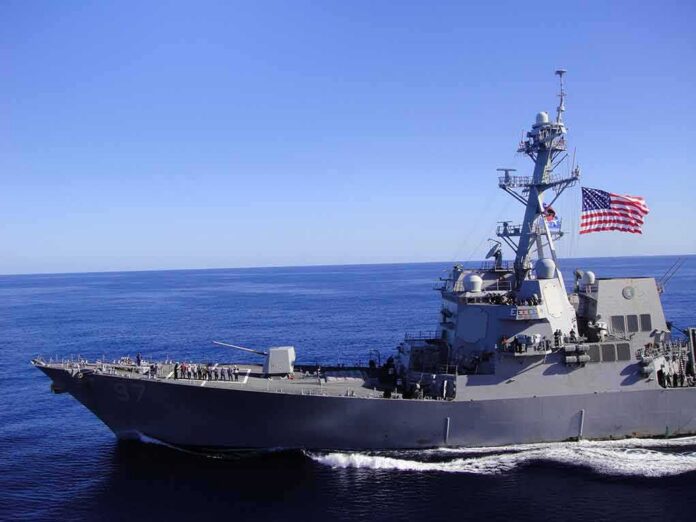
When navies act against a vessel at sea, they rarely do it casually; every intercept sits at the intersection of operational risk, intelligence confidence, and maritime law. The U.S. destruction of an Iran-affiliated dhow in the Gulf of Oman on October 6 is a case study in that calculus: a targeted action against what U.S. Central Command (CENTCOM) described as a surveillance and targeting platform tracking U.S. Navy ships, executed after removing the crew to avoid loss of life.
At a Glance
- CENTCOM says U.S. forces destroyed an Iran-affiliated dhow on October 6 in the Gulf of Oman after it conducted surveillance and targeting of U.S. Navy ships.
- According to the military, the crew was evacuated safely before the vessel was destroyed, and repatriation efforts are underway.
- The action was presented as part of a months-long pattern of IRGC-linked harassment of civilian mariners and U.S. warships.
- Multiple outlets reported the same operational account; specific underlying intelligence was not publicly released.
What CENTCOM says happened and why it matters
CENTCOM’s public account is direct: on October 6, U.S. forces located and destroyed an Iranian-affiliated dhow in the Gulf of Oman that had been conducting surveillance and “targeting” activity against U.S. Navy ships. Crucially, CENTCOM stated the crew was removed from the vessel prior to its destruction and that repatriation was in process, underscoring an intent to neutralize a platform while avoiding casualties. The command framed the strike within a broader operational pattern—months of Islamic Revolutionary Guard Corps (IRGC) pressure on commercial and military shipping—arguing that the dhow’s role fit a recognizable threat profile and warranted action.
Several regional and international outlets reported the same core details from CENTCOM’s statement, identifying the date and general location, the dhow’s alleged Iranian affiliation and surveillance role, the asserted targeting of U.S. Navy ships, and the pre-strike evacuation of the crew. The triangulation here is not forensic—these stories largely echo the CENTCOM release—but it does establish that the U.S. military put its institutional weight behind the claim and provided enough specificity on time and place for external scrutiny of shipping patterns and regional operations.
How a dhow becomes a military problem
In maritime security, intent is inferred from behavior, equipment, and context. A dhow—traditionally a civilian craft used for fishing or coastal trade—can be adapted as a low-signature sensor picket: cameras and antennas to spot hull forms, observe patrol patterns, or cue other assets. To a naval commander, persistent shadowing, pattern-of-life mapping near a task group, or brazen proximity transits can cross the threshold from curiosity to targeting support. That is especially true in choke-point waters like the approaches to the Strait of Hormuz, where time-to-react compresses and the consequences of misjudgment multiply.
CENTCOM’s formulation—surveillance plus targeting of U.S. ships—tracks with this operational logic. The command’s emphasis on removing the crew beforehand serves two purposes. Tactically, it preserves human life and reduces escalation risk. Legally and strategically, it signals that the objective was the platform’s function, not punishment of personnel. In naval practice, disabling or destroying a vessel used for hostile military purposes—after giving an opportunity to safeguard noncombatants—aligns with long-standing targeting principles of distinction and proportionality under the law of armed conflict and naval warfare doctrine.
The regional pattern that informs military judgment
Maritime confrontations between the U.S. and Iran have, for years, revolved around attribution claims built on intelligence that is partly or wholly classified. In the 2019 Gulf of Oman tanker incidents, the U.S. publicly accused Iran of mine attacks while holding back much of the underlying intelligence at first; Iran denied responsibility. Investigations pointed to a state actor, with evidence consistent with limpet mines, but public reports did not attribute the operation to Iran by name. The result is a familiar dynamic: navies act on intelligence their publics cannot fully see, while adversaries exploit ambiguity to deny, deflect, or deter without formal escalation.
Against that backdrop, two features of the October 6 action are notable. First, CENTCOM tied the dhow to ongoing IRGC-linked harassment of both civilian mariners and U.S. warships over recent months, suggesting a cumulative risk environment rather than a one-off anomaly. Second, the Gulf of Oman and the Strait of Hormuz remain among the most contested and consequential waterways on earth; history, law, and commerce collide there. Maritime law scholars routinely stress that the legal basis for using force at sea typically reduces to two pillars—self-defense or United Nations Security Council authorization—and that, in these waters today, only the former is plausibly in play. In practice, that means commanders judge imminence and necessity through observed behavior and classified indicators as much as through overt hostile fire.
The law at sea: thresholds, authorities, and restraint
Two strands of law shape decisions like this. The first is the jus ad bellum threshold for the use of force in self-defense: an actual or imminent armed attack and a response that is necessary and proportionate. Naval law of armed conflict then governs targeting decisions—the requirement to distinguish military objectives, apply proportionality, and take feasible precautions to spare civilians and crews. In littoral chokepoints, where hostile minelaying, covert intelligence collection, and attack preparation can blur together, states rely on a mosaic of indicators that collectively suggest whether a platform is contributing to hostile operations.
The U.S. Navy’s own doctrinal tradition emphasizes both the centrality of self-defense and the obligation to calibrate force to the threat. Modern practice adds a premium on non-lethal mitigation when feasible—warning, maneuver, disabling fire, or, as CENTCOM reports here, extraction of the crew before neutralization. That sequence—safeguard people, then eliminate the platform’s military utility—reflects a prudential approach to both law and escalation management. It is also consistent with contemporary allied legal analysis that treats enemy platforms, including non-traditional hulls repurposed for surveillance or targeting, as legitimate military objectives when they make an effective contribution to military action and their neutralization yields a definite military advantage.
Operational implications for the Gulf of Oman and beyond
Practically, the October 6 strike communicates three messages. To U.S. sailors and civilian mariners, it signals an active force-protection posture: platforms that support hostile surveillance and targeting will not be allowed to loiter unmolested near U.S. units. To adversaries and proxies, it raises the cost of using plausibly deniable civilian-looking hulls as intelligence nodes. And to regional partners whose economies depend on open sea lanes, it advertises a willingness to police the gray zone between open conflict and peacetime harassment—where most maritime coercion now occurs.
The stakes are not abstract. The U.S. Navy-led Joint Maritime Information Center has, at times, raised the threat level for the Strait to “severe,” reflecting conditions in which deliberate hostile action is likely; under those circumstances, commanders compress decision cycles and act on patterns that, in calmer seas, might draw more patience. The dhow’s destruction, reported eight days after the event, fits that world: persistent gray-zone pressure, a premium on intelligence-enabled action, and public statements that outline the who-what-where without exposing collection methods or tactical playbooks.
The bottom line
By CENTCOM’s account, U.S. forces neutralized an Iran-affiliated dhow engaged in surveillance and targeting of U.S. Navy ships in the Gulf of Oman, removing the crew before destroying the vessel. The action conforms to a broader pattern of IRGC-linked maritime pressure and to a doctrine that treats intelligence-gathering platforms supporting hostile operations as legitimate military objectives—especially in constrained waters where time and distance magnify risk. The precision of the date and location, the emphasis on crew safety, and the consistency across multiple reports make the military’s case legible to outside observers even as the underlying intelligence remains classified. For mariners and strategists alike, the incident is a reminder: in the world’s tightest sea lanes, surveillance is never neutral, and letting a sensor live is sometimes the riskiest move of all.
Sources:
article.wn.com, gulfnews.com, foxnews.com, x.com, gcaptain.com, store.jpost.com, moneycontrol.com, asil.org, openyls.law.yale.edu
© impactheadlines.com 2026. All rights reserved.