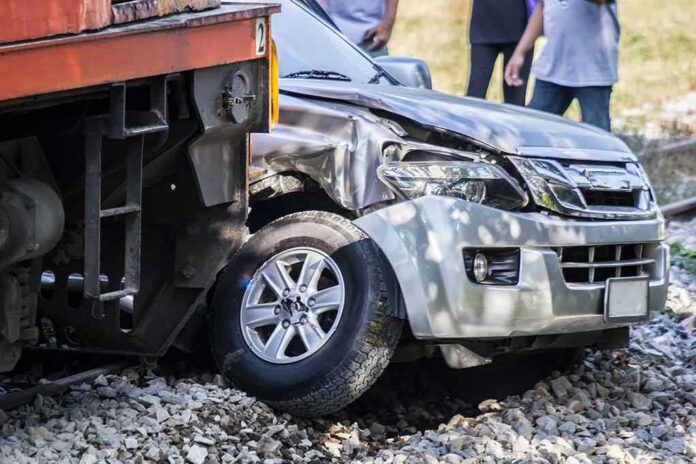
A holiday Amtrak run smashed into a bulldozer-hauling 18-wheeler in Louisiana, derailing cars and injuring passengers as families were trying to get home.
Story Snapshot
- The Amtrak train hit a semi-truck stuck on tracks near Broussard on November 22, 2026.
- The lead locomotive and two baggage cars derailed; five passengers suffered minor injuries.
- Ninety-five people were onboard; responders helped evacuate and moved travelers by bus.
- The crash adds to a stubborn national problem at rail crossings each year.
What happened on the ground, and when
Police and fire crews rushed to the 100 block of Thru-Way Park Road east of Lafayette around 6:05 to 6:15 p.m. on Sunday, November 22, 2026. An Amtrak passenger train struck a tractor-trailer that had become stuck on the tracks. The force derailed parts of the train. Authorities described five passenger injuries, all reported as non-life-threatening. No deaths were reported. The truck was hauling a bulldozer, which increased the mass at the crossing and the damage from the hit.
Amtrak said the impact derailed the lead locomotive and two baggage cars. Local outlets also described a partial derailment of two cars. The train carried 95 passengers, a figure confirmed by local officials and reporting. Emergency teams made the scene safe, guided people off the train, and arranged buses to carry travelers onward to New Orleans. The quick transfer kept the disruption contained to the local area even as the crash snarled holiday routes.
Where the reports agree, and what remains unknown
Core facts line up across wire services and local authorities. The train hit a semi-truck that was stuck on the tracks. The date, place, and time are consistent. The passenger count is clear at 95. The injury picture is limited and minor compared to what could have happened. Some details vary in early updates, including whether two cars or a locomotive plus two baggage cars left the rails, and whether four or five people went to a hospital. Those are common early-report gaps that investigators later reconcile.
Officials have not issued a formal cause. Reports say the truck became immobilized at the crossing. They do not yet state why. Key data still to come include train speed, brake timing, signal function, and the crossing’s geometry. Those facts will show whether this was a problem with the truck’s route or clearance, a driver decision, a crossing design flaw, or a mix of factors. Until then, the safest read is the simple one: the truck was on the tracks; the train could not stop in time.
Why this crash fits a national pattern
This collision is not rare in kind. The United States saw more than two thousand highway–rail crossing collisions in 2025, with hundreds of deaths and many more injuries. These events keep happening because they sit at the messy edge where road habits meet rail physics. A freighted truck needs time and space to clear a crossing. A passenger train needs far more distance to stop than drivers expect. When either side misjudges, steel wins and people lose.
Federal safety investigators have warned about this pattern for years. In a 2022 Amtrak crash in Missouri, the National Transportation Safety Board cited the truck driver for entering the crossing with a train coming, but also flagged poor crossing design that limited sight lines and made stopping hard for heavy trucks. That finding shows how both human choice and infrastructure shape risk. Louisiana officials will likely test those same questions in Broussard.
What responsible safety looks like now
Local responders did their job: protect life, secure the scene, move people out, and restore travel. The next job belongs to investigators and the companies involved. The community deserves clear answers on five basics: why the truck stopped on the tracks, whether warning systems worked as designed, how fast the train was moving, whether the locomotive crew applied brakes as soon as possible, and whether the crossing itself invites trouble for long or low trailers.
Amtrak Derailment in Louisiana After Truck Collision Injures Five https://t.co/3U0HCApmCa
— CrashDaily (@crashdaily_com) November 23, 2026
Common sense, and conservative values, say accountability should follow facts. If a driver ignored signs or blocked a live track, that choice should carry consequences. If the crossing design traps long loads or hides trains, fix it. If railroad operations or signals fell short, correct them. These are not abstract debates. They are choices that decide whether a family makes it home after a holiday trip—or ends up in a headline.
Sources:
nypost.com, freep.com, upi.com, oli.org, catalog.data.gov
© impactheadlines.com 2026. All rights reserved.