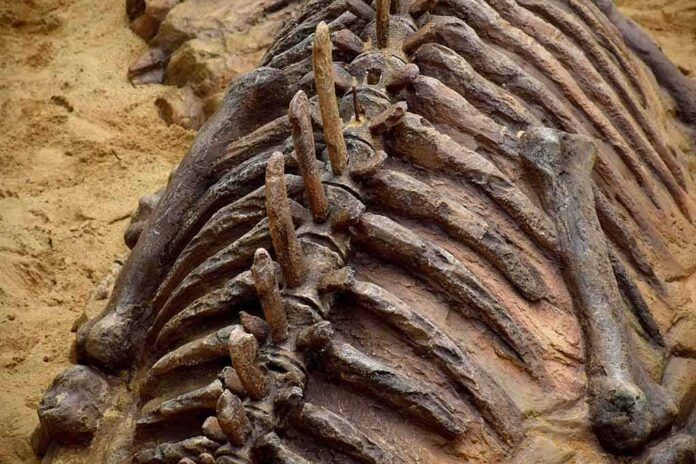
The real controversy inside South Africa’s Rising Star cave system was never just whether a small-brained hominin buried its dead — it is what kind of evidence should ever be enough to prove it, since no one has ever watched a hominin dig a grave 250,000 years ago, and every verdict has to be built from sediment, bone position, and inference.
Key Points
- Paleoanthropologist Lee Berger’s team argues that Homo naledi, a species with a brain roughly one-third the size of a modern human’s, deliberately placed bodies in deep, nearly inaccessible chambers and covered them with sediment.
- The team’s own published language describes this as a “minimal hypothesis of hominin cultural burial” — a conditional, comparative claim rather than a direct observation of digging.
- An independent sedimentological reanalysis found none of the chemical soil differences the original burial claim depended on, and a separate group of researchers has argued that natural processes have not been ruled out.
- Editorial review of the associated complex-behavior claims — burial, engravings, and fire use together — judged the supporting analyses incomplete.
- The dispute remains genuinely unresolved and hinges on testable, specific next steps: independent re-excavation, auditable geochemistry, and dating of the sediment layers themselves.
What Was Found Deep Inside Rising Star Cave
In 2013, recreational cavers Rick Hunter and Steven Tucker wriggled through an 18-centimeter fracture in South Africa’s Rising Star cave system and found a chamber littered with bone. Lee Berger’s team at the University of the Witwatersrand eventually recovered more than 1,500 specimens representing at least 15 individuals, formally naming the species Homo naledi in 2015. Multiple dating methods later placed the remains between roughly 236,000 and 335,000 years old — meaning this small-brained, climbing-adapted hominin, standing about 1.4 meters tall with a braincase near 500 cubic centimeters, was alive at the same time early Homo sapiens were emerging elsewhere in Africa. That overlap alone made the find significant; what happened next made it contentious.
The puzzle was access. The Dinaledi Chamber sits roughly 30 meters underground, reachable only through a narrow vertical chute that even trained cavers find strenuous. There was no sign of flooding, no predator gnaw marks, no other animal species mixed into the bone bed. Berger’s team concluded the chamber could not plausibly have become a bone deposit by accident, and in 2023 proposed something far bolder: that Homo naledi had dug pits, placed bodies in them, and refilled the holes — deliberate burial, a behavior never before attributed to a hominin with a brain this small.
The Case for Deliberate Burial
The published case rests on three pillars. First, the team reports discrete features in the Dinaledi Chamber and Hill Antechamber where subsurface stratigraphy appears disrupted, consistent with digging rather than gradual accumulation. Second, they describe articulated, matrix-supported skeletal regions — bones still connected in anatomical position and encased in sediment — which they read as evidence of rapid covering before soft tissue decomposed. Third, and importantly, the team frames its conclusion carefully: cultural burial is presented as the “minimal hypothesis,” the explanation most compatible with the pattern of evidence, not a claim of witnessed ritual or symbolic intent. In a 2025 revision, the authors went further, arguing that gravity, slumping, downslope movement, and slow sedimentation could not account for what they observed.
Where the Chemical Evidence Collapsed Under Reanalysis
The strongest challenge to the burial claim is not skepticism about motive or narrative — it is a direct, named failure to reproduce the underlying data. Geoarchaeologists Kimberly Foecke, Alain Queffelec, and Robyn Pickering reanalyzed the sediment samples central to the burial argument and reported that the proposed burial features and the surrounding cave sediment fully overlapped in composition, with no detectable chemical distinction between them. Foecke additionally said the original paper’s description of its X-ray methodology left out the settings used and how the data were actually acquired, making the analysis difficult to verify independently. Her team, applying standard field protocols, found neither the jumbled sediment near the fossils nor the cleaner layering farther away that the original claim predicted.
A separate critique led by María Martinón-Torres, joined by Andy Herries and others, argued more broadly that natural agents — a death trap, water transport of bodies and body parts, carnivore activity — have not been excluded, and that substantial additional documentation is needed before anyone can claim pits were intentionally excavated and filled. Bioarchaeologist Aurore Val separately reported insect and snail damage on some remains, suggesting decomposition may have begun before bodies reached the chamber — a detail that complicates the “rapid covering” argument. An independent eLife editorial assessment, evaluating the burial claim alongside associated claims of engravings and fire use, judged the supporting archaeological, hominin, and taphonomic analyses inadequate to sustain such an exceptional conclusion.
Why This Remains a Live Dispute, Not a Settled Fact
Paleoanthropology rarely gets to observe burial directly; it infers it from converging signals — a grave cut, body position, sediment sequence, chronology, and the elimination of natural alternatives. That evidentiary bar has been argued over for decades regarding Neanderthal sites like Shanidar Cave, where claims of flower-strewn graves were themselves later reinterpreted as the work of burrowing bees rather than mourners. Rising Star fits that same pattern: an extraordinary claim, built from indirect taphonomic inference, tested against natural-process alternatives that have not been definitively eliminated. The published record does not contain an undisputed grave — no unambiguous cut boundary, no distinct fill, no tool left behind — only disturbed stratigraphy and articulated bone that two credentialed research teams read in opposite directions.
What Would Actually Settle It
The path forward is not rhetorical; it is procedural. Independent teams could re-excavate preserved feature margins and publish full stratigraphic profiles, thin sections, and particle-size data for blind comparison against undisturbed cave sediment. The original geochemical dataset could be released in full — sample coordinates, raw measurements, calibration records — for a preregistered, independent reanalysis. Multiple dating methods applied to the sediment immediately above, below, and within the contested features could establish whether a burial episode was genuinely discrete and rapid, rather than gradual. None of this requires taking sides in advance; it requires the kind of reproducible documentation that, so far, has been the dispute’s weakest link on both sides.
Sources:
deephistory.substack.com, elifesciences.org, biorxiv.org, gmu.edu, sciencealert.com, wisconsin.edu
© impactheadlines.com 2026. All rights reserved.