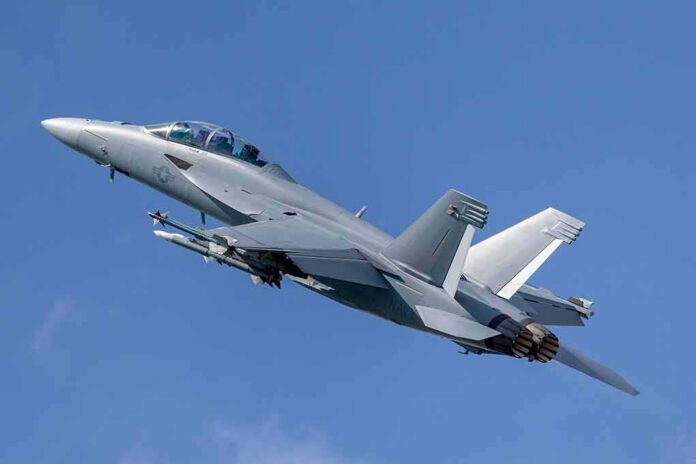
A live weapons release from a B-21 Raider over Edwards Air Force Base is the inflection point where a new bomber stops being only an airplane and starts becoming a strike system; it is the first public proof that the jet’s internal architecture, stores management, and flight controls can choreograph a real munition cleanly out of a stealth weapons bay in flight.
At a Glance
- The Air Force confirmed a B-21 test aircraft released a conventional weapon during a flight test from Edwards AFB.
- Officials framed the event as validating digital “twin” models and the maturity of the bomber’s open-systems architecture.
- The drop marks a shift from basic flight envelope expansion to functional weapons-platform testing.
- Details such as the weapon type and exact test conditions were not disclosed; this remains a developmental milestone, not an operational verdict.
What the B-21 weapons release actually demonstrated
The Department of the Air Force said a B-21 Raider test aircraft released a conventional weapon during a flight test at Edwards AFB, California, in the week preceding its Nov. 13 announcement. That statement matters for a technical reason: it confirms the aircraft has progressed beyond captive-carry or simulated releases to a live separation event, integrating flight controls, bay-door sequencing, environmental sensors, and a stores management system to execute a safe, predictable drop. In the life of a stealth bomber, this is a non-trivial threshold; internal carriage demands precise airflow modeling, door timing, and separation analysis to avoid recontact or destabilizing the jet. The service characterized the test as a validation of the Raider’s digital models and open architecture—an explicit claim that the underlying software, interfaces, and model-based engineering are maturing as intended.
Air and Space Forces and other defense outlets treated the drop as the first publicly announced B-21 weapons-release test, marking a shift from flight sciences toward weapons integration. That framing is consistent with standard test progression: you expand the envelope to learn how the airframe flies, then you prove it can employ stores. Only then do you iterate across weapon classes, flight conditions, and mission scenarios to build a credible warfighting loadout.
How the digital “twin” and open-systems architecture factor in
The Air Force tied the event to “thousands of hours” of digital-twin modeling—high-fidelity virtual replicas of the aircraft and weapon that let engineers predict trajectories and separation margins before risking a live test. For internal-bay stealth designs, those predictions drive door timing, ejection forces, and attitude control laws that keep both aircraft and weapon out of each other’s way. While officials did not publish error bounds or model-to-test residuals, the claim is straightforward: the observed separation comported with pre-test predictions to a degree that boosts confidence in the model’s utility for further integration work.
The program’s emphasis on open architecture is equally consequential over the long haul. An open-systems approach—standardized message sets, modular software services, and decoupled interfaces between the jet and its payloads—aims to reduce the friction and time required to “onboard” new weapons. That ambition runs directly at a chronic problem in legacy fleets, where bespoke integrations can take years. A clean first drop is not proof of universal plug-and-play across all stores, but it is credible initial evidence that the B-21’s weapon interface and mission software stack are behaving the way the system architects intended.
Where this milestone sits in the test-to-war path
Weapon separation at Edwards resides squarely in developmental test and evaluation (DT&E): answering the question, “Does the system meet technical requirements under controlled conditions?” Operational test and evaluation (OT&E) is a different gate: “Is the system effective and suitable in combat-relevant scenarios, with representative crews, threats, and logistics?” The Air Force’s own operational test community has drawn this distinction for decades, rooted in the “fly before buy” ethos and encoded in Title 10 law. A clean separation is a necessary waypoint toward OT&E; it is not a proxy for an operational verdict on mission effectiveness, survivability, or sustainment suitability.
That sequencing is deliberate. After initial separation, test teams typically vary altitude, airspeed, bank angle, and bay-door timing; expand across mass and aerodynamic categories of weapons; then pair releases with guidance, navigation, and control events (for example, GPS-aided or terminal guidance handoffs). Only later does an aircraft face multi-ship missions, electronic attack, and threat-representative environments in OT&E. The public record does not specify the B-21’s exact conditions, weapon type, or post-release performance—unsurprising given classification and the program’s security posture—but the event’s developmental placement is unambiguous.
Why internal-bay separation is technically hard
Stealth bombers keep their signature low by carrying weapons inside. That choice imposes acute demands on airflow management and timing. When bay doors open, pressure gradients and turbulent flow can buffet both aircraft and store; ejector forces must be tuned to clear the slipstream without inducing tumble; and the flight-control system must compensate for sudden drag and center-of-gravity shifts. Separation analysis blends computational fluid dynamics, wind-tunnel work, and now digital-twin modeling to produce a test card that the aircrew flies precisely. A first live release that matches predictions validates not only the physical design—the bay, doors, racks, and ejectors—but also the mission system’s orchestration logic that coordinates the event in milliseconds. That is why a single clean drop is rightly treated as a program milestone.
What remains to be learned through subsequent testing
Progress now depends on breadth and repetition. To translate architectural intent into operational flexibility, the Raider will need to demonstrate captive carries and releases across multiple weapon families with different masses, centers of gravity, lengths, and fin configurations, in day and night, across temperatures and weather regimes, at a spectrum of airspeeds and altitudes. The same open interfaces that governed this first drop should, if truly modular, shorten software updates and certification cycles for each new store. That promise—faster weapon onboarding without destabilizing the aircraft’s software baseline—is one of the most important long-term benefits the Air Force is asserting with the B-21’s design approach.
The service and Northrop Grumman have emphasized the bomber’s role as the future backbone of the force, and defense media linked the test to that trajectory. Even so, seasoned observers will mark the discipline: developmental separation first, then guided employment against targets, then mission-level assessments under OT&E. That cadence is not caution for its own sake; it is how complex aerospace systems buy down risk without sacrificing the learning speed that digital engineering can enable.
𝗕-𝟮𝟭 𝗥𝗮𝗶𝗱𝗲𝗿 𝗰𝗼𝗻𝗱𝘂𝗰𝘁𝘀 𝗳𝗶𝗿𝘀𝘁 𝘄𝗲𝗮𝗽𝗼𝗻𝘀 𝗿𝗲𝗹𝗲𝗮𝘀𝗲 𝘁𝗲𝘀𝘁. https://t.co/OSVvZR4vyt
— Unique World 🌍 | विज्ञान की दुनिया (@scicosmos) November 16, 2026
Bottom line: a meaningful step, properly understood
The B-21’s first publicized weapons release is a concrete, necessary advance from “airplane” to “armed system.” It affirms that the Raider’s internal bay, stores management, and flight-control choreography can execute a real drop, and it lends weight to the program’s model-based engineering and open-architecture storylines. It does not, by itself, answer questions reserved for later phases—weapon diversity, guided performance, target effects, or mission effectiveness under threat—but it sets the stage to do so. In the measured logic of flight test, that is precisely what this event should do: unlock the next cards, expand the envelope, and move the program from promise to proven capability at the pace the architecture was built to sustain.
Sources:
interestingengineering.com, airandspaceforces.com, afotec.af.mil
© impactheadlines.com 2026. All rights reserved.