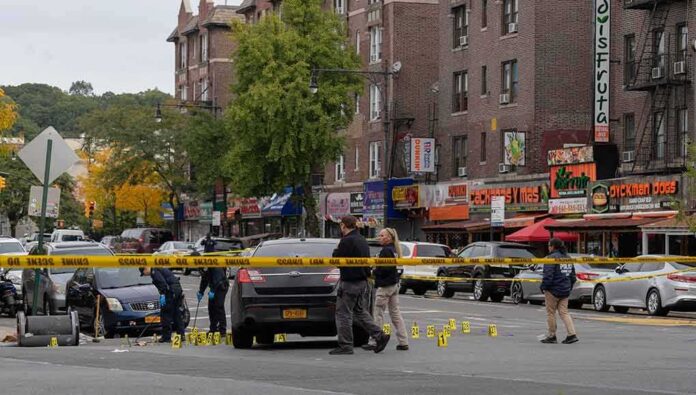
Preventive cases against planned school attacks rarely hinge on a single ominous post; they are built when digital warnings, concrete planning behaviors, and coordinated law enforcement response converge—and that is exactly what happened around Cherokee High School in Georgia.
At a Glance
- FBI-flagged threatening social-media posts triggered a multi-agency investigation tied to Cherokee High School in Canton, Georgia.
- Three suspects—including two teens—were arrested over four days; all face conspiracy to commit murder charges, with an added school-operations charge for the juvenile.
- Investigators report seizing firearms, ammunition, and electronic devices as evidence.
- Police warrants described detailed planning: a school floor plan, clothing/equipment lists, and a chosen date.
What Authorities Say Happened
According to police and school-district accounts, the sequence began when the FBI identified threatening social-media posts tied to Cherokee High School and notified the Cherokee County School District Police, who in turn contacted Canton Police on October 19. Over the next several days, investigators developed leads and made arrests in two states with support from federal, state, and local partners.
The arrests followed a clear timeline. A Canton juvenile was taken into custody on October 20. On October 23, authorities arrested two additional suspects—Shane Keith Taylor, 17, in Georgia, and Michael Brandon Terry, 21, in California—on warrants. All three were charged with conspiracy to commit murder; the juvenile additionally faces a charge related to disruption or interference with public-school operations. The Canton Police Department said it recovered firearms, ammunition, and electronic devices during the investigation; those items were collected as evidence.
From Threats to a Conspiracy Case
Conspiracy is a planning crime: prosecutors allege an agreement to commit an unlawful act and, in many jurisdictions, at least one overt act toward that goal. Here, police described more than generalized violent rhetoric. Warrants reported by the Atlanta Journal-Constitution described a floor plan of Cherokee High School, lists of clothing or equipment to wear, and a planned date—details that move the case from ambient menace into alleged operational preparation.
That distinction—between a threat made and a person who poses a threat—tracks with modern threat-assessment doctrine. Federal analyses emphasize that not every threatener is a would-be attacker, but that disrupted plots typically feature planning behaviors, leakage of intent, and some degree of preparation or materials acquisition. The U.S. Secret Service’s study of 67 averted K–12 plots from 2006 to 2018 found many were uncovered because someone detected communications about intent; charges in those cases often included conspiracy and related offenses.
Multi-Agency Mechanics: How These Cases Actually Come Together
Disrupted-plot investigations tend to scale quickly across jurisdictions and specialties—digital forensics, firearms tracing, and interstate arrests—because the priority is to intervene before a window of opportunity opens. The Cherokee inquiry fits that pattern. Canton Police worked alongside the FBI, Cherokee County School District Police, Georgia State Patrol, the Georgia Bureau of Investigation, the Bureau of Alcohol, Tobacco, Firearms and Explosives, multiple sheriff’s offices, and the Los Angeles Police Department to identify suspects, execute warrants, and move detainees between jurisdictions.
That collaboration matters operationally. Federal partners surface platform data and threat intelligence; local school police bring campus context and relationships; municipal departments run the day-to-day casework; and out-of-state agencies execute arrests and evidence holds. In the Cherokee case, the school district promptly messaged families that all suspects “associated with this conspiracy” had been detained and that there were no known ongoing threats to Cherokee High School or other district campuses, allowing normal operations to resume.
The Evidentiary Backbone in Preventive School-Violence Cases
When police describe seized firearms and electronics, they are pointing to the two most common evidentiary pillars in averted-attack files: means and intent. Firearms and ammunition address capability; phones, PCs, and accounts can show motive, pre-attack research, coordination, and timelines. Canton Police reported recovering firearms, ammunition, and electronic devices in this investigation. Separately, the reported warrant details—a floor plan, a chosen date, specified clothing or gear—are the sort of particulars that, if supported in affidavits and device extractions, typically anchor a conspiracy charge to concrete acts beyond talk.
It also aligns with the prevention model refined in federal school-safety guidance over two decades. Behavioral threat assessment emphasizes identifying concerning conduct early, corroborating signals across sources, and intervening before a subject crosses from ideation into preparation. In data from the Secret Service’s National Threat Assessment Center, many prevented plots were detected because peers, family, or online observers saw communications about intent and alerted authorities; intervention often included law enforcement action paired, where appropriate, with school-based management strategies.
🚨🇺🇸 FBI FOILS SCHOOL SHOOTING PLOT IN GEORGIA
3 arrested — 2 of them minors — in a plot to shoot up Cherokee High School near Atlanta.
FBI spotted the threats online. Guns and ammo seized.
No ongoing threat, police say.
Source: USA TODAYhttps://t.co/1npVSPaI2V
— Tosh Petrovich (@inspiring_tosh) October 28, 2026
What It Means for Schools and Parents
The Cherokee case is not an outlier; it is an instance of a now-familiar preventive posture in K–12 safety. The practical lessons are durable. First, digital leakage—posts, messages, shared documents—remains a primary early-warning channel, and tips to authorities can be decisive. Second, the difference between an alarming statement and an actionable plot is established by corroborated planning behavior: dates, maps, gear lists, reconnaissance, and procurement. Third, interagency coordination is not a cosmetic flourish; it is often the only way to move swiftly across platforms, state lines, and evidence types.
Current Status
As of the week following the arrests, district communications stated that all identified suspects tied to the alleged conspiracy were in custody and that authorities reported no known continuing threat to Cherokee High School or other district campuses. Allegations in any criminal matter are resolved in court, but the preventive arc here—FBI detection of online threats, a rapid multi-agency response, arrests on conspiracy charges, and warrants describing specific planning—follows the profile documented in prior disrupted school-violence cases.
Sources:
nebraska.tv, abcnews.com, people.com, ajc.com, spectrumlocalnews.com, patch.com
© impactheadlines.com 2026. All rights reserved.