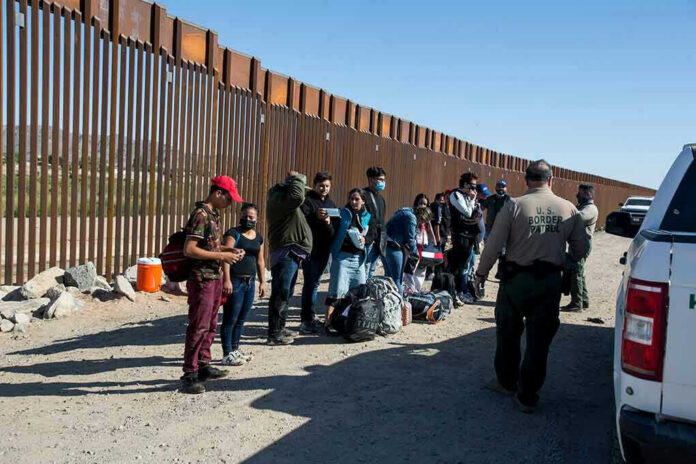
At the center of the Supreme Court’s review lies a durable constitutional question that outlasts any single border surge: how far the president’s power to bar entry under the Immigration and Nationality Act can reach before it collides with Congress’s separate, detailed asylum system for people already on U.S. soil.
At a Glance
- The case tests whether INA § 212(f) and § 215(a) let a president both suspend entry and, by that route, foreclose asylum access for those who nonetheless arrive.
- Lower courts concluded that the asylum statute’s “any alien” application right cannot be erased by proclamation or agency guidance.
- The administration relies on Trump v. Hawaii’s reading of § 212(f) as conferring broad entry-suspension authority; challengers answer that entry control cannot displace asylum and related protections Congress wrote.
- The Court will also weigh whether federal courts may grant classwide relief against immigration rules under 8 U.S.C. § 1252(f)(1).
The legal hinge: entry power versus asylum architecture
Presidential Proclamation 10888, issued on January 20, 2025, invoked INA §§ 212(f) and 215(a) to suspend the entry of noncitizens described as engaged in an “invasion” across the southern border and, crucially, to block those covered from invoking statutory provisions—most prominently asylum under § 208—that would permit their continued presence for processing and adjudication. The Department of Homeland Security issued guidance to implement that design. The administration defends this as a classic use of § 212(f): a finding that the entry of a defined class is detrimental to U.S. interests and thus may be restricted or suspended, with operational consequences that follow at the line of admission.
The challengers draw a hard line at asylum’s threshold text. Congress provided that “any alien who is physically present in the United States or who arrives in the United States (whether or not at a designated port of arrival… ) may apply for asylum” (8 U.S.C. § 1158(a)(1)). In their view, a presidential entry bar cannot extinguish Congress’s guarantee to apply, nor can guidance supplant the removal procedures and screening steps—credible fear assessments, withholding-of-removal eligibility, Convention Against Torture claims—that Congress and the executive’s own regulations prescribe. The D.C. Circuit agreed, holding that § 212(f) does not authorize bypassing that framework and that Proclamation 10888, insofar as it effectively foreclosed the asylum gateway, ran contrary to the statute.
How § 212(f) became a fulcrum, and what Trump v. Hawaii actually decided
Section 212(f) is spare but potent: when the president finds entry of any noncitizens or class “would be detrimental to the interests of the United States,” he may “suspend the entry” or impose restrictions. In Trump v. Hawaii, the Supreme Court treated that clause as conferring broad discretion to set entry conditions after a facially legitimate national-interest finding and sustained the travel proclamation against statutory and constitutional attack. The administration reads Hawaii to endorse a sweeping construction: if entry is suspended, downstream mechanisms that depend on entry—parole, inspection, or asylum processing—can be curtailed for the designated class.
The lower courts drew a sharper boundary. Hawaii addressed who may be admitted from abroad under an entry suspension; it did not bless the use of § 212(f) to negate a distinct statutory rights-bearing regime Congress created for those who arrive, including between ports, and who claim protection from persecution or torture. On that logic, entry control stops at the water’s edge; asylum procedure begins upon presence. Using § 212(f) to disable the latter, they concluded, exceeds what Hawaii upheld and what the INA permits.
Mechanism and consequences: why the statutory pathways matter
The modern asylum system is a set of interlocking channels designed to surface and triage protection claims quickly while reserving final relief for adjudication. When a noncitizen indicates fear, frontline officers conduct “credible fear” screenings—initial threshold assessments that, if passed, move cases into fuller proceedings before immigration judges; separately, withholding-of-removal and Convention Against Torture claims provide mandatory protection if standards are met. Congress and the agencies calibrated pass rates, detention and parole discretion, and case routing to balance speed, accuracy, and deterrence across surges and lulls.
Proclamation 10888’s core move was to declare a covered class categorically ineligible to invoke those statutory doors. The government characterizes that as an entry rule with incidental procedural effects; the challengers answer that it functionally erased Congress’s command that “any alien” may apply and the procedures that follow, replacing them with summary turn-backs and removals. The D.C. Circuit agreed with the latter view, emphasizing that the INA’s processing rules cannot be displaced by proclamation and informal guidance.
What the Supreme Court will decide—and why it endures beyond this administration
The Court granted review limited to two questions: whether the proclamation and its implementing guidance are lawful, and whether 8 U.S.C. § 1252(f)(1) bars the classwide injunctions the lower courts issued. The first goes to institutional allocation: Congress decides the structure of removal and protection; the president controls entry. If the Court endorses the administration’s position, it will mark the high-water line of § 212(f), effectively allowing presidents to condition or suspend not just admission from abroad but access to statutory protections triggered by presence. If the Court affirms the lower courts, it will cabin Hawaii to its admissions context and reinforce that asylum’s gateway rights are not waivable by proclamation.
The second question, though procedural, has lasting practical stakes. Section 1252(f)(1) restricts lower courts from enjoining the operation of certain immigration provisions except as to “an individual alien” against whom proceedings have been initiated. In recent years, litigants on all sides have used or resisted classwide relief to shape national policy swiftly. A ruling narrowing such relief would not decide the asylum question but would reshape how, and how quickly, future immigration rules can be challenged or kept in force pending suit.
Competing claims about effectiveness are not the fulcrum
The government has suggested that restricting access suppressed unlawful crossings; respondents dispute causal claims, pointing to declining apprehensions predating the proclamation and arguing that structural migration drivers and enforcement variations explain the trend better than any single policy. Those empirical debates matter for policy design, but they are not the legal hinge here. The case turns on statutory fit: whether an entry suspension can negate Congress’s instruction that noncitizens who arrive—lawfully or not—may apply for asylum, and whether the executive can shortcut the INA’s removal and protection procedures by proclamation.
Whatever the outcome, the Court’s reasoning will reverberate well beyond the southern border. Future presidents of either party will face migration spikes; future Congresses may or may not overhaul the INA. This decision will either entrench or pare back a theory of executive power that uses the threshold of entry to reorder statutory rights behind it. The institutional answer—who gets to set the rules at which stage—will outlast the news cycle because it hardwires the next crisis response.
US Supreme Court to weigh asylum restrictions at southern border https://t.co/GXpMLuiM5H
— The Denver Gazette (@DenverGazette) November 15, 2026
How to read the opinion when it arrives
Three questions will reveal the holding’s scope. First, does the Court view § 212(f) authority as purely about admission from abroad, or as a lever that can foreclose statutory processes triggered by presence? Watch how the opinion reads Hawaii and the INA’s asylum text in tandem. Second, how does the Court treat the removal framework—credible-fear, withholding, CAT—as a unit that cannot be displaced absent clear congressional authorization? Third, on remedies, does the Court read § 1252(f)(1) to broadly bar classwide injunctions, and if so, what alternative vehicles remain for system-level relief? The answers will decide not only this proclamation’s fate but the shape of executive and judicial power in immigration for years.
Sources:
cbsnews.com, govinfo.gov, supremecourt.gov, scotusblog.com, nbcnews.com, cgrs.uclawsf.edu, media.cadc.uscourts.gov, clearinghouse.net, congress.gov, cambridge.org
© impactheadlines.com 2026. All rights reserved.