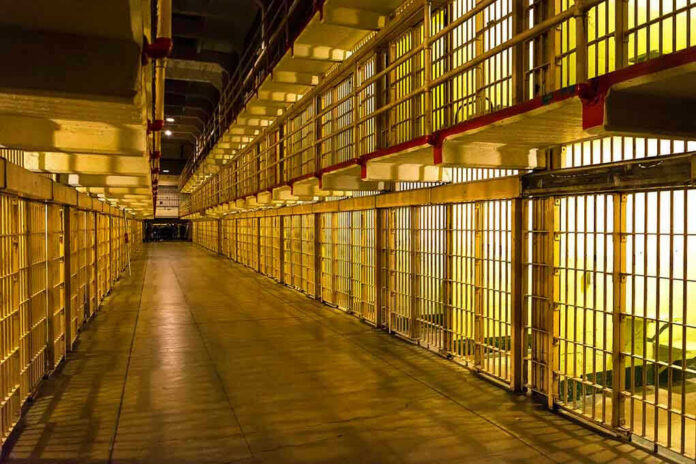
Britain’s outgoing Labour government has used early-release schemes so aggressively that victims now fear killers and rapists will be walking free years sooner under Keir Starmer’s legacy.
Story Snapshot
- Labour cut time served for many prisoners and plans further early release for serious offenders.
- Nearly 40,000 inmates have already walked out early under emergency measures to ease overcrowding.
- Official rules say sex offenders and serious violent criminals are excluded, yet new reforms would shorten sentences for rapists and killers.
- Victims and conservatives warn the policy puts public safety and justice behind “compassion” for criminals.
Labour’s mass early-release drive to fix a broken prison system
UK Prime Minister Keir Starmer’s Labour government launched a major early-release scheme in September 2024, known as SDS40, to cope with a prison system that was almost full. Under this plan, most prisoners on standard fixed-term sentences are automatically freed after serving just 40% of their time, down from 50% before. Officials say the change was needed because England and Wales were on the brink of running out of cells, with fewer than 100 spaces left nationwide. Between September 2024 and June 2025, nearly 40,000 inmates were released early under Labour’s emergency schemes, yet prisons still sat at about 99% capacity.
Ministry of Justice statements stress that this 40% rule does not apply to the worst offenders, such as sex criminals, terrorists, or people jailed for serious violence. Those prisoners are supposed to remain under the tougher “two-thirds” rule or other long-term controls. The government insists that anyone freed early is placed on strict licence conditions, including tagging and curfews, with a promise they can be sent back to jail if they break the rules. Yet Labour’s own numbers show the prison estate is still dangerously crowded even after tens of thousands of early releases, raising questions about whether the whole system is now built on short-term fixes instead of real capacity.
New sentencing reforms: killers and rapists set to leave prison sooner
Alongside SDS40, Labour pushed a sweeping Sentencing Bill that goes much further by cutting time served for serious crimes like manslaughter and rape. Under these reforms, prisoners convicted of offences including manslaughter, rape, grievous bodily harm, and other serious sex crimes would become eligible for automatic release after serving half of their sentence, instead of the current two-thirds requirement. Burglars, domestic abusers, stalkers, groomers, and repeat shoplifters would gain even more, with some allowed out after just one-third of the time ordered by the court. The Ministry of Justice has refused to give exact totals, but reports suggest between 5,000 and 7,000 prisoners, including rapists and killers, will benefit from the new rules in the first wave alone.
Detailed analysis of government figures shows how dramatic this shift could be for the worst crimes. Murderers, once held for an average of around 184 months before release, could see that cut by more than five years under the new halfway rule. Rapists might see about two and a half years shaved off their time behind bars, dropping average release from just over eight years to closer to five and a half. Officials frame these changes as a reward for “good behaviour” in prison and a way to free up about 4,100 spaces by encouraging compliance. For many victims and conservatives, though, this sounds less like justice and more like a quiet amnesty for dangerous criminals, driven by overcrowding rather than fairness.
Victims’ anger and conservative warnings over public safety
Victim advocates and conservative critics have reacted with fury to the idea that killers, rapists, and domestic abusers will be released years earlier to solve Labour’s prison crisis. The Victims’ Commissioner has warned that “dangerous prisoners will be released” under Starmer’s plans, pointing to proposals that even violent offenders and sex criminals recalled to prison could be automatically re-released after just 28 days. Media coverage has echoed this alarm, with headlines describing the policy as a “slap in the face” for victims and a sign of “soft justice” that puts criminals ahead of public safety. Conservatives in Parliament argue that Labour is gambling with ordinary families’ security instead of building enough prisons or tackling crime at its roots.
This row fits a long pattern in the UK, where governments of all stripes reach for early-release levers whenever overcrowding hits crisis levels. Labour insists its schemes are temporary and backed by tighter monitoring, and earlier fact-checks note that murderers and rapists were initially excluded from the 40% emergency plan. But as the Sentencing Act and new reforms expand good-behaviour release even to some of the most serious offenders, the line between “low-level” and “dangerous” crime is starting to blur. For many on the right, the lesson is simple: when you build justice policy around capacity and compassion for offenders instead of clear punishment and deterrence, it is law-abiding citizens and victims who pay the price.
Sources:
pjmedia.com, legislation.gov.uk, news.sky.com, theguardian.com, russellwebster.com, independent.co.uk, lordslibrary.parliament.uk, gov.uk, hansard.parliament.uk, publications.parliament.uk
© impactheadlines.com 2026. All rights reserved.